A democracy or a kleptocracy? How South Africa stacks up:
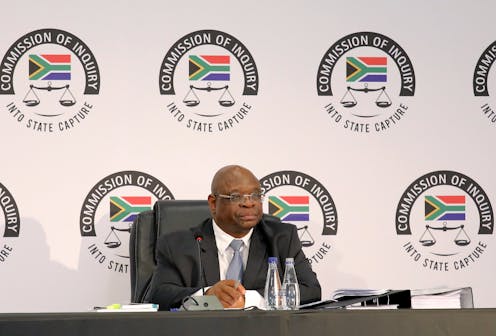
South Africans have been held spellbound by the torrent of evidence of corruption emerging from two parallel commissions of inquiry – into state capture, and the fitness to hold office of two senior officials of the National Prosecuting Authority.
These strengthen perceptions that South Africa under former President Jacob Zuma – from May 2009 to March 2018 – transformed from a democracy into a “kleptocracy”: a country ruled by thieves.
The country scored only 43 out of 100 on Transparency International’s Corruption Perceptions Index for 2018 Corruption Perceptions Index for 2018, down from 47 in 2009.
So the question is: is it indeed the case that South Africa has become a kleptocracy? Has it travelled far along the road to joining states such as Russia and Equatorial Guinea, notorious for being ruled by authoritarian leaders in league with corrupt oligarchs at the expense of ordinary people? If this is so, is that condition reversible?
Understanding kleptocracy
Derived from the Greek words for thieving and ruling, the word “kleptocracy” entered the modern social science lexicon through the work of the Polish-British sociologist Stanislav Andreski in the 1960s. His book The African Predicament identified post-independence African regimes as kleptocratic.
Basically, he presented kleptocracy as government by corrupt leaders who use their power to exploit the people and national resources of their countries to extend their personal wealth and political powers. But, the notion of kleptocracy didn’t gain much leverage until the present decade. This reflects a widespread belief that corruption is gaining ground at an unprecedented rate in the world.
Key to contemporary understandings is that kleptocracy now extends beyond the boundaries of the countries that kleptocrats plunder, and is becoming a danger to democracy globally.
Whereas there was previously a strong tendency to see kleptocracy as primarily a pathology of countries in what used to be referred to as the “third world”, today it is recognised that the scourge has gone global.
President Vladimar Putin’s Russia is widely cited as leading the pack of kleptocrats. It is strongly followed by other “emerging market economies” (such as Turkey and Malaysia), with African countries (such as Equatorial Guinea and Nigeria) continuing to feature strongly. Sub-Saharan Africa is the lowest scoring region – that is, the most corrupt – in Transparency International’s index.
The most distinctive development of the contemporary era is that advanced capitalist democracies are viewed as under threat from kleptocracy. For instance, there are accusations aplenty that the presidency of the US is being systematically used to enrich the family and companies of President Donald Trump.
Also, it is widely recognised that despite the virtuous platitudes of the British government, London has become a major centre for money-laundering. So what has changed?
Simply put: globalisation and neo-liberalism have hugely increased the capacity of rulers, corporations, oligarchs and criminal networks to obscure their movements of money through the international financial system,
A combination of neoliberalism and globalisation has led to the development of a massive industry servicing kleptocrats. This spreads outwards from London and New York to offshore jurisdictions and real estate hotspots, often arranged by Western financial services providers. Offshore finance has become critical. Untraceable shell companies are being used to shift money from one country to another.
Once money has been “cleansed”, it is increasingly invested in luxury housing and valuable real estate. Amid this, the laundering of reputations becomes critical. This often requires the hiring of politicians and lobbyists to re-brand kleptocrats as philanthropists and engaged global citizens.
The case of South Africa
South African President Cyril Ramaphosa recently referred to the years of his predecessor Zuma as “wasted”. But, typical of his style, this was an understatement. South Africa under Zuma advanced far down the road to becoming a kleptocracy.
Corruption became increasingly organised, politicians and parastatal managers being bought by external private interests. The Jacob Zuma Foundation appears to have served as a front for outright theft and appropriation of public monies. Intermediaries like KPMG and other auditing companies were used to hide the private appropriation of state resources from public gaze.
The London-based Bell Pottinger public relations company was used to explain away the scandals of the Zuma regime. While by its nature money laundering is obscure, there can be little doubt that money has been squirrelled away in offshore accounts.
Revelations emanating from the two commissions of inquiry indicate that South Africa stands in great peril of falling prey to kleptocracy. Under Ramaphosa, the government of the African National Congress (ANC) has taken important steps to reverse the trend. These include the appointment of a highly respected advocate to be the country’s chief prosecutor. But much will depend on the political will of the ANC to rid its ranks of its in-house kleptocrats for this promise to bear fruit.
Battle to defeat kleptocracy
Tackling kleptocracy is enormously complex. Eliciting information from myriad international (often reluctant) sources takes time, money and patience. Legal action is time consuming and costly. Kleptocrats and their allies fight back strongly.
The good news is that South Africa has made a good start with the establishment of the commissions of inquiry.
The bad news is that the ANC government’s pursuit of the country’s kleptocrats may drop off once it has won the national elections in May. It will be up to opposition parties, the media and civil society to ensure that that doesn’t happen.

Roger Southall has previously received funding from the National Research Foundation
Source: The Conversation – Articles (AFRICA)
Read more on The Conversation.
Join the fun: Add Your event | Submit a Press Release | Add your listing.


