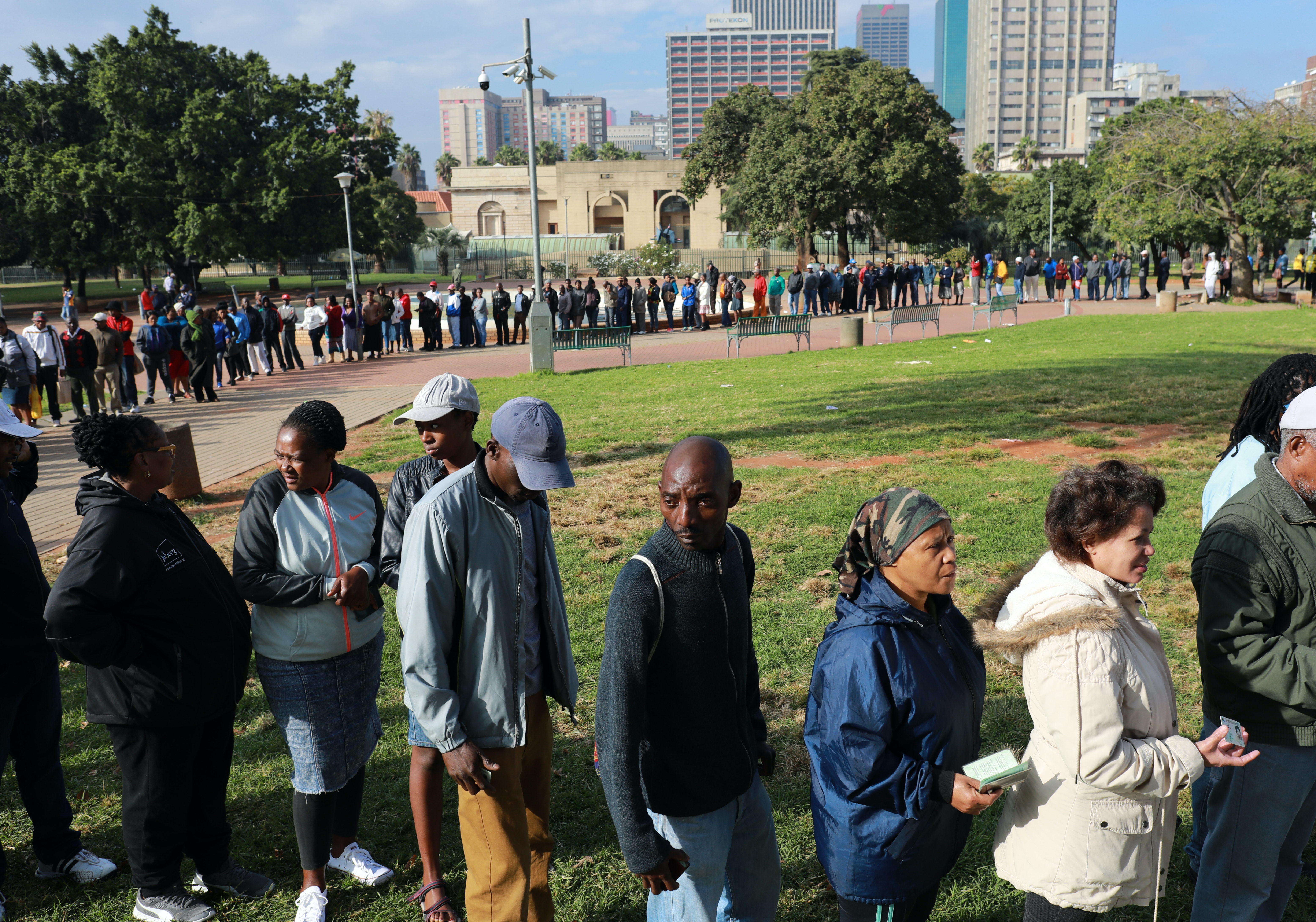
After 28 years of democracy, South Africa is having to reform its political party-based electoral system to make it fairer and in line with the constitution, by allowing independent candidates to contest national and provincial parliaments. A bill to amend the country’s electoral law accordingly is before parliament.
The present electoral system has underpinned the governing African National Congresses’ (ANC’s) dominance of the political system since 1994, not least by making individual MPs accountable to party bosses rather than the voters. This lack of accountability has facilitated the stunning level of corruption in the country.
Now there are calls for a national referendum on the electoral system to define the way forward, and liberate it from the clutches of party barons. The intention seems to be to give the decision to “the people” rather than to parliament, which is the ordinary way for legislative change to be enacted.
But, this proposal would need to be handled carefully.
Referendums can be easily abused. Politicians often resort to them to avoid responsibility for making a difficult political decision, or to secure backing for a controversial policy and thus beat an opponent.
Examples abound.
British Labour prime minister Harold Wilson’s 1975
referendum on whether Britain should stay in the European common market was an example of the first. South African president FW de Klerk’s 1992 referendum among whites to secure backing for entering negotiations with the ANC to end apartheid – thereby scuppering the opposition Conservative Party – was an example of the second.
Both Wilson and De Klerk received the answer they wanted and
expected. But politicians can also miscalculate badly. The most obvious example is British Conservative prime minister David Cameron’s decision to call a referendum in 2016 on whether the UK should stay in the European Union.
He fully expected to win, but in the face of a scurrilous campaign by populist politicians like Boris Johnson and Nigel Farage, he lost. Today Britain is having to live with the consequences of Brexit: increased costs of imports from Europe, lower exports to Europe, constant supply chain problems, labour shortages and huge difficulties around Northern Ireland.
Lessons to be drawn
Britain’s history with referendums is worth noting. South Africa does not want to go the same way. Lessons need to be drawn from these and other examples around the world.
Care and rules are needed for how any referendum, on any question,
would be conducted.
-
Who would devise the question put to the electorate? Are they independent, or are they subordinated to the interests of particular politicians?
-
Are the questions posed neutrally phrased, or do they deliberately or otherwise point their respondents in a particular direction?
-
Would the government of the day be bound by the result of a referendum, or would it be advisory?
-
Would a government accept a result endorsed by a 50.1% majority,
or would it require a “special majority”, of say 55%, to pass? -
What rules would have to be followed during a campaign, and how would the media be required to conduct themselves?
-
What sanctions would be imposed to limit the subversion of the campaign by lies by both sides of the electoral debate?
-
Would there be any rule outlawing a repeat of the referendum within any given period of time?
Without careful regulation, a referendum can be predisposed to securing a particular answer. Yet it is ostensibly designed to deepen democracy, not to subvert it.
Proportionality
Electoral systems can be highly complex. The great virtue of South Africa’s proportional representation electoral system is that it is simple. The voter has two votes, one for national level, one for provincial level. These votes contribute to the proportionate vote of the chosen party.
It is rather more difficult to explain to voters how mixed member systems ensure proportionality of party representation. These systems combine first-past-the-post constituency elections with proportional representation.
This poses the issue of how members of parliament who are elected by constituencies would be balanced by those elected by proportional representation to ensure an election result which, as the constitution requires, is overall, proportional. In other words, what proportion of MPs would be elected by constituencies as against those elected by proportional representation?
These complexities and other considerations suggest a way forward if much-needed electoral reform, beyond that presently ordered by the Constitutional Court, is to be achieved in South Africa.
The first step must be for the ANC to be pushed well below 50% in the 2024 election. Turkeys do not vote for Christmas. The ANC is unlikely to hold a referendum which might lead to far-reaching electoral reform.
It is unlikely that the ANC will vote for radical electoral reform unless it is hard pushed to do so. It is at present working hard to minimise the impact of allowing independent candidates to stand in elections, as required by a ruling of the Constitutional Court.
Second, there needs to be a binding commitment by opposition parties to electoral reform and how to bring it about. Presuming that the ANC receives well below 50% in the 2024 election, this commitment must be a condition of any coalition agreement formed between political parties forming a government.
Third, there should be a repeat of the 2003 Van Zyl Slabbert Commission to consider electoral alternatives. Such a commission should be composed in such a way to earn the trust of both politicians and voters.
Its deliberations need not take much time, as the commission has already discussed the fundamental principles involved. It also ran a survey which – rather than asking respondents directly what electoral system they favoured – asked them what values they wanted an electoral system to express, values like fairness, equality and accountability.
Fourth, the recommendations of such a commission would need to be
accepted and implemented by parliament. This is where any coalition
agreement should kick in. Perhaps such a coalition agreement might
require that, in the event of a serious disagreement about electoral reform, the matter should be referred to the Constitutional Court.
What issues should the people decide?
This leaves open the issue of whether, following the approval or
defeat of a bill to implement electoral reform, the outcome should be
referred to the electorate in a referendum.
It needs to be clear as to why, if parliament has made a decision, the
matter should be referred to a referendum. Perhaps it should. Perhaps this would be a way of making South Africa’s democracy more direct, and its politicians more accountable.
But if the form of an electoral system can be referred to the electorate in a referendum, why not capital punishment? And why not abortion? Or LGBTIQ rights?
Care is needed. A referendum may well have a place in the country’s
democracy, but beware – it may release a host of problems.


