Africa hosts very few clinical trials. Why this is bad for innovation:

Clinical trials are the foundation of any new medicine. They allow scientists to test the efficacy and safety of a drug or therapy.
The African continent offers many of the best conditions for conducting clinical trials. It has a diverse population of potential patients, and many have not been previously exposed to any kind of pharmaceutical drugs. Importantly, a number of diseases – particularly those defined as neglected and tropical – are endemic to the developing world, which includes Africa.
So it makes sense to run clinical trials for drugs that would treat such diseases in the areas most affected by them.
Data I collected for a recently published paper in the Asian Biotechnology and Development Review shows that the number of clinical trials conducted in African countries is rising. But it is still a tiny figure compared to the number of clinical trials that are ongoing or have been completed in recent years in other parts of the world. For instance, in the last week of May there were 11 858 such trials reported in China alone. There were 26 006 for the whole East Asian region.
The study emerged from my research interests, particularly the role of innovation in developing countries and how science and technology can boost economies.
Given what the data shows, it’s clear that African countries should be looking to initiate or host more clinical trials. This can have positive outcomes for the continent. For example, it can improve local health care workers’ and researchers’ knowledge base. It can also improve a country’s research culture. And it could contribute to overall improvements in the continent’s health systems.
Countries like Egypt and South Africa, which have the highest numbers of clinical trials, can offer lessons to others about building their capacity to host such trials. These countries have invested more heavily in their overall research and development capacity and developed the infrastructure necessary to host and manage clinical trials.
Collecting and assessing data
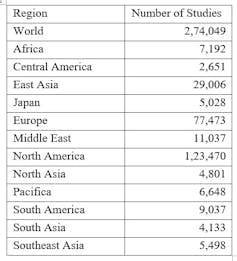
There are some online databases about African clinical trials. For example, South Africa maintains a register of clinical trials in that country. There is also a pan African clinical trials registry.
But the data on these sites is not easy to download, so I turned to a full repository of all the clinical trials currently in various stages of development all over the world. The site is constantly updated. Some of these trials are government funded; others are funded by private companies or research institutions.
Using the data from this site I found that, from 1991 to the end of May 2018, only about 7192 clinical trials had been completed or were ongoing on the African continent. That’s around 2.5% of the global total.
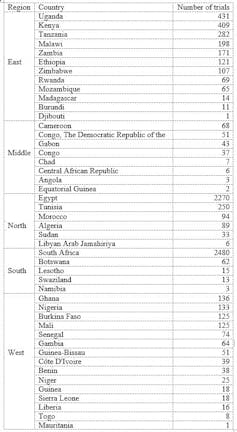
As can be seen from the data in Table 2, some countries on the continent do far better than others when it comes to hosting and managing clinical trials. Egypt and South Africa far outstrip other countries, with more than 2000 each completed or ongoing in the last week of May 2018. Large countries like Nigeria and Ghana perform poorly by comparison.
Pan African solutions
If the African continent wishes to increase the number of clinical trials conducted on its soil, some changes will be necessary.
The first step would be to get a set of agreed ethical guidelines for the continent. Studies conducted by the New Partnership for Africa’s Development (NEPAD) have shown how much ethical guidelines for clinical trials vary across countries. Some, like Egypt, South Africa, Uganda and Ghana have rules that protect participants in a trial; others, among them Ethiopia, Cameroon and Benin don’t offer such legislative protection.
Uniform, pan African ethical guidelines may be useful. These could be set out by a representative body like the African Union. This would be a similar approach to what’s taken in Europe, where the European Union set up ethical guidelines for all its member states.
Collaboration will also help to improve countries’ capacity to host clinical trials. Those countries with a weak research and development culture can learn from those like Egypt, South Africa and others in the global South which are more advanced.

Swapan Kumar Patra does not work for, consult, own shares in or receive funding from any company or organization that would benefit from this article, and has disclosed no relevant affiliations beyond their academic appointment.
Source: The Conversation – Articles (AFRICA)
Read more on The Conversation.
Join the fun: Add Your event | Submit a Press Release | Add your listing.


