Africa needs to start creating its own medical technology. Here’s how:
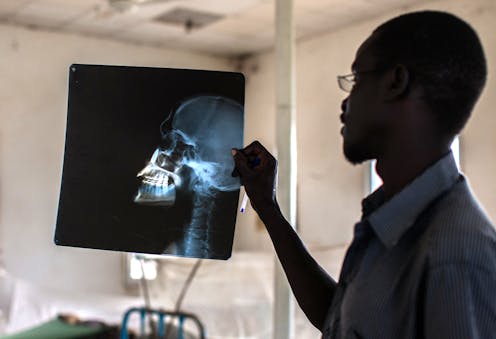
Biomedical engineering can save lives. It draws on and integrates knowledge from disciplines like engineering, computer science, biomedical sciences, and public health as well as clinical practice. This knowledge is combined to improve health – often through the design of medical devices for diagnosis, treatment and rehabilitation.
Most of Africa’s medical equipment is imported. “Equipment graveyards” become the final resting place for medical devices that aren’t suited to local conditions. This can include dust, heat, humidity and an intermittent supply of electricity. Some machines are discarded because hospital and clinic staff haven’t been trained to operate them or because replacement parts are not available when they’ve broken.
African countries need to start producing and developing their own medical devices. A cadre of suitably skilled biomedical engineers is needed for this sort of innovation to take root. That’s what prompted a number of African universities to establish the African Biomedical Engineering Consortium. We advance education and research in biomedical engineering across the continent.
Skills development
We know that biomedical engineers alone won’t suddenly make Africa a world leader in medical device innovation. Other elements are needed – like well-equipped laboratories that enable experimentation and prototyping. Funding to support the translation and scaling of prototypes is another. Manufacturing infrastructure is important. So are regulations to ensure equipment safety and structures to oversee intellectual property management.
But the consortium’s focus is on producing people to bring innovation to life. Now five years old, it brings together established and emerging biomedical engineering programmes at African universities to develop the continent’s capacity for innovation in health technology. The network has grown stronger as more member institutions have introduced degree programmes in biomedical engineering.
Now some members of the consortium have turned their attention to a more focused transfer of skills and knowledge across participating universities. This is being done with the aid of funding from the European Commission.
We’ve launched a capacity-building project to support the training of postgraduate students. Six African universities are involved. These are Addis Ababa University; Cairo University; Kenyatta University; Uganda’s Mbarara University of Science and Technology; the University of Cape Town (UCT); and the University of Lagos. Italy’s University of Pisa is also participating.
The first round of applications has just been concluded. Our postgraduates will be drawn from the six participating African universities as well as others on the continent. Each student will receive a full scholarship to cover tuition, travel and living expenses. This will support training for Master’s and PhD candidates at partner institutions outside their home countries over a five-year period.
The initiative particularly focuses on building skills that address African needs by engaging students in projects that arise from local realities. Examples include:
-
Creating prosthetic limbs for landmine victims
-
Using mobile phones, along with custom-built applications, as diagnostic tools in remote areas.
-
Eliminating the need for expensive imaging equipment that’s not always readily available, by developing software that enables 3D visualisation of the anatomy from ubiquitous X-ray images.
We’ll start training the first cohort of students in 2018.
Building the academic base
But training emerging scholars isn’t enough. Africa needs more academics who can navigate the interdisciplinary environment needed to develop technological solutions to health problems.
That’s why the project also supports academics who want to improve their skills. They can travel between African partner universities to develop their research and training capacity. An academic from a new biomedical engineering programme in Uganda, for instance, could work with colleagues at UCT, then share teaching approaches back home. Or a lecturer from Cairo could spend time in Lagos teaching and sharing research methods.
This is also a good way for universities to harmonise their biomedical engineering curricula and benchmark them against those of partner universities. And it’s a way to promote the sharing of scarce resources.
This article is based on a piece which appeared in the South African Journal of Science.

Tania Douglas receives funding from the National Research Foundation, the Medical Research Council, the National Institutes of Health (Fogarty International Center), and the European Commission (Education, Audiovisual and Culture Executive Agency). She has, in the past, received funding from Lodox Systems and CapeRay Medical.
Source: The Conversation – Articles (AFRICA)
Read more on The Conversation.
Join the fun: Add Your event | Submit a Press Release | Add your listing.


