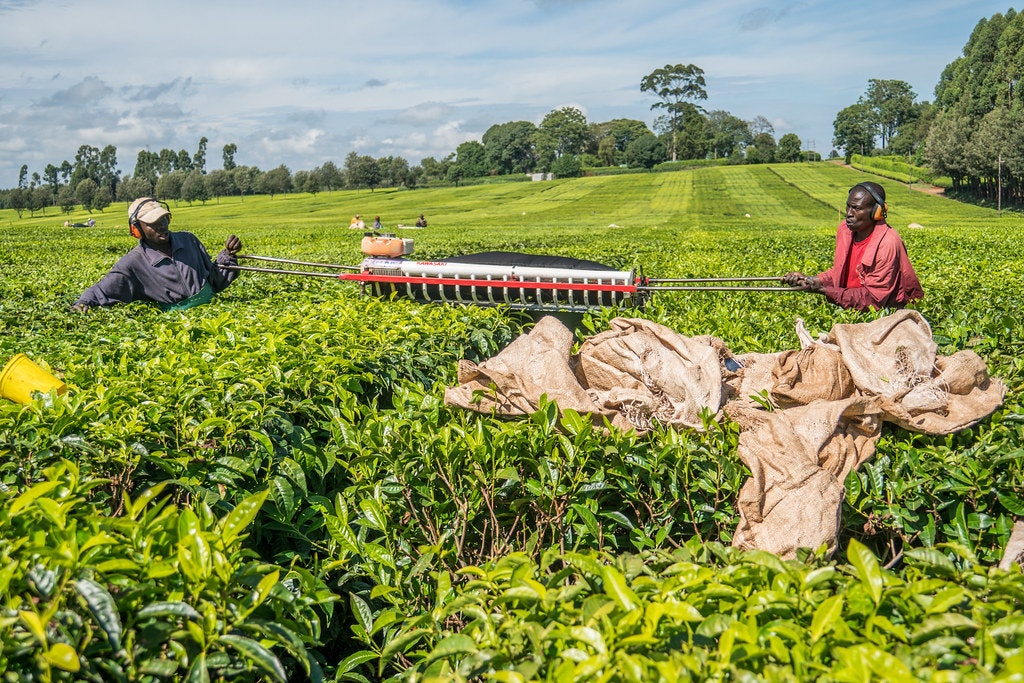
Africa’s agriculture sector accounts for about 35% of the continent’s gross domestic product, and provides the livelihood of more than 50% of the continent’s population. These shares are more than double those of the world average and much higher than those of any other emerging region.
Dependence on agriculture has declined in other emerging regions. For example in Southeast Asia, agriculture’s share of GDP dropped from 30-35% in 1970 to 10-15% in 2019. In Africa it has remained unchanged for decades, according to World Bank data. At the same time, Africa’s agriculture sector is the world’s least developed, with the lowest levels of labour and land productivity. Value added per worker in agriculture is about a quarter of the world’s average and less than a fifth of China’s.
The sector is dominated by smallholders, producing mainly for their own consumption. They operate well below minimum efficient scale and scope. Average farm size in Sub-Saharan Africa is 1.3 hectares, compared with 22 hectares in Central America, 51 hectares in South America and 186 hectares in North America, according to International Fund for Agricultural Development data.
Average farm machinery use in Africa is the lowest in the world and has increased only very slightly since the 1960s.
Against this backdrop, the development of the agribusiness sector holds enormous potential to foster Africa’s economic development. For this to happen, the productivity of Africa’s agribusiness must rise.
Read more: Science has the power to boost farming in Africa. But a lot has to change
My research on Africa’s economic prospects has led me to believe that agribusiness offers African countries the most promising path for development and a shift towards higher value-added activities. This is the first step towards economic development.
There are five reasons why agribusiness should drive Africa’s economic development.
Why agriculture should be the focus
Firstly, Africa has abundant land. Agribusiness might be its foremost source of comparative advantage. Africa’s land size is larger than China, India, the US and most of Europe combined. More than half is arable land, suitable for crop growing. The weather in different parts of Africa provides perfect conditions for the growth of various crops.
Read more: Africa’s youth and abundant arable land are a potential winning combination
Secondly, agriculture has huge potential for adding value, and Africa has comparative advantages in this sector. Also, most African countries export commodities and raw materials and import finished goods. Ghana, for example, exports cocoa and imports high value-added chocolate; Kenya exports tea leaves and imports expensive branded tea. Nigeria and Angola have some of the world’s largest oil resources, but lack refining capacity and depend on imports for their energy consumption.
Africa’s dependence on imports for its consumption is the highest in the world as a share of its GDP. The development of agribusiness is fundamental for Africa’s ability to ensure food security.
Upgrading to activities that add more value in agriculture often requires less advanced technology than in manufacturing industries. Compare the technology of producing spare parts for the automobile industry with that needed to produce tea bags.
Thirdly, agribusiness is attractive because there are ready markets for its output. Africa has vast local markets for food. Agribusiness producers can sell much of their output in local markets. This enables local farming operations to grow and become more sophisticated in a less competitive environment before expanding internationally. Regional integration via the African Continental Free Trade Agreement greatly increases these opportunities.
Read more: Kenya and South Africa are working to address trade barriers: where to start
In export markets, Africa’s agribusiness products are likely to benefit from the continent’s reputation for high-quality natural resources. Ghana’s cocoa is considered as some of the world’s best, as are Kenya’s tea and coffee.
Fourth, African countries need to develop their agricultural sector also because they are unlikely to follow the traditional development paths. Many other emerging markets developed through industrialisation and export-driven manufacturing. Growth led by manufacturing needs infrastructure; Africa’s infrastructure is poor. This growth model is also threatened by automation and robotics that replace labour, and by growing protectionism in the world’s major markets.
With a few exceptions, such as Ethiopia and Morocco, most African countries have failed to establish a significant manufacturing sector, despite political efforts. A study showed that most African people who leave agriculture turn to low-skill, low-productivity services rather than to manufacturing. In 2022, manufacturing employment accounted for slightly over 10% of sub-Saharan Africa employment, the smallest share of any emerging region according to World Bank data. Nor did the flow of low-wage manufacturing jobs out of China trigger the development of Africa’s manufacturing sector.
Read more: Chinese imports could undermine Ethiopian manufacturing – leaving women workers worst off
Yet another reason to pay more attention to Africa’s agribusiness is that it is at the forefront of environmental challenges and global warming. Drastic changes in rainfall and weather patterns change what can grow where, and increase the importance of efficiency of land use. It is important to understand the consequences of these changes so that they can be managed effectively.
Africa’s agribusiness must develop in order for the continent to develop economically. Its strengths and weaknesses make agribusiness the most significant sector to drive its overall economic development. Policy makers, educators and researchers should take note. Done right, the economic gains of developing Africa’s agribusiness will be enormous.


