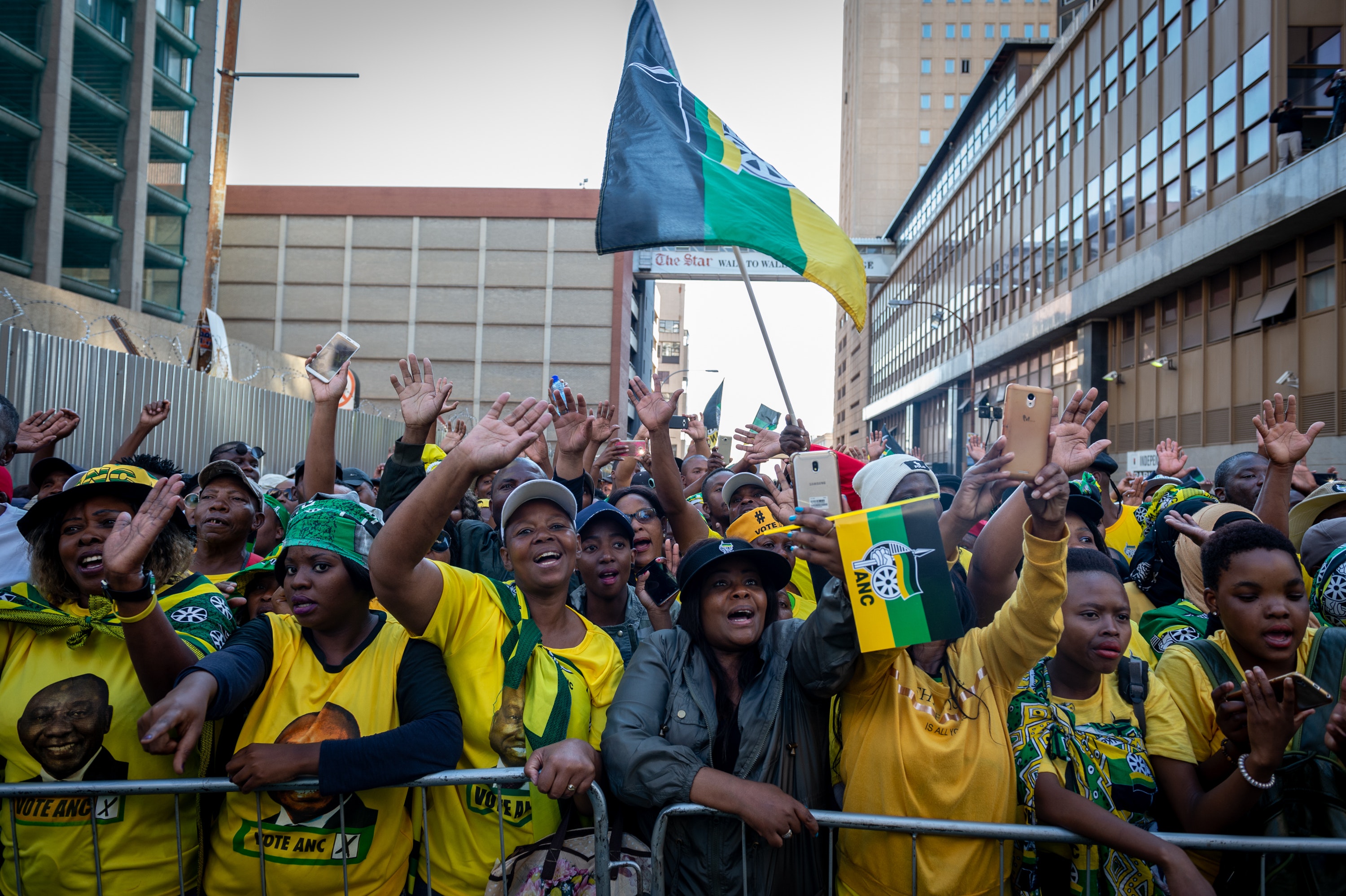
Democracies are precarious endeavours, as events around the world are showing.
In most, political parties hold sway over whether the system delivers the will of the people, or doesn’t. So how political parties are organised plays a big role in the health, or ill health, of democratic states.
In South Africa, the issue of how the governing African National Congress (ANC) is held accountable by its members has come to the fore in recent weeks. Ace Magashule, ANC secretary-general, has reminded the public that it is party branches which elect and remove ANC leaders.
The trouble is that the ANC’s branch structure, designed initially as a means of grassroots democracy at work, is in a mess. This is best exemplified by the collapse of branches in the North West province.
Another problem is that most South Africans, since the dawn of democracy in 1994, have shown diminishing interest in politics and voting.
I calculate by comparing the number of citizens with the estimated number of party members that, at most, 1% or 2% of citizens sign up as members of a political party. That’s because South Africa has around 58 million people.
The ANC is the biggest party, with 600,000 members. The Inkatha Freedom Party’s historical claims of over a million members are obviously false, because it gets fewer votes than that. (It’s theoretically possible for a party to get fewer votes than its membership, but it’s unlikely.)
The Democratic Alliance or DA, the official opposition, keeps its membership numbers as tightly held as a Kremlin secret. In the absence of inside knowledge, I will infer a ballpark figure: they probably have over 100,000 members.
If we assume that the DA is the second biggest party with about 100,000 members, all the rest smaller, it appears that fewer than 2 million South Africans belong to any political party.
But usually most of those members don’t attend their party branch meetings. Where a party directs its branches to hold monthly meetings, typically only between 15 and 25 out of 100 members will attend an average meeting.
Enthusiasm for politics also routinely oscillates – at a peak in the run-up months to an election; then dying back once the election is over.
The African National Congress, which has governed South Africa since the end of apartheid in 1994, is representative of other parties in witnessing these hard facts of political life. Gwede Mantashe, when secretary-general of the party, sounded concern – the branches are supposed to be the power-house of the party, but all too often fizzle out between election years.
ANC branches probably peaked with enthusiasm and numbers between its unbanning along with other liberation movements in 1990 and the first universal franchise elections of 1994. The party’s membership of 600,000 is now down from over a million in 2010.
While there may not be a tight correlation between party members and voters, member numbers are usually broadly proportional to the number of probable voters.
‘Ghost members’ and gate-keeping
Superimposed on these universal facts of political life are the ugly machinations of power contestation. These often take the opposite forms of ghost members and gate-keeping.
“Ghost members” typically come about through the machinations of wealthy aspirant politicians who can cheerfully pay 100 people to join, as the minimum for an ANC branch in good standing, as well as pay each of their R20 (about US$1.30) annual membership fees. Such a ghost branch will then nominate a voting delegate to an elective conference to vote for their patron politician to some higher office. After the election, the branch will fizzle out for the next five years.
“Gate-keeping” refers to hostile politicians at a regional or provincial level removing members in good standing from membership lists, until a branch falls below the threshold of 100 members. The aim is to deny a branch the right to send a delegate to the elective conference, if the branch is likely to vote against the gate-keepers’ preferred candidate.
Where a branch is deemed “no longer in good standing”, a few members will seek to join a nearby branch. But most will be demoralised and drop out.
Another problem stems from the ANC constitution requiring a quorum of half of the members in good standing to a branch annual general meeting (AGM) or to elect a voting delegate. One middle class branch had to call its AGM seven times before it could get 50 members under one roof at the same time to vote. Less scrupulous branches will take the attendance register from door to door until they accumulate 50 signatures, and then hold their election.
Tackling membership malpractices
The ANC has taken steps unprecedented by any other South African party to counteract these malpractices. At the branch meetings to elect Cyril Ramaphosa or Nkosazana Dlamini-Zuma as leader of the party in 2017, each member had to produce their identity document, which was digitally imaged, date-stamped and had geo-location added (personal observation).
This was done to prove that all who signed the attendance register were physically present at the same time on the same premises. The device had an automatic shut-down at 21h00.
Three years later, the ANC migrated its membership lists from the usual paper system to an online system where each member directly signs on with Luthuli House, the head office in Johannesburg. The intention is that this will short-circuit any gatekeepers at a regional or provincial level. Currently, the system has teething troubles.
The ANC is long overdue to revise its constitution to provide a mechanism for quorums used by many statutory and other entities. Where attendance is below a quorum, the meeting is adjourned for seven days, with no changes to the agenda. When reconvened, that meeting is deemed to be quorate, regardless of actual numbers in attendance. This would prevent demoralised members from coming in vain to meeting after inquorate meeting.
These valiant efforts will not address the problem of low attendance at routine branch meetings. Whereas political parties have resorted to starting all large rallies with a pop concert, this cannot be done at branch meetings.
In Africa, the ANC is the oldest surviving party, and the DA the eighth-oldest. As historical achievements are not always a guide to future performance, both need to touch base with their supporters before the 2021 local government elections.

Keith Gottschalk is an ANC member, but writes this article in his personal capacity as a political scientist.


