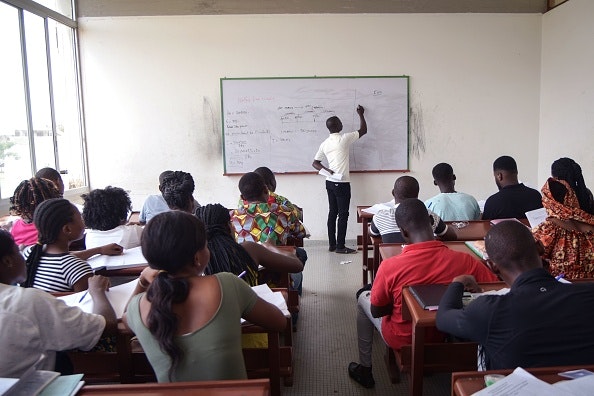
Education has been described as a tool for development. In certain instances, a good, stable and quality educational system is synonymous to development. But to play this role, education systems need to stay relevant. Institutions of learning and training centres must adjust their educational systems as well as their curricula to suit the demands of current times.
This has happened through the centuries. As major changes have occurred in society – or put another way as industrial revolutions have taken root – higher education institutions have adjusted their systems accordingly.
I did a literature review to understand this process, with a view to gaining insights into what it means for rural education institutions in African countries. The research was aimed at understanding how institutions were adjusting the type of education they provide.
Rural institutions are usually established in rural areas to aid development and proffer solutions to challenges faced by the community. The focus is often on addressing illiteracy. I selected rural institutions for my study because they are likely the most vulnerable in terms of preparedness for the current social and economic shifts.
I also wanted to find out the factors hindering rural institutions of learning from preparing for current conditions. And what rural African institutions should be doing. Lastly, I wanted to know what they should focus on.
I concluded that public education has to be overhauled to prepare people for the jobs of the future. This is to ensure that the educational systems fit into the demands of the current age, or what has become known as the Fourth Industrial Revolution.
This digital revolution is a blend of technology fields like artificial intelligence, robotics, the Internet of Things, 3-D printing, nanotechnology, biotechnology, materials science, energy storage, and quantum computing with biological and physical worlds. This digital age is capable of transforming the world’s industries through automation.
An overhaul of the education system in preparation for the Fourth Industrial Revolution implies revisiting the curricula as well as study programmes to ensure they fit the demands of future world of work. If this is done, students will be able to contribute to the development of the communities they live in.
How education progressed
My literature review shows how formal education adjusted during the first, second and third industrial revolutions. A major effect of the first three industrial revolutions on formal education is that they caused a continuous educational shifts.
The first industrial revolution spanned from around the end of the eighteenth century to the beginning of the nineteenth century. The focus of the economy shifted from agriculture to industry.
The second industrial revolution, otherwise called the “Technological
Revolution”, took place between 1870 and 1914, shortly before WWI. It was characterised by the growth of pre-existing industries and expansion of new ones – such as oil, electricity, steel and mass production through the use of electric power.
New technologies, especially in the refining of internal combustion engine and petroleum, alloys and chemicals, electricity and communication technologies, were also improved.
The third industrial revolution took place in the twentieth century. The period saw Henry Ford master the moving assembly line and introduced the age of mass production. It was also characterised by digital technology.
In a bid to ensure that institutions of learning were relevant in all three revolutions, curricula were revisited.
Earlier studies show that African higher education struggled to cope due to lack of infrastructure. For instance, several institutions of learning are still struggling to adjust to the use of power point during teaching and learning with the use of overhead projectors. This influences the level, type and quality of education provided to students.
Recommendations
Public education has to be overhauled to prepare people for the jobs of the future.
The gap between what’s in place and what’s needed is vast. Some countries, such as South Africa, have done some work. The country has done this mainly through the support of local innovations
But most countries are way behind the curve which means they will continue to struggle to remain relevant. Steps governments need to take urgently can include:
-
Redesigning education systems to ensure that there’s lifelong learning. This can be done through curricula redesign to enable learning and relearning at various levels.
-
Revise Science Technology Engineering and Math courses to bring them in line with developments.
-
Revamp Technical and Vocational Education and Training with the involvement of the private sector. This can be done through internships and mentorships. Private organisations can be encouraged to partner with selected rural universities to practically train young people in relevant Science Technology Engineering and Math areas. A good example is the Ford Motor internship in the US.
-
Education policies for rural based institutions of learning should be revisited.
-
Establishing more institutions that specialise in Science Technology Engineering and Math, business, social sciences related areas that would be relevant for the Fourth Industrial Revolution.


