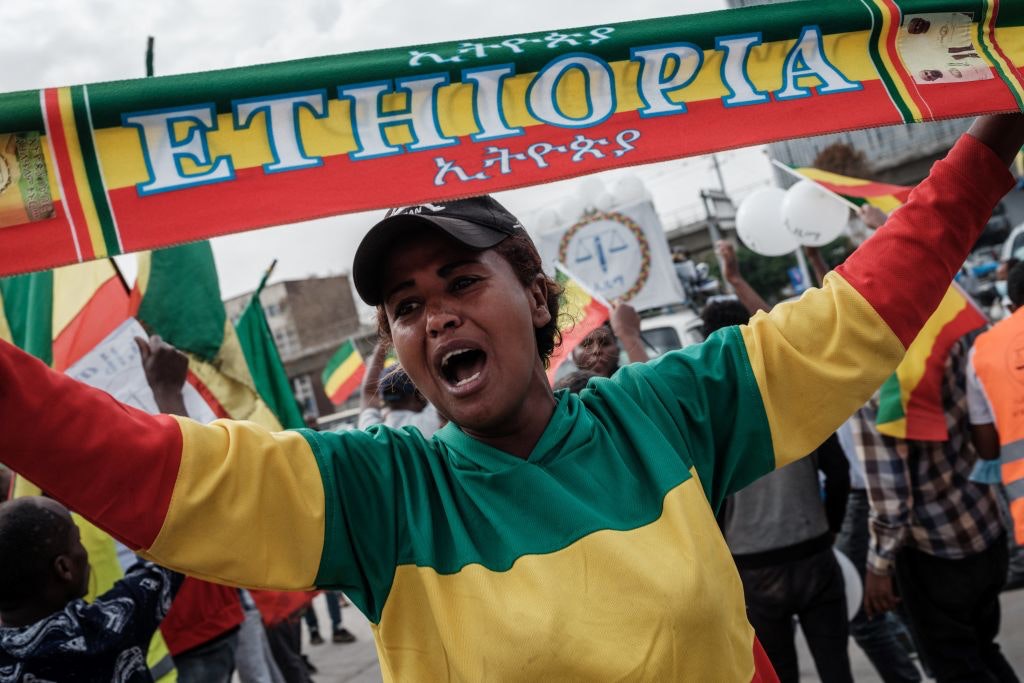
After two postponements due to the COVID-19 pandemic and later for logistical challenges, millions of Ethiopians go to the polls on Monday. Held in the midst of historic domestic challenges – not least a war in Tigray region and instability in Western Oromia region – this election will be significant for several reasons. Here is why.
Elections alone do not guarantee strong democratic progress. But they are the main source of political legitimacy for the current crop of political elites led by prime minister Abiy Ahmed. Abiy detractors have repeatedly made the point that his administration is a caretaker government that emerged after the March 2018 resignation of former premier Hailemariam Desalegn. As such it doesn’t have the legitimacy that elections provide.
Therefore, if Abiy’s Prosperity Party ultimately wins the elections, as many in the country expect, a lot will change. An electoral victory would bestow that needed legitimacy. This would in turn confer new political capital to advance the political reforms of 2018 and 2019 that have since slowed down.
Second, the sixth national election since 1991 will be the first of its kind in which the Tigray People’s Liberation Front will not be taking part. It is to be remembered that the liberation front was declared a terrorist group by the House of Represenatives. The former regional party was the dominant force in the country’s governing coalition for 27 years – Ethiopian People’s Revolutionary Democratic Front – until 2018.
Lastly, this election takes place in the wake of massive internal displacements of people. This has been triggered by all time high ethnic polarisation and ethnic conflicts. These cannot be wholly blamed on the current government as they have historical roots. Moreover, the country’s failing ethnic federal arrangement has made it difficult to address the issue of internal displacements through resettlements and political solutions. Although displacements have stopped and stability returned to affected areas, many voters in such areas could face difficulty in accessing polling stations.
Nonetheless, one major consequence of the national elections would be the emergence of a government that has the popular legitimacy to use its power to address lingering political, economic and security challenges.
Most Ethiopians consider Abiy’s administration as one that inherited massive political challenges. Thus, many hesitate to blame it for the country’s problems. However, once elected and legitimatised through a democratic process, it now could be held accountable.
Ethiopia’s electoral system
A parliamentary system since 1991, Ethiopia’s legislative body has two chambers. The lower chamber, known as House of Representatives, is the most powerful one. The upper chamber, known as House of Federation, mainly deals with constitutional and budgetary matters. While members of the lower chamber are directly elected by the people, members of the upper chamber are mostly appointed by regional councils that consider the proportional representation of all ethnic groups in the chamber.
In existence for 30 years, the House of Federation is considered ineffective even in dealing with its core mandates.
The most important electoral outcome, therefore, is who takes control of the House of Representatives. A political party that wins the simple majority of seats in this lower legislative chamber would then form a government. The house majority would also elect the prime minister and deputy prime minister.
Therefore, when Ethiopians go to polls on Monday, it is not to select their country’s leader, but to vote for their representatives in parliament and leaders of local and regional councils.
The parties in contention
The Prosperity Party currently has the majority of seats in parliament and remains the favourite to win this election. This is mainly because its competitor, Ethiopian Citizens for Social Justice (Ezema, in the abbreviated Amharic name), is not contesting in many areas. Ethnic polarisation is the reason why many opposition parties are not fielding candidates across many constituencies outside their bastions. Even if they fielded candidates, the costs would outweigh benefits due to the volatile nature of ethnic animosities in some parts of the country.
Other smaller parties, such as National Movement of Amharas (NaMA) and Bladeras for Democracy, are also competing in fewer regions and towns. With some ethnic parties either prevented from taking part in the elections or boycotting them altogether, the 2021 national elections are Prosperity Party’s to lose. But given more than forty parties participating in the process, the elections would ultimately confer needed legitimacy to the winner.
The campaign issues
Due to armed conflict in Tigray, instability in western Ethiopia and the highly polarised political atmosphere, the campaigns have been low-key. Unsurprisingly, these two areas also happen to be the only region and localities where elections will not take place given the instability there.
Nevertheless, that does not mean that Ethiopians consider these elections less important. Many hope that the new government, come September, would be one determined to address domestic peace and security issues. They hope it can mitigate ethnic conflicts and usher a period of reconciliation and political dialogue.
Among the most pressing campaign issues was also the need for constitutional reforms. This demand has been voiced more strongly by opposition political parties than the incumbent Prosperity party. But, given that the prime minister is reform-minded, it is expected that some constitutional reforms could be inevitable.
These reforms could include ways of addressing the fragile ethnic federal arrangement. They could also strengthen the federal government and its ability to deal with inter-ethnic clashes and internal displacements.
Conclusion
The times are challenging for Ethiopia. Besides domestic conflicts, there is diplomatic tension with Sudan over disputed territory. Therefore, having an elected and stable government will benefit Ethiopia and Ethiopians most.
The chance that Ethiopia will emerge a fully fledged democracy after these elections may be slim. But it will be a step in the right direction.


