Galaxies – massive collections of gas, dust, and billions of stars and their solar systems – are a fundamental component of our Universe. Understanding how they have formed and evolved over cosmic eras remains one of the greatest challenges of modern astronomy.
There are a few reasons for this. First, the number of galaxies: astronomers have estimated that there are roughly 200 billion galaxies in our Universe. Second, the sheer size and age of these galaxies. Their ages range from 100 million to 10 billion light years and the size ranges from roughly 3,000 to 300,000 light years. One light year is 9.46 x 10¹² km – clearly, then, galaxies are huge and ancient.
However, galaxies aren’t totally mysterious. Technology is allowing astronomers to study and analyse them in far more detail than was previously possible. Our new study used observations from the powerful MeerKAT radio telescope array, located in South Africa, to analyse more than 2,000 galaxies. MeerKAT is the most sensitive radio telescope in the southern hemisphere until the Square Kilometre Array (SKA, which will be the world’s largest radio telescope) is completed.
Our findings suggest that, within the galaxies we analysed, their course of evolution is likely accompanied by cosmic ray electrons losing energy with time. The energy does not – and cannot – simply vanish. Instead, as the electrons slow down, their energy is converted into that of the electromagnetic emissions. These emissions, after escaping the confines of the galaxy and traversing the cosmic distances, are among the telltale signals picked up by the MeerKAT.
These findings help us better understand the nature of these galaxies, and furthermore, the formation and evolution of galaxies in general – including our home galaxy, the Milky Way, which may be undergoing a similar process at the moment. This isn’t a process to worry about; it’s just something scientists want to understand better.
Combining the data
Our study was what’s called a statistical analysis. Different astrophysical phenomena create electromagnetic waves in different wavelengths, including radio, visible light, infrared, ultraviolet, and x-rays. It is therefore important to be able to combine different observations across a broad range of spectra. That’s what a statistical analysis allows.
We selected 2,094 galaxies that are active in forming stars, which means they are energetic and young – in cosmic time-scales. This is an ideal sample to study the way that galaxies grow up and the key features that affect their formation and evolution.
The distances to these galaxies are so great that light, the fastest messenger in the Universe, takes roughly 1 to 11 billion years to arrive from them. So, the galaxies we observe now reflect how they used to be roughly 1 to 11 billion years ago; they are at different evolutionary stages.
Read more: Discovery of two new giant radio galaxies offers fresh insights into the universe
Next, we studied the fundamental physical properties of these distant galaxies by combining the new observations from MeerKAT and the existing observational data from other telescopes. The MeerKAT data were collected over nearly 20 hours as part of the MeerKAT International GHz Tiered Extragalactic Exploration (MIGHTEE) project. This seeks to observe the deep extragalactic space to explore the cosmic evolution of galaxies. It is one of the MeerKAT’s large survey projects prioritised by the South African Radio Astronomy Observatory.
Key findings
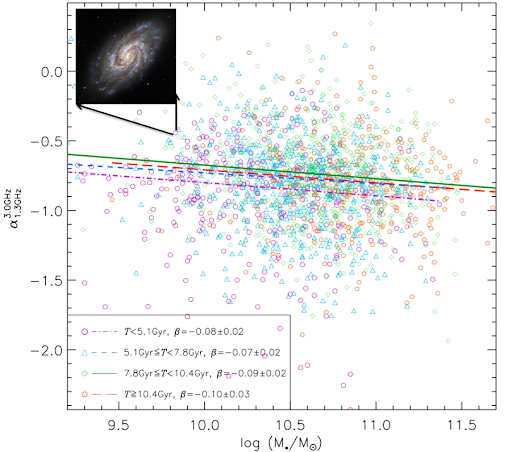
By combining the emission of light in visible, infra-red, and radio from these selected 2,094 galaxies, the study measured how massive, how active, and how bright they appear to be at different radio frequencies, as well as some other fundamental physical properties. Then we connected the intensities of radio emission with the measured physical properties of these galaxies.
The difference between the radio emissions at different radio frequencies was correlated with the mass of the galaxies. On average, the most massive galaxies show the largest difference of radio emission intensity at different radio frequencies. On average, we find that the more massive a galaxy is, the larger such a difference tends to be.
Further quantitative analysis shows that this statistical trend is consistent with the radio emission from cosmic ray electrons that are gradually slowing down – a process that accompanies these galaxies throughout different stages of evolution.


