Ancient DNA changes everything we know about the evolution of elephants:
For a long time, zoologists assumed that there were only two species of elephant: one Asian and one African. Then genetic analyses suggested that the African Elephant could be divided into two distinct species, the African Forest and African Savannah elephants.
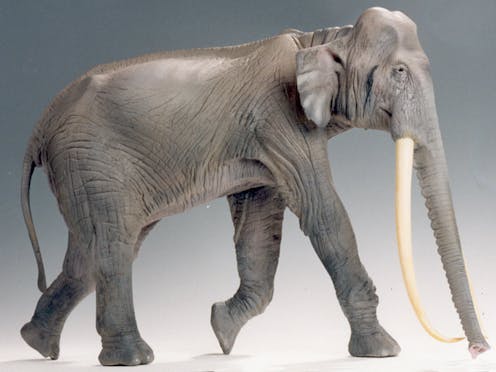
Now a new elephant has been added to the mix. The palaeoloxodan antiquus has been extinct for 120 000 years. This elephant roamed Europe and western Asia during the last ice age, about 400 000 years ago. A study of its DNA shows that this supposedly European animal is actually the African forest elephants’ closest relative. Another study by the same team found that at a genetic level, it may even have more in common with the modern African forest elephant than the African savannah elephant.
This study changes everything we thought we knew about the evolutionary history and ancestry of modern elephants and their closest relatives. It also shows that the African elephant’s lineage was not confined to Africa; the animals actually went out of the continent, which we didn’t know before. It roamed Europe and – through a lot of interbreeding – left its genetic mark far from its original stomping grounds.
The new find, based on DNA from fossils found in Germany, may also shed light on a DNA discrepancy that has puzzled scientists for some time.
The evolution of elephants
Palaeoloxodon antiquus is known as the straight-tusked elephant because of its distinctive and somewhat bizarre appearance. Its ancestors, the Palaeoloxodon recki, lived in Africa between 3.5 millon and 100 000 years ago. Fossils show that the straight-tusked elephants arrived in Eurasia around 750 000 years ago and that they left Africa through the Middle East.
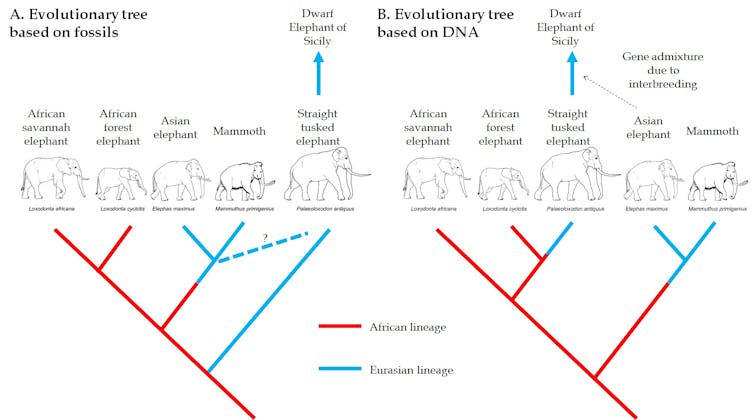
Once it reached Europe, the Palaeoloxodon antiquus had to adapt to new conditions. One of its new homes was the island of Sicily and, as is common when large animals settle on an island, it evolved into a dwarf species. This is a way for large animals to deal with the paucity of resources common on islands.
My own research on this dwarf elephant, Palaeoloxodon falconeri has shown that this remarkable species had an exceptionally large brain. In fact, it’s the only animal species ever recorded with a brain size comparable to a human’s.
There’s a problem, though: DNA revealed some years ago that the Palaeoloxodon falconeri wasn’t descended from or related to any of the African elephant species as expected. Its closest relative was actually the Asian elephant.
That made no sense. How could the straight-tusked elephant be related to African elephants and its dwarf descendant be related to Asian elephants? Was that study wrong? The new study, which examined Palaeoloxodon antiquus DNA, could help unravel the mystery.
This is because the Palaeoloxodon antiquus’ DNA appears to be a mixture of many species’ DNA, which would have happened when they interbred. This process, known as admixture, probably occurred once Palaeoloxodon left Africa. That’s how its descendents ended up with Asian elephant DNA, and even DNA from the famous woolly mammoth.
It is possible that a small chunk of the dwarf elephant’s DNA analysed years ago was extracted from a fragment of sequence inherited from the Asian elephant – and its other origins weren’t picked up.
DNA speaks
This new information about elephants’ evolution and history is extremely exciting. It shows that the two modern African elephant species are heirs of a glorious and evolutionary successful past which still survives and speaks through their DNA. Conservation efforts therefore do not only preserve species, they also save the genetic memories of these peaceful giants.

Julien Benoit receives funding from The Claude Leon Foundation; PAST and its Scatterlings projects; the National Research Foundation of South Africa; and the DST-NRF Centre of Excellence in Palaeosciences (CoE in Palaeosciences).
Source: The Conversation – Articles (AFRICA)
Read more on The Conversation.
Join the fun: Add Your event | Submit a Press Release | Add your listing.


