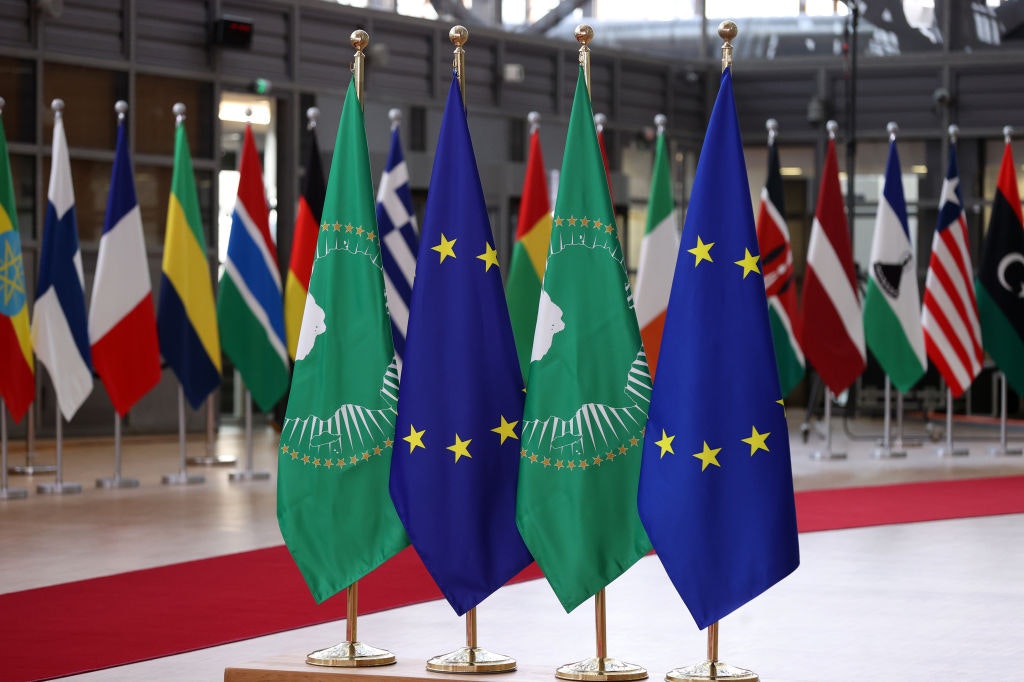
Like several prior summits, one of the proclaimed goals of the recent gathering in Brussels was to “lay the foundations for a renewed and deeper partnership” between the European Union (EU) and the African Union (AU).
Initially, I thought that this time there was a real chance for the long-standing and often repeated calls from African partners for more equality and joint agency to finally be recognised. Prior to – and during – the summit, much had been spoken and written about the urgency of making “it” happen this time – the pressing of the reset button and the start of partnering on an equal footing.
However, from visits to the EU and AU websites, I soon got the impression that the emphasis on partner equality existed primarily on the European side. Apparently, the EU Commission hired US advertising firms to assist them in effective branding and communication. Official EU websites were – and are still – brimming with summit-related announcements.
In contrast, prior to the summit, the AU website said very little about the upcoming event. Even now, the concluding summit declaration (henceforth referred to as the Joint Vision only figures as one among several other news items on the AU’s homepage.
So, what has this year’s summit actually achieved in terms of resetting the relationship? Importantly, what lessons can be learned from what worked and did not work at the 6th summit to enable the parties to do better at the 7th meeting in two years’ time?
A partial reset – on Africa’s side
It seems that African participants have finally decided to press the reset button and have begun to act as equal partners.
Prior to the 6th summit, most commentators, including myself, were thinking of the EU participants when suggesting a relationship reset. However, as the Joint Vision and various post-summit assessments indicate, on the EU side, rhetoric and policy practice still diverge when it comes to “partnership equality”.
The reasons for this divergence lie in how summit meetings have so far been organised. Judging from the main speeches delivered at the last summit, each side presented their respective ‘wish list’ to the other side. This was often done rather vaguely.
A case in point is the investment package of €150 billion over seven years. The EU said it would mobilise this money for projects to be undertaken under the G7 Global Gateway initiative in Africa. Evidently, no proper prior consultations with Africa on this ‘offer’ took place.
Unfortunately, the Joint Vision doesn’t address the issue. Left unanswered is how the summit process can be improved so that it leads to more equality among the partners, and more concrete and well-founded outcomes.
Nevertheless, why not start thinking about possible ways to improve the process to do better at the 7th summit?
How to do better
The first and most urgent reform that the partners might want to consider is the design of a joint preparatory process to support summit participants’ decision-making. But to get the design of this process right, some complementary reforms would also be necessary.
Second, there needs to be clarity on the main purpose of summit meetings. Is the aim just to serve as an opportunity for wide-ranging information exchanges and informal consultations? Is it necessary to reach an agreement on concrete projects of shared interest and concern? Or is it about both?
Third, to get outreach activities right – and to understand what motivates different parties to cooperate – there needs to be clarity about what type of interaction is being talked about. For example, is it about:
-
development assistance or aid from the EU to Africa, or
-
joint collaborative efforts of the AU and EU in support of trans-union public goods (such as an agreement on migration pathways), investment, and trade opportunities that the EU seeks to tap in Africa or Africa in Europe, or
-
requests for enhanced management of negative policy spillover effects that one union directs to the other union?
Fourth, agreement needs to be created about when financial resources from the EU to Africa should be channelled to or through the AU Commission, and when to other recipients, such as a regional economic commission, country or project. The same holds for flows from Africa to Europe, where they exist.
Fifth, this kind of clarity would lay the foundation for establishing indicators of progress and improved monitoring as called for in the Joint Vision. This should, of course, also be conducted jointly or perhaps even by an independent body.
If such a reform package were adopted and a joint preparatory summit process organised, all concerned actor and stakeholder groups would have a more effective voice. This in turn would lead to improved project selection, design and impact. It would also lead to the realisation of partner equality and a strengthened AU-EU relationship.
In sum
Among the positive results of the 6th summit is that, rhetorically, the need for a reset of AU-EU relations is being realised. Africa no longer just called for being recognised, but acted as an equal partner.
These facts put the spotlight on the weaknesses of the present AU-EU summitry, and, by making them more apparent, offered important cues on doing better next time, including through the five reform ideas discussed above.


