On March 22 as the global community marked World Water Day, residents of a small town in Somaliland also had reason to celebrate.
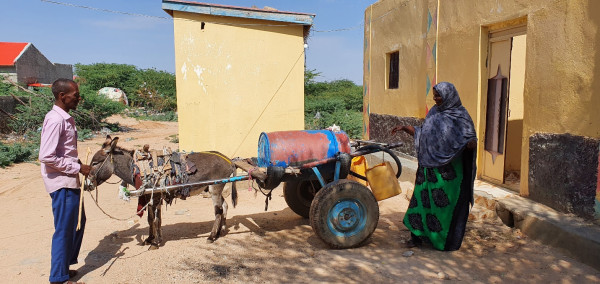
With a population of about 24,500, Arabsiyo is about 35 km west of the capital, Hargeisa. The town previously had 75% of its inhabitants relying on unsafe water delivered by donkey carts and truck operators who often drew from unprotected and poorly maintained water sources like shallow hand-dug wells around seasonal riverbeds.
Only about 20% of the population had access to potable water from a borehole through a household connection managed by Arabsiyo Water Agency (AWA), the public water utility. The remaining 5% got their water from water kiosks at high costs.
According to AWA, the water volume was insufficient to meet the minimum WHO-recommended per capita urban consumption of 35 liters per capita per day. It fell short by almost 67% of this recommendation.
During that period, Khadra Mohamed, 62, spent about a third of her daily income to purchase potable water. “I bought water four times a week from a donkey-drawn cart private operator who travelled about six km round trip for each supply. Still, this was not enough for my sanitation and hygiene needs,” says the mother of seven, a resident of Arabsiyo.
She recalls that her daughter walked the same distance each time to call out and direct a donkey cart operator to their house to supply water, and therefore missed school regularly.
This inability to meet the growing water needs of communities in Arabsiyo was widespread, especially in Somaliland’s informal settlements. But the story has changed since 2022, thanks to the Water Infrastructure Development Programme for Resilience in Somaliland (WIDPR), funded by the African Development Bank and implemented by the Ministry of Water Resources Development in collaboration with CARE International.
The program, implemented over six years (2016-2022) in several rural and peri-urban communities across Somaliland, established resilient and sustainable water and sanitation infrastructure in Somaliland.
It entailed the construction of an 83,000-cubic meter Haffir dam in Faraweyne, close to the border with Ethiopia; construction of 5 earth dams, rehabilitation and building of five strategic boreholes and 11 shallow wells. Another 18 shallow wells were constructed to serve as village mini-water-supply facilities. They are solar-powered and serve rural and peri-urban communities. Some 23 public sanitation amenities were also built in schools, health facilities and markets.
The project had a capacity-building component comprising establishing and training 27 community water management and 23 community sanitation and hygiene promotion committees. These community-level management structures will ensure systematic and sustainable water supply and sanitation access for the beneficiaries.
In addition, the program made available a borehole drilling and maintenance rig to increase water production in Arabsiyo Town. This helped AWA to improve water supply through house connections and enabled the construction of more water kiosks.
Khadra’s family is among several households that benefitted from the new water supply system. Her daughter, who previously had to abandon school to enable her to walk 6 km to draw water for the household, now attends classes regularly.
Khadra says: “Providing me access to piped water means a lot. My daughter is now fully back in school, and the amount of money I spend on water has significantly reduced. I can now save money for small trading to support my family.”
For example, before the project, families like Khadra’s paid $7.5 per m3 to private water vendors; now, they pay as little as $1.5 per m3 through a water connection.
It’s not only the inhabitants of Arabsiyo town that have benefitted from the WIDRP. The program also extended water to internally displaced persons’ camp in the north-western port city of Berbera and other new settlements, serving hundreds of displaced persons with clean water.
Implemented as the Augmenting Berbera Urban Water Supply Scheme (ABUWSS), the program increased the number of house connections from 1,200 to 6,750, serving an additional 38,800 people in the township and another 8,500 displaced persons having access to affordable potable water.
Fardusa Osman, 30, who fled conflict in Ceel Afweyn in the north-eastern Sanaag Region, to the Berbera camp with her three children and husband, now boasts of affordable clean water supply. “Initially, we got limited quantities of water from a well-wisher, and we would spend about $2 to $3 per 200-liter barrel supplied by water tankers, which was more than ten times the approved water tariff of $1 per 1,000 liters,” she says.
Fardusa adds: “As a result of the high cost of water, what we could afford was not enough to meet basic hygiene and sanitation needs. I am happy and thankful to the African Development Bank and the Government for making water available in the camp. I now get enough water from the water kiosk for drinking, cooking and cleaning, and it does not cost me much.”
Completion of the ABUWSS initiative saw water production capacity increase by 2,400 m3 daily following the development of four new high-yielding boreholes. This was in addition to upgrading the existing transmission and distribution network with 10.5 km of pipeline and constructing seven water kiosks, which improved supply to the targeted areas, including the camp.
Berbera City Mayor, H.E. Abdishakur Cidin, lauded the Program and the partnership with the Bank, saying: “An urban water system that provides reliable water to the urban poor is essential for maintaining public health.”
The Program contributed to the Ministry of Water Resource Development’s vision of becoming a water-secured nation where every citizen has easy access to clean, adequate, affordable water, sanitation and hygiene.
Distributed by APO Group on behalf of African Development Bank Group (AfDB).


