The honeybee is the world’s most important pollinator of food crops and beekeeping plays an important global economic role. Around 1.6 million tonnes of honey is produced annually and wild honey is also known to be widely collected by foragers globally. Hive products like honey, beeswax, bee larvae, pollen and propolis are used for food, medicinal and cosmetic purposes. They also provide sources of income for households across much of Africa.
Considerable historical and ethnographic literature across the continent suggests bee products, honey and larvae have long been important as food and in making drinks. But it’s not known how old the practice of honeybee exploitation is in Africa.
Our recent project research has yielded the first direct chemical evidence for honeybee product exploitation in West Africa. We achieved this result by analysing organic residues of prehistoric pottery excavated from Nok culture sites in Nigeria.
The Nok people, known for their remarkable large-scale terracotta figurines and early iron working, lived around 3,500 years ago in Nigeria. Little was known of their diet and subsistence practices, as acidic soils at Nok archaeological sites meant there was little surviving organic material. Animal bones or plant remains, which would reveal whether they grew crops and kept domesticated animals or hunted wild game, did not survive.
Organic residue analysis thus provides the only means to investigate diet and subsistence practices of Nok people, to provide information on whether they were early farmers or still practising the hunter-gatherer way of life. This has implications for our understanding of the domestication of plants, such as pearl millet, and the timing of the arrival of domesticated animals in the area.
Our research
The technique of organic residue analysis involves grinding up small pieces of ancient pottery. From these we chemically extracted lipids – the fats, oils and waxes of the natural world. This provided a “biomolecular fingerprint” of the foods cooked in Nok pots. Animal fats – such as milk and meat from cattle, sheep, goats and pigs – are by far the most common foodstuffs identified in ancient pots.
That’s why we were surprised when our analyses revealed that one third of Nok vessels contained a complex series of lipid biomarkers that pointed to the presence of beeswax. Determined genetically through the honeybee’s biochemistry, the composition of beeswax is extremely constant. It offers a reliable “chemical fingerprint” for detecting the presence of beeswax in archaeological vessels.
What does the presence of beeswax in the pots tell us? After all, beeswax itself isn’t edible although it can be used for technological and medicinal purposes. Its presence in the pots is probably a consequence of the processing (melting) of wax combs through gentle heating, so that the pots absorbed some wax. Or it could be that honey itself was cooked or stored in the pots.
Ancient people would probably have sought out wild bee nests both for their honey, a rare source of sweetness, and possibly other bee products, such as the larvae, which are still eaten in many places across the globe today. Honey offers a high quality source of dietary energy, fat and protein and is often an important food source for hunter-gatherers.
There are several groups in Africa, such as the Efe foragers of the Ituri Forest, Eastern Zaire, who have historically relied on honey as their main source of food. They collect all parts of the hive, including honey, pollen and bee larvae, from tree hollows which can be up to 30 metres from the ground, using smoke to distract the stinging bees.
Honey may also have been used as a preservative to store other products. Among the Okiek people of Kenya, who rely on the trapping and hunting of a wide variety of game, smoked meat is sometimes preserved with honey, being kept for up to three years. A number of the Nok pots did contain biomarkers suggesting the presence of both beeswax and meat products.
As well as using honey as a food source, it may have been used to make honey-based drinks, wine, beer and non-alcoholic beverages, which are commonplace across Africa today. The writings of ancient explorers provide insights into the antiquity of these practices. For example, Ibn Battuta, the Muslim Berber scholar and explorer, while visiting Mauritania in 1352, told of a sour drink made from ground millet mixed with honey and sour milk. A further account of the preparation of wine from honey is found in a record of a Portuguese visit to the west coast of Africa (1506-1510).
Read more: Does alcohol have an undisclosed African heritage?
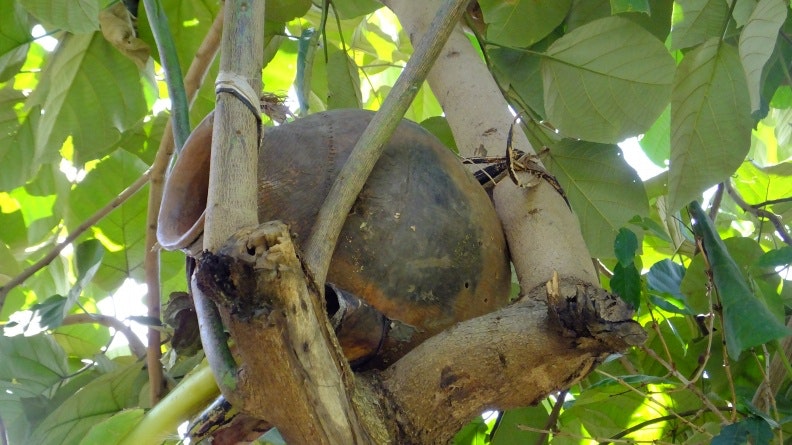
A further possibility is that the pots themselves may have been used as beehives, implying some management of the bees. This is commonplace in modern-day Nigerian traditional beekeeping, where pottery hives are either placed on the ground or in trees.
Read more: Lessons from Africa on how to build resilient bee colonies
Thus, our identification of beeswax, and possibly honey, in Nok pots raises interesting questions about the antiquity of honey collecting in West Africa. Pottery was invented in this region at least 8,000 years before this. It’s possible that analysis of these early pots would reveal early hunter-gatherers in the region were honey-hunting too.


