Better access to stories can improve adolescent lives in Africa:

Across cultures, the self-making powers of storytelling are widely recognised. Steve Biko, the South African Black Consciousness thinker, once said that we need to speak from where we stand. Seeing the impact of our environment on our thinking about ourselves can change our thinking, he suggested. Telling our stories is an important way of doing so.
Though stories are universal, access to them is not. We are involved in a project that’s trying to address this. The United Kingdom Research and Innovation fund’s Accelerate project is working with adolescent groups in Africa to understand how young people see their lives in terms of story. And how inequality configures their relations to storytelling.
We’ve found that the stories young people on the continent encounter – in films, web content and even young adult literature – tend to be about others, from elsewhere. There are barriers to having their own stories heard, and those stories tend to be undervalued.
Our aim is to design appropriate interventions geared to improving adolescent lives through the activity of storytelling.
What we found out
To get closer to the issues we ran a workshop in Cape Town, called Narrative and Adolescence.
Professional storytellers, performers and young people’s groups explored how storytelling approaches might allow adolescents to feel more positively centred in their contexts. We also wanted to discover more about the access young people had to stories.
Using performance, drawing, and role-play, our workshop explored how storytelling provides a platform for thinking about our environments in new, self-aware ways. We immediately found that there are many different ways of thinking about story. There are “negative” stories – tales of gangsters and pregnant teenagers – and “positive” stories – tales of breakthrough and survival featuring sparky trend-setters and valiant underdogs.
We noticed many of the young people felt that the stories imposed on them by the media or chiding parents tended to be negative. We also noticed that they often saw positive stories as coming from elsewhere. Breakthrough stories in many cases involved an escape from their communities to affluent places abroad.
Clearly, the young people felt motivated by different kinds of story, not only a particular set of stories, such as about national heroes, but an accessible spectrum of stories ranging from Cinderella tales through to self-help narratives. They also enjoyed the creativity of storytelling. Their enjoyment supported our sense that such activities might help improve their lives.
The power of stories
Our thinking about having your story heard correlates with research on narrative approaches in various fields, including medicine and economics. Many studies show how art can help structure experiences like illness, even when that experience seems to lack structure. Experiential psychology provides ample evidence that “how we see the world” is as important as “how the world is”. So, the activity of storytelling can itself make an impact on how we see the world.
A newspaper report in which young South Africans were asked what they needed during lockdown underlines the importance of story as a platform to articulate their needs. They enjoyed hopeful stories of recovery involving people “like them”.
Our workshops bore out these ideas. They pointed to our need to feel that wherever we are in the world, our storytelling is worth supporting.
Uneven geographies of storytelling
However, economic, social and other factors condition the way people access storytelling platforms such as theatre, spoken word events and reading groups. The geographies of storytelling are uneven. Which in no way means that African countries suffer a dearth of stories.
Quite the contrary. It’s the platforms for such creativity that are circumscribed. This means that where you come from affects the narratives you have available to feed your imagination. Though creativity is clearly not correlated to wealth, there are people whose material conditions limit their access to a range of possible narratives. Particularly to those narratives involving people like them speaking from where they stand.
The interactions we have with young people in our ongoing research project suggest that reasons for narrative inequality include a lack of representation in global popular culture. They are not seeing enough of themselves in the stories they can access. Moreover, dominant value-systems tend to associate individual freedom with consumption.
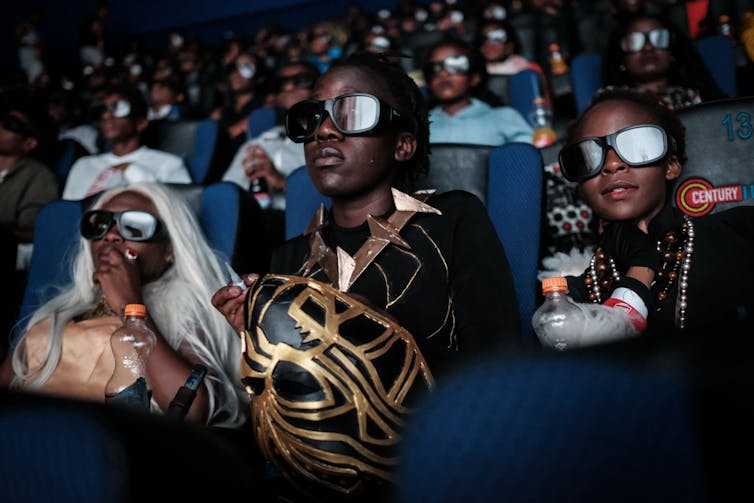
In South Africa, education and, increasingly, entrepreneurship, form the primary narratives of social aspiration. Other stories are not as strongly validated. Resources for storytelling are also lacking. These inequalities are exacerbated by factors like language and accent-marking.
A 2016-18 Nigerian creative writing competition, organised by Accelerate researcher Isang Awah, interestingly demonstrated the reluctance of some young Nigerians to view themselves as central protagonists in their own stories. Awah suggests that a lack of stories featuring ordinary young Nigerians conditions the stories they consider valuable.
As the writers Binyavanga Wainaina and Chimamanda Ngozi Adichie argue, if we only have access to certain stories, we imagine in less exploratory ways. These two African authors insist on the need to throw off colonial models and to free imaginations. Biko, similarly, argued for the vital need for people to shape their own forms of consciousness.
Expanding storytelling
If we think stories matter, then two other things matter – not just what stories we tell, but also how stories are accessed. If individuals are empowered by hearing stories that speak to their own conditions, then there is an excellent case for policy-makers and researchers on Africa to intervene to make more stories and more storytelling facilities available to more young African people.
Alongside designing development interventions, we can expand the infrastructures of storytelling, for example by funding community radio stations and storytelling slams.
We need to support adolescents on the continent with infrastructures that will enable them to tell their stories. The infrastructures of storytelling can be a powerful force for change.
Zimpande Kawanu and Archie Davies are co-authors of this article. Zimpande, a Mandela Rhodes Scholar, is currently enrolled in the MFA programme at the University of Cape Town. Davies is a Leverhulme Early Career Fellow in the Department of Geography at the University of Sheffield.

Elleke Boehmer receives funding from the United Kingdom Research and Innovation research fund through the UKRI GCRF Accelerating Achievement for Africa’s Adolescents Hub.
Source: The Conversation – Articles (AFRICA)
Read more on The Conversation.
Join the fun: Add Your event | Submit a Press Release | Add your listing.


