Blame politicians, not Mandela, for South Africa’s unfinished business:
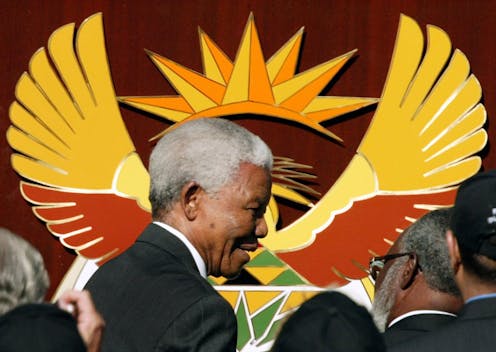
July 2018 marks Nelson Mandela’s centenary year. Why is he still so revered across the world? The answer simply is that he is widely regarded as the personification of values which he spent much of his life fighting for. These included social justice, democracy, and freedom.
At the Rivonia Trial in 1964, he asserted that it was these values for which he hoped to live, but for which he was “prepared to die”. He would spend 27 years in prison before he could realise his dream of a South Africa freed from repressive and brutal racial segregation.
In prison, Mandela’s stature and mythology was carefully nurtured by his movement, the African National Congress ANC, and the anti-apartheid movement. This established him as the focus for the global struggle against apartheid.
By the 1980s, Mandela was the world’s most famous political prisoner. He was celebrated at rallies, featured on protest posters, and immortalised in popular culture.
Mandela’s conviction and adherence to non-racialism and democratic ideals came to symbolise the intrinsic moral nature of the struggle against white minority rule.
In the world’s current international climate of conflict and political cynicism, Mandela’s legacy continues to serve as a rare example of a principled politician who represented an indefatigable commitment to forgiveness and reconciliation.
Mandela commanded respect and moral authority at home and abroad for his strong convictions, humility, and courageous actions that ensured all South Africans could live in a democratic society. These achievements in the face of enormous challenges should not be underestimated.
As South Africa’s first democratic president there was a clear emphasis on transformation for the majority. This came about through political action under the slogan “a better life for all”, the introduction of a progressive and liberal constitution, stabilising the economy, and enshrining the ideals of democracy by stepping down from the presidency after one term in office.
Yet there is mounting disquiet and frustration about the slow pace of South Africa’s transformation in the democratic era. This is characterised by stubborn economic inequality, growing unemployment, missed opportunities and the failure to establish the form of “new” society articulated by Mandela.
What would have seemed unthinkable a few years ago is a growing and vocal criticism of Mandela’s legacy. The primary target of this frustration is the compromises and reconciliation efforts of the early 1990s, which so endeared Mandela to the world. But for many South Africans the outcomes were too accommodating to the white minority.
Is the mounting criticism of Mandela fair? I would argue not. South Africa currently faces many challenges, but it isn’t Mandela who failed people’s expectations. The blame for that must be put squarely at the door of the country’s politicians.
Is criticism of Mandela fair?
First of all its deeply unfair and highly problematic to prescribe South Africa’s current travails on one person. Part of this problem stems from the perception that Mandela single-handedly delivered freedom for South Africa and led the negotiation process.
This is simply not true. And the “single story” is a disservice to the multitude of organisations and activists that fought apartheid including the ANC, the Black Consciousness Movement, trade unions, and the United Democratic Front.
In addition it was the collective leadership of the ANC, not Mandela alone, that negotiated with the National Party during the transition process to seek a political compromise.
The ANC should certainly have pushed for more concessions. In reality the party effectively sacrificed wider economic and social change for political power.
It is the lack of substantive change enacted during the transition that has prompted the emerging reevaluation of Mandela’s legacy.
To argue that Mandela “sold out” through these compromises is a misreading of the situation and fundamentally ignores the challenges and constraints of the period. These included: escalating violence across the country; the ANC negotiating from a position of structural weakness; the National Party remaining undefeated; the impossibility of overthrowing the apartheid regime by force; and a fundamentally altered post-Cold War political and economic environment.
Most important of all, 1994 was not supposed to be the final stage for transformation. Rather, it was a platform for future efforts. But the ANC has not succeeded in doing enough to initiate wider-societal transformation since 1994 based on the unfinished business of the negotiations.
ANC failures
The party’s inability to implement sustained policy changes for the benefit of the majority is evident from a number of ongoing political debates. These include anger about unemployment, land expropriation without compensation, and corruption.
In addition, the ANC appears to have lost its sense of direction. The political elite has been badly mired by scandals, most notably under the former presidency of Jacob Zuma.
There is no doubt Mandela was a complex and flawed individual, but his vision still matters. What is required in this centenary year is for people from all sections of society to work together to embody Mandela’s values and convictions to keep the country moving forward to overcome the deeply ingrained legacies and injustices of the past.

Matthew Graham does not work for, consult, own shares in or receive funding from any company or organization that would benefit from this article, and has disclosed no relevant affiliations beyond their academic appointment.
Source: The Conversation – Articles (AFRICA)
Read more on The Conversation.
Join the fun: Add Your event | Submit a Press Release | Add your listing.


