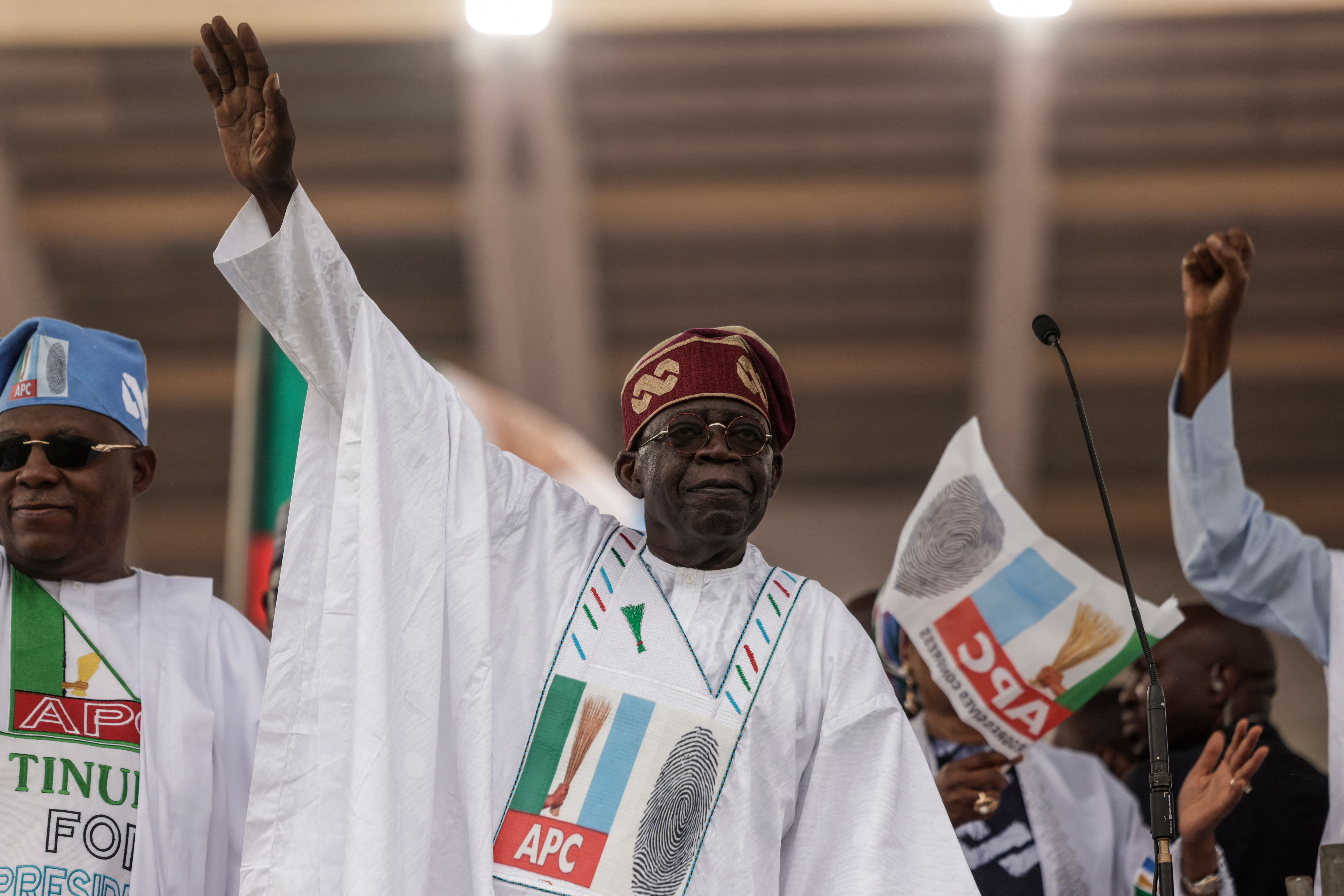
Bola Ahmed Tinubu, of the ruling All Progressives Congress in Nigeria, has been declared winner of the country’s keenly contested presidential election.
The 70-year-old former governor of Lagos State and Nigeria’s political kingmaker will inherit a Nigeria that is faced with a fractured polity, national security threats and economic challenges including skyrocketing cost of living.
Tinubu polled 36% of the 24,965,218 votes cast in the 25 February presidential election whose outcome is being disputed by his closest rivals.
To emerge as Nigeria’s President, Section 134 of the constitution states that a presidential candidate must score the highest number of votes cast at the election. In addition, the candidate must also score at least a quarter of the votes cast in each of at least 25 states in the Federation including the Federal Capital Territory. Tinubu met this requirement.
His closest rivals Atiku Abubakar of the Peoples Democratic Party got 29% and the Labour Party’s Peter Obi got 25% of the votes cast. Both parties had earlier described the poll as a sham and demanded a cancellation.
The PDP and Labour Party protested the inability of the Independent National Electoral Commission, INEC, to upload the Presidential election results, from each of the 176,606 polling units, on an electronic portal accessible to all citizens as earlier promised.
The electoral commission blamed its failure to upload the results on failing internet network across the country.
Tinubu’s campaign was largely based on his record as governor of Lagos state, Nigeria’s commercial capital. He was, however, defeated in Lagos by Obi, a former governor of Anambra State, southeast Nigeria.
Obi’s relatively unknown Labour Party galvanised the interest of young, urban dwellers and took the country’s two-party system to task in the 2023 presidential election.
Nigeria has the largest population of youth in the world, with a median age of 18.1 years. About 70% of the population are under 30, and 42% are under the age of 15. The youth are often left with the shorter end of the stick when it comes to governance and economic indices.
Outside of Lagos, Tinubu won most other states in his home region of the south-west. He also secured the constitutional requirement of scoring at least 25% of votes cast in 24 states of the federation.
Widely believed to be the political kingmaker responsible for the emergence of President Muhammadu Buhari in 2015, Tinubu is loved and loathed in almost equal measures.
His admirers describe him as Nigeria’s number one political strategist, a technocrat, an astute administrator, a talent spotter and nurturer. They give him credit for the recent development of Lagos, Nigeria’s commercial capital.
Critics see a different Tinubu. They point to controversies surrounding his age, parental ancestry, educational background and health. Allegations of corruption have lingered though he has been tried and acquitted.
As an academic and journalist who has reported Nigeria’s politics for more than three decades, I offer my assessment here of Tinubu.
Tinubu’s political rise
Tinubu came into national prominence during Nigeria’s ill-fated Third Republic (1985-1992), when a National Assembly existed along with a military president, General Ibrahim Badamosi Babangida.
Under the quasi-democratic arrangement of that time, Tinubu was a member of the Nigerian Senate when Babangida annulled the results of the 1993 presidential election. The winner was believed to be the charismatic business mogul Moshood Kashimawo Olawale Abiola.
Tinubu’s fight to re-validate that election was what brought him into national political consciousness. He openly opposed the annulment and worked to restore democracy in Nigeria.
He and others became targets of military elimination and he had to flee abroad. Tinubu coordinated and largely funded the campaign for democracy in Nigeria from exile.
At the dawn of the return to democracy in 1999, Tinubu emerged as the governor of Lagos State, the country’s commercial capital.
Governor of Lagos
In his eight years as governor (1999-2007), Lagos State introduced reforms in revenue generation, the judiciary, security, infrastructural development and other sectors.
But his time in office was dominated by a long battle with the federal government over his decision to create new local governments in Lagos. This angered the President Olusegun Obasanjo led federal government which took the decision to withhold the monthly federal allocation that was due to the state.
Until then, no state in the country was thought to be capable of surviving without monthly federal allocations. Tinubu was able to raise the state’s internal revenue, which sustained it through that period. Since then, Lagos has kept increasing its capacity to fund itself. In 2022, only six of Nigeria’s 36 states were capable of surviving independently.
Tinubu was the only governor, out of six, in the south-west region of Nigeria who won re-election in 2003 on the platform of the then opposition party, Alliance for Democracy. The other five governors all lost their second term bid to opponents fielded by the ruling Peoples Democratic Party under then president Olusegun Obasanjo. Tinubu is believed to have won due to his popularity among Lagos voters.
He has remained influential in the state and is popularly described as the godfather of Lagos politics, having played a substantial role in the emergence of his successors as Lagos governor.
Bridge builder and nurturer of talent
Tinubu is often described by his admirers as a political bridge builder. He is reputed to be able to spot and nurture talent. Many of those he has spotted have become high performers in Nigeria’s politics and governance.
For instance, he appointed Nigeria’s current vice-president, Yemi Osinbajo, a law academic, as attorney general and commissioner for justice in Lagos State. In 2015, he nominated Osinbajo as vice-president to Buhari.
Tinubu has also been instrumental in the emergence of many ministers and special advisers in the Buhari’s cabinet, former and current members of the National Assembly, and former and current state governors who were his aides and political followers.
The controversial Tinubu
Controversies around Tinubu’s parental origin and academic credentials were obstacles to his bid for votes.
In Nigerian politics, identity issues such as family and ancestral lineage often play a key role in how candidates are assessed.
The late Alhaja Abibat Mogaji, the powerful leader of the association of market traders who had the title of Iyaloja General of Lagos and Nigeria, was widely acknowledged as Tinubu’s mother. She died in 2013, aged 96.
But critics insist that she could not have been his biological mother. They argue that Tinubu has a different identity from what is in the public domain. His family has countered such rumours.
His age is another source of dispute. Tinubu says he is 70. His critics say he is probably older than that. His critics also insist that he is unhealthy and unfit to be president, a claim he and his supporters have refuted.
Allegations of corruption have clung to him over the years. He has never been convicted. Under former president Goodluck Jonathan, he was charged before the Code of Conduct Tribunal but acquitted. This was a boost for his image. His supporters argue that if he was truly corrupt, he would have been convicted, especially since he was an opposition politician.
The kingmaker is President-elect
In 2015, Tinubu led a political movement that gave birth to the All Progressives Congress party, a coalition of opposition parties that eventually defeated the Peoples Democratic Party at the presidential poll.
It was the first time since 1999, when Nigeria returned to democratic rule, that a ruling party and sitting president had lost an election.
Tinubu is widely believed to be the political kingmaker responsible for Buhari’s success in 2015. He is also believed to have supported Buhari in his second term bid in 2019.
Now, he has emerged as President-elect and successor to President Buhari whose tenure officially ends on 29 May.
This article has been revised to reflect the election results


