Bold steps are needed toward a ‘new normal’ that allocates water fairly in South Africa:
Discussions of the water crisis that has hit Cape Town tend to focus on supply and demand. In other words, a severe and unusual drought has created a situation in which there is not enough water (supply) to meet people’s needs (demand).
The City of Cape Town is focused on increasing supply through use of aquifers and temporary desalination and decreasing demand through restrictions. It announced an impending Day Zero, now pegged for July, as the day when water will be cut off and people will be forced to collect water from one of 200 collection points.
Water shortages aren’t just being felt in the Western Cape. Other parts of the country, such as the Eastern Cape and KwaZulu-Natal, are also being affected by drought and most major metros have introduced water restrictions.
Politicians have started using the term “new normal” to mean that people must learn to live with less water. But this masks the political decisions being made around allocation: a “new normal” must make sure that everyone in urban areas has equal access to water and that the law is followed when allocating water to different groups of users – residents, agriculture, business, and industry.
South Africa is a water-scarce country whose cities are full of swimming pools and lush gardens. Inequity and a lack of fairness and justice pervades water distribution. It is time to make some longer term, strategic choices about equity in urban water demand and about the allocation of water resources.
Unfair distribution
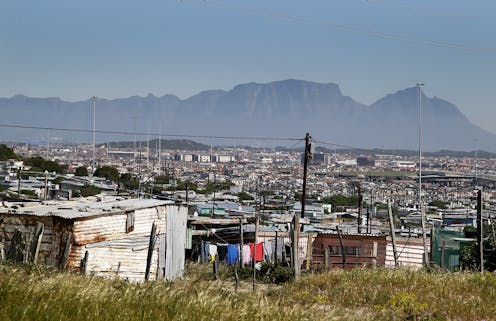
Water use by all of Cape Town’s residents is now seriously restricted. But the amount being imposed across the board is in fact equal to what poor households have lived with for years. For example, in places like Khayelitsha, the largest township in Cape Town, the amount of water that poor people access is typically limited by taps that don’t work or have serious leaks. On top of this they serve far too many people and are far from households.
Access is also limited by the cost of water over the Free Basic Water amount of 200 litres per household per day. But the charges levied against poor households isn’t fair. To begin with the number of family members is not taken into account in setting this limit.
Poor people are also adversely affected by water management devices. The city started installing these in poor households in 2007 as a credit control measure. The devices cut off water daily when the allocated amount has been used. Known in poor areas as “weapons of mass destruction”, they are hated by many of the 140 000 homes who are forced to live with them. Often they malfunction leading to leaks, or they break, blocking households’ access altogether.
In response to the water crisis the number of devices being installed has more than quadrupled to 2000 per week. But now they are being used to curtail usage of households found to be using an excessive amount.
A new normal would involve a mass rollout of these devices to all households in all areas. This would effectively prohibit hedonistic use in wealthy areas.
The other major factor affecting poor areas is poor sewage systems. The toilet war and poo protests are evidence of the level of desperation felt by communities about poor sanitation.
Promises of flush toilets are unlikely to be met given the current water shortages.
There are potential alternatives, such as dry sanitation which could be installed in poor as well as middle class areas. One example is Urine Diversion Toilets. These separate urine and faeces when the toilet is used. One type allows the faeces to dry, producing a human waste compost that can be removed as humans typically produce about four medium suitcases-full per year when dried out.
Over 80 000 of these toilets have been rolled out in poor areas in Durban’s periphery, but here many people still want flush toilets.
Again, the new normal would mean that all households, including middle class homes, would convert to a form of ecological sanitation, and full flush toilets would become a non-option across the board.
Lessons from agriculture
South Africa has rules for fair play in water allocation. The National Water Act clearly states that people’s basic needs and the ecological reserve — that permits the environment to recharge itself enough to continue to function – must be the two top priorities.
The Department of Water and Sanitation is responsible for the implementation of the Water Act. But it’s not been doing its job. A good way to illustrate this is to follow the sorry tale of what happened in the agricultural sector in the Western Cape.
Under pressure from the agricultural lobby, the Department didn’t curtail the allocation of water to agriculture in the province early enough or significantly enough. The Department’s recent claim that agriculture has finally been cut off masks the truth: in reality the sector has used its annual allocation and the main season that needs water is nearly over.
With no early action to limit water allocation, farmers stuck to their normal planting patterns. Water should have been allocated for permanent crops (like wine and fruit trees) and seasonal crops sacrificed. It would have been cheaper to compensate farmers for their costs and farmworkers for their wages related to seasonal crops than to build temporary desalination plants.
Whether in the Western Cape or elsewhere, water allocations must be done according to the law, with people and the environment first, and then monitored and regulated.
Action needed
Civil society is calling for action. Its focus needs to be on defining what the so-called new normal means for all South Africans, and thinking outside the box to address the deeper historical and structural realities that people will live with well past Day Zero.

Mary Galvin does not work for, consult, own shares in or receive funding from any company or organization that would benefit from this article, and has disclosed no relevant affiliations beyond their academic appointment.
Source: The Conversation – Articles (AFRICA)
Read more on The Conversation.
Join the fun: Add Your event | Submit a Press Release | Add your listing.


