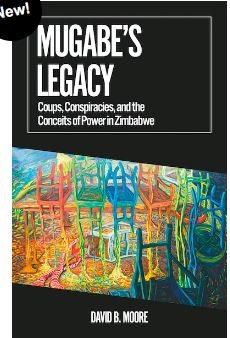
Development studies professor David Moore’s new book, Mugabe’s Legacy: Coups, Conspiracies and the Conceits of Power in Zimbabwe, attempts to understand the legacy of Robert Mugabe, who led Zimbabwe from 1980 to 2017, when he lost power in a military coup.
Moore maintains that Mugabe’s legacy revolves around what he terms “the three Cs”: coups, conspiracies and conceits of political power. He shows that “the three Cs” have their origins in the perilous politics of the independence struggle, in which Mugabe was a key participant.
The book consists of a prologue and 10 chapters. The first chapter seeks “to erect a conceptual structure on which the Zimbabwe ‘facts’ will sit”. Chapters two to five set out “the making of Mugabe and his legacy” in the liberation struggle years. Chapters six to nine trace the independence time trajectory of Mugabe’s political career through to the 2017 coup. Chapter ten examines Zimbabwean politics after Mugabe’s fall from power and death in 2019.
The scholars Ezra Chitando; Sue Onslow and Martin Plaut; Stephen Chan; and Sabelo Ndlovu-Gatsheni and Pedzisai Ruhanya, among others, have debated the legacies of Mugabe’s 37-year rule.
Moore largely ignores the contributions of these important contending studies about Mugabe’s legacies. This is subnormal academic practice. Consequently, the precise ways in which his book surpasses or buttresses competing works about Mugabe’s legacy are indistinct.
Bar an interview with the veteran nationalist politician Edgar Tekere (who had a mammoth lifelong axe to grind with Mugabe) in 2004, Moore did not interview anybody else in Zanu-PF who knew Mugabe well, or worked closely with him for an extended period. For that reason, the book is bereft of exceptionally revealing findings about Mugabe’s leadership, legacy and the politics of Zanu-PF. Moore’s main sources are unremarkable diplomatic cables in Western archives and material already in the public domain such as newspaper articles, NGO reports and published books. They do not make for a groundbreaking book.
Missing the point
We live in an age where the decolonisation of the knowledge agenda has, rightly, come to the fore in the academy. In light of this, I expected arguments about Mugabe’s leadership developed by black Zimbabwean scholars based in Zimbabwe to be central to Moore’s analysis. In place of debates about Mugabe by black Zimbabwean scholars, he has the thought of 20th century Italian Marxist intellectual-politician Antonio Gramsci as his book’s central point of reference.
Moore invokes Gramsci ad infinitum, without ever properly contextualising his ideas or making clear their illuminating pertinence in debates about Mugabe’s legacy. Nor does Moore use his study of Mugabe’s legacy to extend and refine Gramscian theories. My comprehension of Mugabe, his legacy and Zanu-PF was not enhanced in any novel way after all that Gramsci.
Discussion of real and imagined coups is an important theme in Moore’s book. This is presented as a key component of Mugabe’s legacy. But, Moore does not engage relevant coup and military rule literature in order to enhance our understanding of Zimbabwe’s 2017 coup, and for the coup to advance broader studies about the nature and effects of coups, such as work by Samuel Decalo, Kristen Harkness, Naunihal Singh, Barbara Geddes and Alicia Decker, among others.
Moore states that he finds coup literature “boring” because it consists of “conservative tracts on the primordial-like prebendal and neo-patrimonial coupishness of Africans” (page 164). Serious coup scholars will bristle at his characterisation of their work as “conservative”, and defined by a propensity to regard Africans as innately prone to coup making because of personalised patronage-based politics.
Moore cursorily engages the African studies scholar Ali Mazrui’s 1973 article, called Lumpen Proletariat and Lumpen Militariat: African Soldiers as New Political Class, about the consequences of coups, to underline why he finds coup literature “boring” and unhelpful.
The problem with this is that Mazrui’s article is dated and was hardly authoritative even in 1973. Moore depicts a crude caricature of a diverse, sophisticated, instructive and evolving coup and military rule literature.
Portrayal of women
Feminist scholarship has done much to challenge patriarchal erasure and trivialisation of women in political science. Moore’s book does precisely what feminist scholars have critiqued for decades now. It is laden with unquestioned patriarchal notions and gendered trivialisations that impoverish the study of politics.
Moore writes as if nothing can be gained analytically by treating women (Zimbabwe’s former first lady Grace Mugabe, specifically) seriously. By this I mean methodically tracing, listening to and understanding women’s actual political incentives and experiences.
Moore employs sexist tropes when discussing Grace Mugabe’s role in politics and the 2017 coup. For example, he describes her as “the volatile former secretary”, “the woman who whipped her son’s girlfriend” and “incendiary Grace”. Yet there is no mention of the equally notable emotional volatility of the powerful political men – Mugabe, Constantino Chiwenga, Dzinashe Machingura, Joshua Nkomo, Samora Machel and Josiah Tongogara – who he discusses in his book.
Conclusion
Moore did not unearth any treasures in his research of Mugabe’s legacy. He has not even drawn a map that might lead us to an enhanced understanding of the making of Mugabe and his legacy, the politics of Zanu-PF, and coups and their corollaries.
Blessing Miles Tendi is the author of The Army and Politics in Zimbabwe – Mujuru, the liberation fighter and kingmaker.


