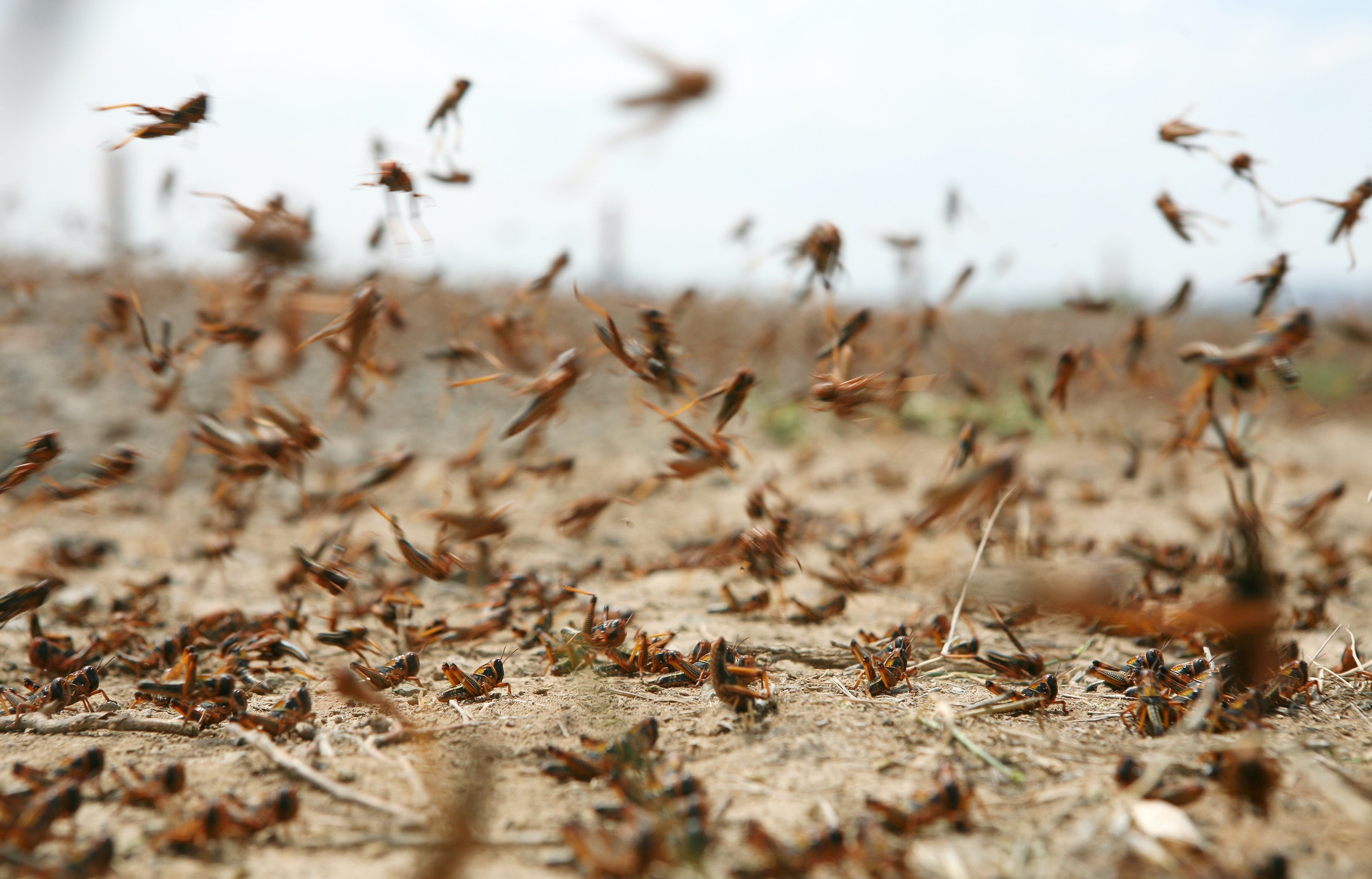
The Northern Cape and Eastern Cape provinces of South Africa recently experienced their longest drought in 100 years. The seven year drought, starting with lack of rains in February 2013, wrought havoc on this sheep farming community. When the summer rains finally fell in October 2020 the farmers had to contend with a locust outbreak as well.
The brown locust found in this area mainly eats grass but will consume any green plants and has been known to decimate maize fields.
The two provinces fall within the Nama Karoo, a vast, open, arid region dominated by low-shrub vegetation. The last locust outbreak in the region was in 2012, so the interesting question is how the insects survived a long drought and could still produce the large numbers seen in the area after the rain.
The answer lies in the fact that the eggs can survive for several years in the soil with the embryos developing at different rates in response to environmental conditions.
The brown locust (Locustana pardalina) is an arid adapted locust endemic to South Africa. It is a different species to the swarming locusts found in other parts of Africa. It has regular outbreaks in the Nama Karoo region and these outbreaks can extend into the southern parts of neighbouring Namibia and Botswana.
Read more: Explainer: what’s behind the locust swarms damaging crops in southern Africa
The female locust lays on average 380 eggs during her life in 6–10 egg pods. The eggs are protected by being in the soil and by having a foam cap. These drought resistant eggs will remain in the soil until they get sufficient moisture to hatch. Each egg contains an embryo which will ultimately emerge as a hopper.
As a study I conducted has shown, the development of the embryo is complex. In some eggs, there’s a delay in the embryo development regardless of the moisture available, whereas in other eggs the embryo will start development as soon as moisture is available. Both types of eggs can be found in the same egg pod. All embryos, from both egg types, can reduce their rate of development when environmental conditions are unfavourable.
Egg build-up and synchronised hatching
Thus, these eggs can remain in the soil for several years with the embryos waiting to receive sufficient moisture to complete development. This results in synchronised hatching when there’s sufficient rain as all the embryos are at the same stage of development regardless of when the eggs were deposited.
The solitary females tend to lay their eggs in the same areas and thus there is a build-up of eggs in particular areas. How the females find these egg laying sites is unknown. Many farmers know where the potential sites of the eggs are due to the large numbers of hoppers they see emerging simultaneously. But ploughing egg beds to destroy the eggs is not feasible because this also destroys grazing.
While many of the eggs remain in the soil, some hatch and produce the solitary form of the locust, thus maintaining the locust population at a low level. This contributes to the build-up of eggs. With the onset of good summer rains, synchronised hatching occurs along with the growth of grass.
Grass found in the region, Enneapogon desvauxii, has long-lived seeds which germinate with the onset of rain, providing food for the hoppers. A pheromone (or chemical) found in locust faeces stimulates the hoppers to aggregate and develop into the gregarious phase if the population density is high. These hoppers form bands and move up to 8km per day in search of food, competing with livestock for the available grazing.
The behaviour of the adults depends on the hoppers. If the hoppers don’t form large enough bands and change colour from green/brown to black and red/orange, then the adult will not form into large swarms and leave the area. As is currently happening in the region, the adult swarms are smallish, locusts fly close to the ground and tend to stay in the same area. Without control these adults will mate and lay eggs, adding to the build-up of eggs in the area.
Due to the large area and sparse human population many swarms aren’t detected. When they are, locust control district officers in each region co-ordinate the chemical control – spraying the government approved insecticide with knapsack and vehicle pump sprayers. The hoppers are sprayed while they roost on the bushes, either in the late afternoon or early morning. The adult swarms are sprayed while they are settled on a field for the night. This targeted spraying is less environmentally damaging than aerial spraying.
Going forward
Alternatives to the environmentally damaging chemical control are needed because even though there has been over a century of chemical control, the locust outbreaks still occur. Future research needs to focus on understanding the impact of rangeland management and climate change on locust outbreaks.
Location of the egg laying sites and criteria used by female locusts in choosing these sites will improve the current prediction models and assist in locust surveillance.


