• Skip to main content
  • Skip to secondary menu
  • Skip to footer
  • Add Event
  • Directory
  • Submit News

MyZA

Free Events Calendar and Business Directory

  • SA News
  • Contact
  • Submit News
  • Directory
  • Quickly Add Listing

Burkina Faso: Over a quarter million people victims of new “water war” in peak dry season

3 May 2022 By admin

Norwegian Refugee Council

Thirty-two water facilities have been destroyed so far this year, impacting nearly 300,000 people according to a group of 13 national and international organisations providing humanitarian and development assistance in the country. Targeted attacks have ranged from direct hits on water points and water trucks, purposeful contamination of water resources to sabotaging public water network’s generators.

“These repetitive attacks on water services and their severe impact on hundreds of thousands of vulnerable civilians are unprecedented in Burkina Faso and have not been seen elsewhere in the Central Sahel region either,” says Hassane Hamadou, Country Director for the Norwegian Refugee Council in Burkina Faso. “Disrupting civilians' access to water is no longer a mere by-product of the conflict, it has become a weapon of war and marks a new, despicable turn in violence. For the sake, dignity and survival of an already exhausted population, this war on water must stop.” 

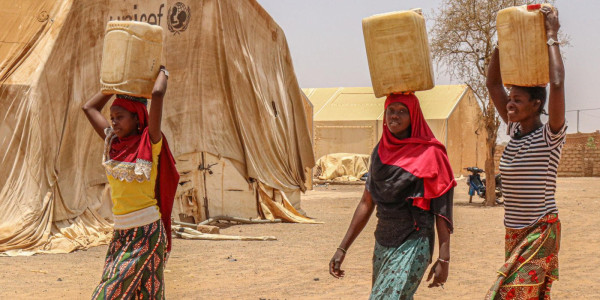
Most destructions occurred in Djibo in the Sahel region, a city that hosts more displaced people than any other in the country. Civilians there have access to less than three liters of water a day to cover all their needs from drinking to hygiene and cooking, compared to roughly twice that amount before the attacks – an already critical level. 

While Europeans use on average 150 liters of water daily, the World Health Organization considers people in emergency situations need at least 15-20 liters. Seven liters is the “minimum survival allocation,” viable only for a few days. Residents in Djibo are now forced to sustain themselves with less than half that amount.

“I went through hell to get my family here safely,” says Fatoumata. “But once in Djibo, I found that the ordeal was not over. It continues for us here.” 

“We struggle to find enough to eat and drink since we've arrived,” says Dicko. “Often, we spend the entire day at the water point only to leave with one jerrycan, and sometimes with nothing. We pay for and drink water that’s very dirty and impure. We can’t even dream of having enough to wash clothes, or ourselves.”

Distance to fetch water and time spent queuing are not just excessively long, they can also expose civilians to more violence. Beyond attacks on water facilities, civilians on their way to or waiting at water points are being intimidated and threatened by armed individuals. On 11 March, unidentified gunmen fired warning shots to disperse a crowd queuing near a borehole in Djibo resulting in a woman dying from her wounds after being hit by a stray bullet.

“Djibo has been a flashpoint of the humanitarian crisis for over three years and now finds itself on the frontline of a new type of war,” says Rebecca Bouchet-Petersen, Country Director for Solidarités International in Burkina Faso. “The conflict is now putting at risk the very thing no one can live without: clean water. Civilians in Djibo were already facing alarming shortages of food and medicine, now they are going thirsty too. Considering all the health risks associated with drinking unsanitary water, temperatures averaging 40C and challenging road access, Djibo sits on the brink of humanitarian disaster.”

Attacks on water have recently spread to other regions as well. On 15 April, gunmen set fire to a water truck in the Center-North region. Assailants made it clear they did not want to see water trucks on that road again. All water trucking activities, currently the only way to provide emergency water assistance to the residents, have been halted as a result.

Full list of signatories:

Association pour la Gestion de l’Environnement et le Developpement (AGED)
Association pour la Paix et la Solidarité (APS)
Action pour la Promotion des Initiatives Locales (APIL)
Experts-Solidaires
Groupe de Réflexion et d’Action pour le Développement en Afrique (GRAD-A) 
Group for Research and Technology Exchanges (GRET)
Handicap International — Humanité & Inclusion
La Salle – Association Frères des Ecoles Chrétiennes (AFEC) 
Norwegian Church Aid (NCA)
Norwegian Refugee Council (NRC)
Self Help Africa
Sauvons l’Environnement, l’Eau Potable et l’Assainissement pour Tous (SEEPAT)
Solidarités International

Facts and figures:

• 290,000 people are impacted by direct attacks on water facilities, and over 520,000 are impacted when including indirect interruption of water services due to destruction of electricity infrastructure (Source: WASH Cluster)
• 235,000 of the 290,000 people directly impacted live in the city of Djibo, while 55,000 people reside in other localities (Source: WASH Cluster)
• Djibo residents used to have around 6 liters of water a day at their disposal. Since the attacks and destruction of water facilities, it is estimated they now have less than 3 liters (Source: WASH Cluster)
• 15 liters of water a day per person is considered the minimum to cover basic needs for domestic use in emergency contexts (drinking, cooking, washing, personal hygiene). 7 liters is the “minimum survival allocation” for drinking and food preparation (sustainable for only a few days) (Source: WHO) 
• The city of Djibo hosts 283,428 internally displaced, including 178,238 children, which is the highest number of IDPs in a single locality in Burkina Faso. Kaya hosts the second-largest (123,610 IDPs) (Source: CONASUR)
• Burkina Faso counts 1,850,293 internally displaced people as of March 31, 2022, representing almost 10% of the country’s population (Source: CONASUR)

Distributed by APO Group on behalf of Norwegian Refugee Council.

Media files
Norwegian Refugee Council
Download logo

Source: Africa Newsroom – APO


Previous: New forms of urban planning are emerging in Africa
Next: How vulnerable is the University of Cape Town to destructive wildfires?


Filed Under: Africa Tagged With: apo

RSS Events

  • Soweto Gets a New Summer Lifestyle Festival as Sugar People & Friends Celebrates Its First Birthday
  • Deftones Setlist: What to Expect From Their 2027 Live Show
  • Hyde Park Corner Brings Out the Stars for This Year’s Spectacular Tree Lighting Celebration!
  • Step Inside: Prudential Center – Home of the New Jersey Devils
  • Exclusive November Imax Lineup Features Iconic Music Legend and a Hollywood Blockbuster
  • Kasi Republic Brings Kwaito, Kasi Cars and Ispantsula Style to Riversands Farm Village This Reconciliation Day
  • Festive Shopping Made Simple at Solly Kramer’s Parkhurst
  • LEDBox Hires Outdoor LED Screen Trailers with On-Site Crew
  • From Busking to the Business of Music: MEX Opens New Doors
  • P!NK Setlist: What to Expect From Her 2027 Live At Sphere Residency

About admin

The one with a "My Complex" - incurable but fun. Grumpy, Cynical, Wise and Idiotic. I can also be found HERE.

Footer

Latest News from Africa

  • Prince Albert – the New King of Jazz
  • Eritrea: Independence Cup in Southern Region
  • President El-Sisi Follows-up on the Evacuation of Egyptian Citizens from Sudan
  • United Arab Emirates welcomes initiation of talks between Sudanese Armed Forces and Rapid Support Forces
  • Ghana’s regions: why creating new territories has caused problems
  • Uganda Red Cross Delivers Relief Aid to Kisoro Floods-Affected Communities
  • President Ramaphosa alarmed over conflict, violence in eastern DRC
  • Mental health: almost half of Johannesburg students in new study screened positive for probable depression
  • Dietary Supplements for Dogs and Cats: Enhancing Well-being
  • Midwives scramble to ensure safe deliveries amid violence in Sudan

RSS MyPR’s Free Press Releases

© 2026 MyZA · Port Elizabeth, South Africa | Privacy Policy | MyZA content usage