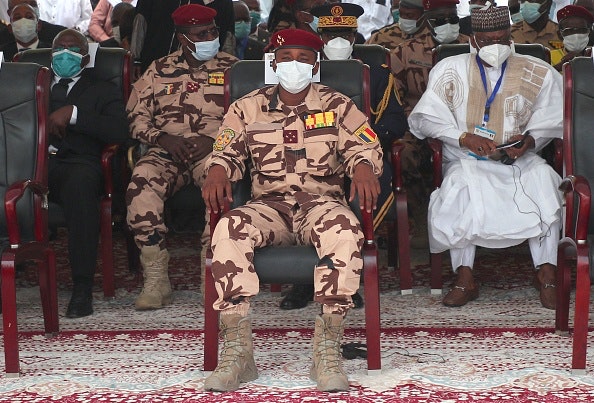
On 29 July 2021, the National Transition Council in N’Djamena presented a roadmap for the reintroduction of democracy in Chad. It also contained improvements to security, national unity and fostering the rule of law and good governance.
The roadmap was eagerly expected after the recent dramatic events in Chad. In April, a sudden advance of the insurgency group Front for Change and Concord in Chad (FACT) from its Libyan sanctuary was met by a strong military response personally led by President Idriss Déby Itno, who died on the front.
In the subsequent tumult, the President’s son, Mahamat Idriss Déby grabbed power with the support of people close to the former president. To forestall public protests they organised a National Transition Council to indicate their willingness to relinquish power.
When the Council announced the roadmap, two tangible promises stood out. An inclusive national dialogue in November and December 2021, and parliamentary and presidential elections between June and September 2022.
Read more: Chad’s ‘covert coup’ and the implications for democratic governance in Africa
As the national dialogue draws close, the key question is what prospects the coming year and a half holds for Chadian politics. This article identifies three scenarios and discusses their implications and likelihood. These are the implementation of the roadmap, a network with close ties to the Déby family retains power under guise of democracy, or a violent transfer of power.
Three potential outcomes
An implementation of the roadmap constitutes the first scenario.
Such an outcome would lead to an upheaval of the Chadian state-society relations. Idriss Déby Itno put up a democratic façade under his leadership between 1990 and 2021. But it was everything but a true democracy. Despite the existence of a plethora of political parties, violence and personal connections were the primary ways to economic privileges and political influence. These benefited militant groups and people that had been close to the Déby family for decades.
If the roadmap portends national reconciliation and the possible transfer of power, it means that large segments of the population would gain increased political influence.
Such a scenario remains unlikely. Nevertheless, a combination of pressure from civil society actors and external actors may force the Mahamat Idriss Déby-led junta to follow through on the roadmap’s promises. External actors include France and the African Union.
Even if Mahamat Idriss Déby is true to his word on national dialogue and resumption of democracy, the second scenario may be that a network with close ties to the Déby family still retains power. A network of family members, primarily Idriss Déby’s brothers and sons, are entrenched in the security forces, diplomacy, and key state companies.
Moreover, the ruling party, the Patriotic Salvation Movement, has served as a vessel for clientelism that linked elites to the former regime. A similar picture is apparent within the security sector, where senior leaders are loyal to people in power rather than the state.
Income from royalties from oil production and other export goods financed this network at the expense of the wider population, who still suffer from excruciating levels of poverty.
In this scenario, elections in 2022 would follow the script of previous elections since democracy in 1996. The ruling party will be the only one to run in all electoral districts and other parties and presidential candidates will face a range of technical hindrances.
The government may include politicians outside its existing network. But the president is likely to rotate them out of office regularly to avoid the establishment of alternative powerbases.
The third scenario is a violent transfer of power. Senior power brokers close to the former president face the risk of losing political influence and income to finance their political clients. For them, a reprise of the military coup in April 2001 may be more promising than accepting marginalisation.
In the 2000s, a thwarted coup and subsequent insurgency war were to some extent the result of disagreements among the circle close to Idriss Déby Itno on the distribution of oil income and Déby’s elimination of the two-term presidential limit. Insurgency groups in Libya may also overthrow the current political leadership in N’Djamena. The Front for Change and Concord in Chad is but one Chadian insurgency groups that benefits from General Khalifa Haftar’s need to cooperate with militias in Southern Libya to retain control.
A more ominous, but less likely threat comes from Sudan, where Vice President Hamdan Hemeti, a key power broker in the Sudanese government and a Chadian Arab, has strong links with Arab groups in Chad. He may seek to exploit the fluid situation and the increase in violence in Darfur to relaunch the proxy war with Chad.
However, Mahamat Idriss Déby is keenly aware of the danger and has moved to ensure that he remains close to France in preparation for defending the status quo should that be needed.
Chad is a major ally of France in the region. Paris showed the importance it attaches to stability in Chad in 2019 when it interdicted an insurgency column heading for N’Djamena from another Libya-based insurgency group.
High stakes
The political situation in Chad is more fluid than anytime since Idriss Déby Itno grabbed power in 1990. Doubt and fear of a coup or civil war go together with high hopes for real democratic change and reconciliation.
Nonetheless, the most realistic scenario is frustratingly familiar. The country’s political institutions are corroded by corrupt politics. So are the security institutions to a degree that make true political reforms highly unlikely.
Conversely, the actions of Mahamat Idriss Déby against Boko Haram and Libyan-based insurgents, as well as his co-option of large parts of his father’s power network, are likely to stem violent attempts to overthrow the current political settlement.
What remains is the prospect of simulated political reforms, ad hoc co-option, and continuity of practices to keep the ruling network in place.


