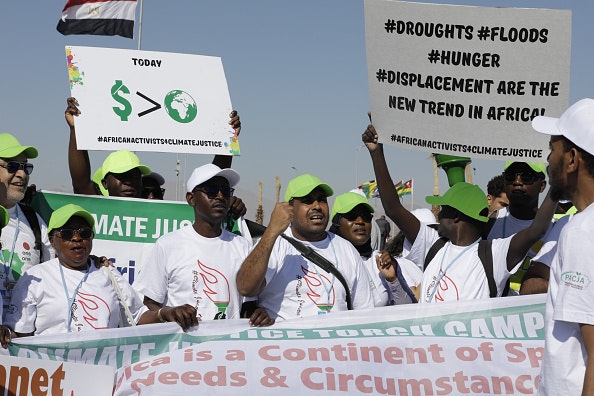
Climate finance for the African continent got a boost at the 2022 United Nations Climate Conference (COP27), with the launch of the African Carbon Markets Initiative. This aims to make climate finance available for African countries, expand access to clean energy, and drive sustainable economic development.
Led by a 13-member steering committee of African leaders, chief executives and industry specialists, the initiative promises to expand the continent’s participation in voluntary carbon markets.
Carbon markets are trading platforms which allow individuals, firms and governments to fund projects that reduce emissions (instead of reducing their own emissions).
Kenya, Malawi, Gabon, Nigeria and Togo have already indicated their intention to collaborate with the market.
Climate projects include reforestation and forest conservation, investments in renewable energy, carbon-storing agricultural practices and direct air capture. In return for funding projects like these, investors receive carbon credits – certificates used to “offset” the emissions that they continue to produce.
The African initiative’s goal is to produce 300 million new carbon credits annually by 2030, comparable to the number of credits issued globally in voluntary carbon offset markets in 2021.
However, there is considerable scepticism about whether carbon offset credits do mitigate climate change.
Two important issues
In assessing the effectiveness of carbon credits, one important concern is the concept of “additionality”. Emission reductions or removals are “additional” if the project or activity would not have happened without the added incentive provided by the carbon credits. For example, if a landowner is paid to not cut down trees, but had no plans to cut them down in the first place, the project does not deliver additional emissions savings. The landowner is paid for doing nothing and the buyer’s emissions are not offset.
Providing carbon credits to projects that would have been implemented anyway delivers zero climate mitigation, and can result global emissions that are higher than if the credits hadn’t been issued. This is a serious challenge for carbon offset markets because additionality is not measurable, despite industry claims. While project managers may claim that they are unable to proceed without funding, there is no way of knowing whether these claims are true.
A second issue is permanence. Carbon offsets have to be permanent because carbon emissions remain in the atmosphere for hundreds of years. It is almost impossible to guarantee that emissions will be offset for this length of time. But it depends on the type of offset project.
There are two types of carbon offset project:
-
those that reduce the amount of carbon that is emitted
-
those that remove carbon from the atmosphere.
In the case of carbon reduction projects, overall emissions remain positive. Examples of carbon reduction credits include investments in renewable energy. Even though the supplier of the carbon credit is not generating any emissions, the buyer continues to emit, and so the overall level of emissions is positive. Carbon neutrality – net-zero emissions – cannot be achieved using carbon reduction credits.
There should be more funding available for carbon reduction activities in Africa, but investors should not receive carbon credits to offset their own emissions when supporting these activities. Such investments would be philanthropic – for the good of the planet, not to balance the carbon accounting books.
Carbon removal projects do, however, have the potential to deliver a permanent net-zero emissions outcome. Direct air capture projects, which use chemical reactions to extract carbon dioxide from the atmosphere and store them deep underground, can meet this goal. The cost of direct air capture, however, remains very high.
Forest growth, a less costly type of carbon removal project, is less permanent. Landowners may commit not to cut down trees, but wildfires, disease, and other disruption events can release much of the stored carbon back into the atmosphere. There is still value to forest carbon credits, but they can’t guarantee permanence. Forest projects provide “carbon deferrals”. Additional forest growth projects remove carbon from the atmosphere for a fixed amount of time. There is value to this delay because it can reduce peak warming and gives society more time for the costs of decarbonising technologies to fall. While there is value to these carbon deferral projects they should not be used to generate carbon credits that are used to permanently offset the emissions produced through economic activity.
Goals of the market
The African Carbon Markets Initiative has bold ambitions. It will attract investments in Africa by firms, consumers and governments in countries that have historically contributed the most to climate change. Whether these investments result in any meaningful climate benefit, however, is unclear. Time will tell.
Existing carbon offset projects lack credibility. This doesn’t mean that carbon credits can’t be more useful in future. Being transparent about what projects actually deliver, rather than what we hope they deliver, is paramount. Given the limited resources available to mitigate climate change, we need more than good intentions.


