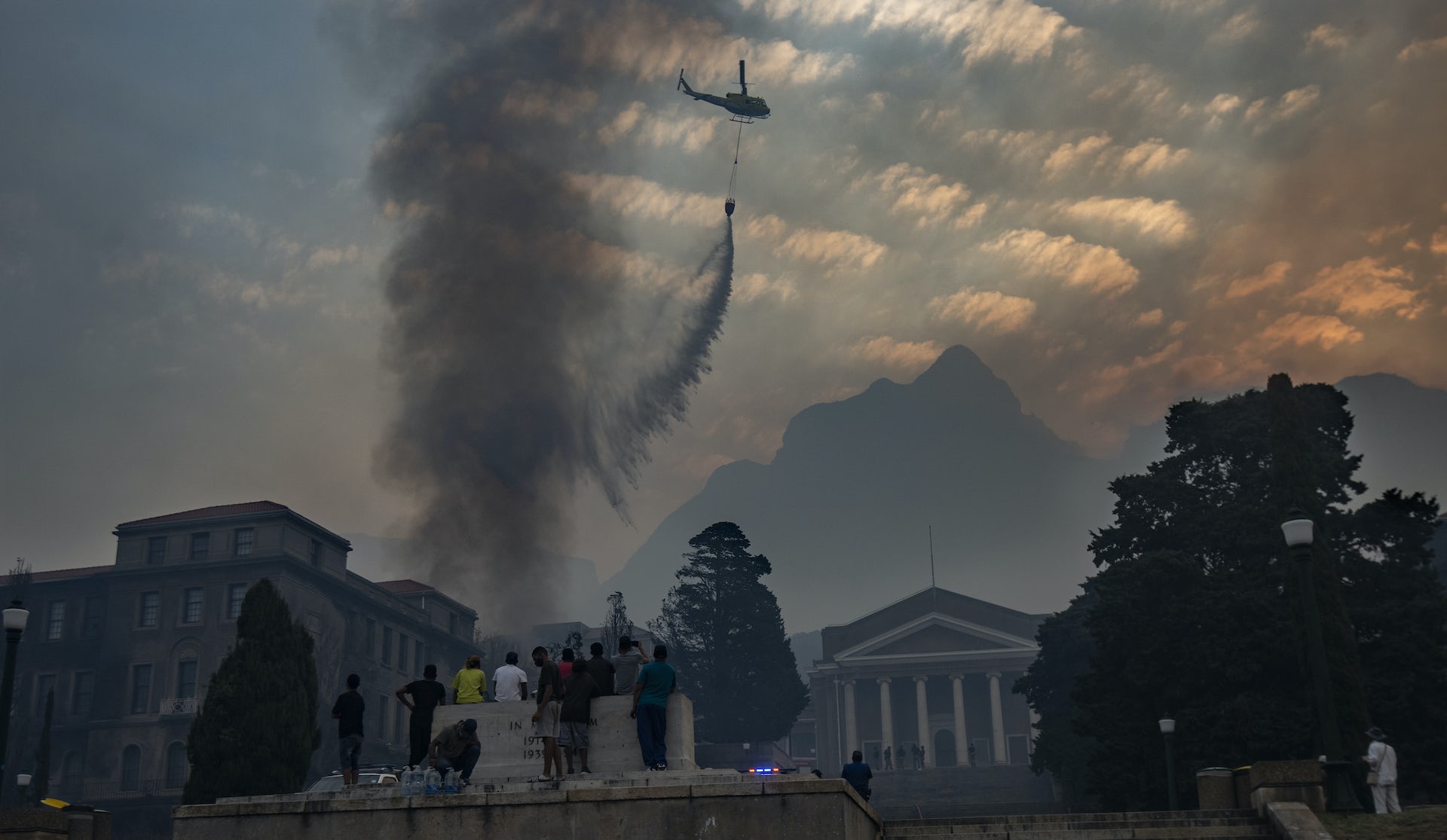
Across the globe, many recent severe wildfires have moved from wildlands into the urban periphery (the “wildland urban interface”). In their wake, they’ve left death, destruction and disruption. This has led to questions about the extent to which climate change is to blame.
A field of study called extreme event attribution has developed to answer such questions. These studies quantify the links between global climate change, regional extreme weather events, and their effects on people, property and environment.
This branch of attribution science aims to inform climate change adaptation following extreme events. It also highlights that long-term, global-scale climate change is having real impacts, now, at the scale of human experience. Attribution studies can make the public more acutely aware of climate change effects and increase support for mitigation measures.
But the rapidly growing body of event attribution analyses shows a strong bias towards extreme events in the global north. Few attribution studies have considered African events.
One of us, Zhongwei, recently led and Stefaan was involved in the first attribution study to quantify the role of climate change in the risk of extreme fire weather conditions in southern Africa.
Wildfires are complex phenomena. They can only be understood fully by considering social, environmental and weather conditions together. We know, however, that extreme wildfire events occur almost exclusively under extreme fire weather conditions. Studying associations between global warming and fire weather can provide evidence for how wildfire potential is changing and help to inform responses.
We analysed the destructive April 2021 wildfire on the slopes of Devil’s Peak in Cape Town, South Africa under extreme fire weather conditions. We concluded that such extreme fire weather has become around 90% more likely in a warmer world.
The April 2021 Cape Town wildfire
The wildfire we studied started as a small grass burn. Within a few hours it had destroyed historical buildings and priceless materials in the University of Cape Town African Studies collection.
The event received widespread coverage, documenting the resulting losses and the factors responsible for its destructiveness. Questions were raised that required further research. One issue was the role of climate change in the weather conditions during the event.
Shortly after 10 am on that day, 18 April 2021, hot, extremely dry and windy conditions took hold. These extreme conditions resulted in highly unusual fire behaviour, which made suppressing the fire exceptionally challenging. Burning embers transported by the wind set vegetation alight at least 350 metres ahead of the main fire.
We found that the observed fire weather conditions were the most extreme in the 1979–2021 autumn (March–May) record. These conditions have become almost twice as likely as a result of climate change.
How we came to this conclusion
We used multiple climate model simulations selected from those run for the Intergovernmental Panel on Climate Change assessments. These gave us many years of data to provide a robust risk estimate. This is important because our study area was the smallest over which a wildfire event attribution has been done. Over small domains, local variability makes climate change signals harder to detect. The more data you have, the better the chance of picking up signals.
Using temperature, wind, humidity and rainfall, we calculated the value of an index of fire weather (FWI) over Cape Town on 18 April 2021. Then we compared a past climate before human-driven warming with our current climate to see how often the models output Cape Town autumn FWI values that are at least as extreme.
Our results strongly suggest that the weather conditions under which extreme Cape Town wildfires can occur are happening ever more frequently in this area in a warming world. This adds to a broader body of literature indicating that climate change is increasing the potential for “megafires” in the world’s dry-summer climates.
Responding to this risk requires interpreting findings in context and engaging across disciplinary boundaries.
In addition to suitable weather conditions, wildfires require a source of ignition and fuel (vegetation that can burn). Cape Town’s mountain slopes are covered by fire-prone indigenous fynbos and alien vegetation that can burn very intensely. Given the increasing numbers of people around the mountain, some fires are bound to start.
Read more: The Table Mountain fire: what we can learn from the main drivers of wildfires
We outline three avenues for risk mitigation.
Steps to mitigate risk
Adopting more holistic fire management approaches
Focusing exclusively on fire suppression (putting fires out as quickly as possible whenever they occur) can allow very high fuel loads to build up. Experts have warned that this widely used strategy is “destined to fail”. It can also threaten biodiversity in fire-dependent ecosystems. In the fynbos biome of south-western South Africa, fast-growing alien invasive species and low-density urban expansion into surrounding wildlands enhance the risk of megafires.
Instead, researchers suggest wildfire risk management should also involve limiting flammable plants and materials immediately around buildings (“defensible space”) in the urban periphery, developing evacuation plans and conducting fire-aware urban planning.
Timely and accurate forecasting and communication of extreme fire weather risk
This must incorporate understanding of fire pathways that pose the greatest risk locally.
Doing this can aid short-term preparedness and risk reduction. The fire weather index that’s used in South Africa was developed for the savannah and grasslands of the hot, summer-rain Lowveld in the country’s far north-east. The ecology, climate and fire risk factors in the Lowveld are very different to those in the fynbos. Consequently, this fire weather index appears not to have been able to identify unprecedented fire weather risk associated with recent extreme wildfires in the fynbos biome.
Further research to inform vegetation management
It’s crucial to understand which alien and possibly indigenous vegetation can produce “ember showers”, such as those responsible for setting alight buildings and plants haphazardly on Devil’s Peak. Case studies to assess factors associated with building loss and survival can also inform locally relevant policy.


