Community forestry can work, but plans in the Democratic Republic of Congo show what’s missing:
The Congo river basin spans six central African countries: Cameroon, the Central African Republic, the Democratic Republic of Congo, Gabon, Equatorial Guinea and the Republic of Congo. It is known as “Africa’s lung” because it hosts the world’s second largest tropical forest. It covers an area of around 3 million square kilometres – almost the size of India.
This massive forest acts as a huge “carbon sink”, trapping carbon dioxide and storing it as biomass. It’s home to rich and unique flora and fauna, and sustains and shelters millions of people, providing for their needs in food and energy.
Deforestation rates are still low compared to other tropical regions, but population growth, national industrial development plans, and smaller-scale production of charcoal, crops, minerals, timber and wild meat are rapidly increasing the pressure on the forest.
In particular, most communities clear forests for agriculture and related subsistence activities – such as charcoal making and artisanal logging – to make a living. These are today among the top drivers of forest disturbance.
The good news is that potential solutions to decrease such disturbances exist. Community forestry models included in the legal frameworks of most countries in sub-Saharan Africa and beyond are among them. Models vary, but in general community forestry means the government grants communities rights over a given area which they must manage sustainably.
Formal rights is the key here, as community forest titles do not always come with the full “bundle of rights” such as access and use rights to management, exclusion and alienation.
In Cameroon, for example, communities are granted the right to establish and manage a community forest, but no tenure is given. In other words, the state can decide at any time to convert the granted area to non-forest uses.
In the Democractic Republic of the Congo (DRC) things are different. There, millions of hectares of forests are potentially available for communities. They can ask the government to grant them – in perpetuity and with tenure rights – community concessions of up to 50,000 hectares, roughly the size of Kinshasa.
This means – for the first time – granting communities formal rights to the forests they have inhabited since time immemorial, including the very important right of recourse if unauthorised resource extraction occurs.
We conducted research on the DRC model, and we found a lot of potential but also some weaknesses which we believe need redressing. The most serious was that estimates on the financial returns of the business models that communities plan to adopt are rarely conducted.
It’s essential that this is done so that planners can balance local income and sustainable management. Communities will be more likely to protect forest resources, and possibly even restore already degraded lands, if they perceive direct benefits to their livelihoods.
What needs fixing
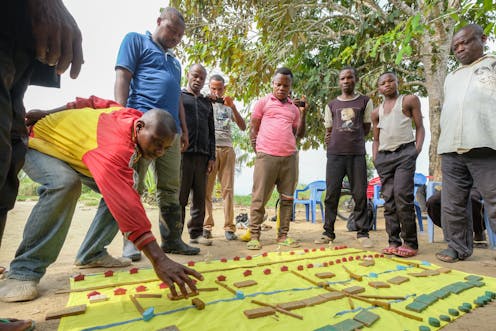
Communities usually choose what activities they want to conduct and where, but they must respect a management plan which is established by a managing committee, elected by the community itself.
Success or failure depends on a multitude of locally determined variables, for instance what resources exist or how well organised the community is. There’s no silver bullet solution and it is generally a long-term process.
Yet after tenure rights are secured, the next step is to select and maintain a sustainable business model and a solid governance structure. This is where most current models need improving to make a difference.
Two crucial fronts are worth mentioning.
Firstly, the extravagant costs of creating and managing a community concession must be vastly reduced. For instance, obtaining and using a legal title may cost up to US$ 150,000 on account of associated expenses, such as detailed mapping and inventory of the area. This is unthinkable for any community which struggles to get by daily.
Costs can be reduced by simplifying or delaying legal constraints. For example, communities could be authorised to start earning money under the community model, while preparing light inventories and simplified management plans of the area. More details will be added as time goes by.
Second, tenure rights are indeed a great first step, but communities need to see some economic benefit materialising in the short term. Why would they take the trouble to get a legal title if it did not bring them similar or more benefits than the activities they were already conducting in the forests? Among these activities are artisanal logging, charcoal-making, hunting and agriculture.
But who knows what benefits are there now and what there will be when the community concession is granted?
This is not a rhetorical question. We are currently working closely with one community, and it has already taken us about a year just to crunch numbers with them and see whether their community concession would make sense. It’s a tedious and long process, but one that must be done upfront and not kept as a second-order objective as is largely the case.
Sustainability and forest conservation are nice concepts, but they must be translated into the local livelihoods’ language to work in the long term.
Local engagement and understanding are key. Introducing a package of incentives and disincentives which make the model work at the community level is indeed a complex task, but one which will deliver a much sought after right to the land in the first place. And – if well conceived and followed through – it could improve local livelihoods and reduce deforestation and degradation in large swaths of the Congo Basin forest.

The research and development activities conducted on the topics discussed in this article are supported by the European Union and by the CGIAR Research Programme on Forests, Trees and Agroforestry through the FORETS project (Formation, Recherche et Environnement dans la Tshopo, DRC, www.cifor.org/forets).
Source: The Conversation – Articles (AFRICA)
Read more on The Conversation.
Join the fun: Add Your event | Submit a Press Release | Add your listing.


