Connecting food waste and sanitation services can help African farmers:

African agriculture is fundamental to supporting rural livelihoods and bolstering economic growth, and can benefit from technology and advances in other development sectors. One solution to help Africa’s agriculture can come from an unlikely sector: sanitation.
Most of the work in Africa’s agricultural sector is done by smallholder farmers but it’s an increasingly tough way to earn a living. Smallholder farmers have limited access to irrigation, are vulnerable to essential phosphorus supplies for their crops, pests, diseases and power supplies are unreliable where they exist. Access to new agricultural technologies, such as renewable fertilisers, are limited. In addition, they are particularly vulnerable to the effects of climate change..
What if at least part of the solution to these problems lay with another of the continent’s major challenges: in this case, sanitation.
Across the continent less than 10% of the population is connected to a sewer system; with most households using some type of onsite sanitation technology (e.g. pit latrines or septic tanks). If not managed properly, untreated excreta can have serious human and environmental health impacts. But if managed adequately, human waste can offer many opportunities: it’s rich in nutrients (nitrogen, phosphorus and potassium), carbon (for energy) and water.
All can be harnessed into productive resources using technologies that also mitigate the health risks associated with untreated sewage and solid waste. The end product can be delivered to smallholder farmers to fertilise their crops. Food waste from large markets can also be converted into nutrients for farmers.
Connecting two major sustainable development issues – organic waste from food and sanitation services and agriculture – can allow countries to develop a circular economy . This could address unnecessary loss of resources. It also presents an alternative to the business as usual use-and-dispose system, and focuses on reusing and recycling waste and resources.
The African continent has tremendous capacity and an abundantly rich natural resource base. But a lack of private sector incentives, institutional rigidity, and lack of systems to support the use of renewable fertilisers, has prevented improvements in wide scale organic waste management and alternative agricultural practices.
Our ongoing research in sanitation and food systems suggests that many African countries are well placed to benefit from this approach. In fact, one project already underway in Malawi shows how it can be done.
Malawi’s story
In Malawi, agriculture employs up to 64% of the population. Fresh food waste is a major health and urban management problem. This is because most people still shop at large, open-air markets which produce a great deal of waste.
At the Limbe Market, the largest in the City of Blantyre, more than a ton of organic waste– like over-ripe tomatoes, banana peels and cabbage leaves – is generated each day. The City Council transports the waste from market to a composting facility where it’s turned into rich, organic compost. This is then sold on to consumers.
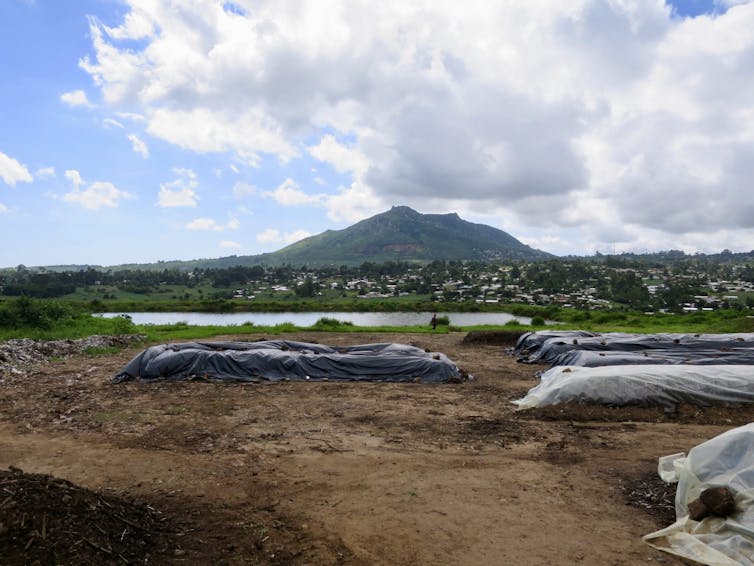
This isn’t an approach used everywhere due to transport, logistical and space constraints, but the Blantyre facility shows that it’s technically feasible to divert waste from landfills and to add value to an otherwise useless product.
Economic analysis of the benefits of composting have been conducted. It shows that financial and environmental benefits are higher than relying on landfill. In Africa, an open windrow composting can be a low-cost option for local council to manage their organic waste.
The use of recycled human excreta can also provide positive yield improvements, but community perceptions remain a barrier to adopting these fertilisers.
Support structures
Any innovative project will need input and buy-in from smallholder farmers and be relevant to their developmental needs and skills. Traditional ways of agricultural extension of providing farmers with new technologies are unlikely to succeed without adequate awareness and evidence based approaches. Extension officers can work with farmers – using their extensive knowledge – to develop on farm organic recycling systems that are low-cost and that allows them to reduce their use of external fertilisers.
Strong institutions that support circular economies and enforcement of waste management regulations are also crucial. In a circular economy, a range of policies that create standards for imports and production, tax incentives, and explicit targets can help shift behaviours and motivate industries.
In Malawi, the same type of subsidy currently in place for chemical fertilisers could be piloted for organic fertilisers (as we have found in Sri Lanka) to gauge interest and market demand.
The private sector needs incentives to reduce risk and link new products with farmers. In Malawi, borrowing money from banks comes with a 23% interest rate. Micro-credit unions exist, but loans are often small. This creates little incentive for private businesses to invest in waste management plants or marketing organic fertilisers. Banks can play a crucial role in stimulating the private sector in Malawi and creating new business opportunities.
Great opportunities
A circular economy framework can benefit African nations in improving development outcomes while reducing environmental harm. This can help nations work towards delivering on the sustainable development goals in an integrated way through linking food, waste, and sanitation systems.

Federico Davila and co-authors supported for this work were supported by the Australia Africa Universities Network
Alice Mutiti Mweetwa receives funding from The Australia Africa Universities Network (AAUN).
Dana Cordell was supported for this work were supported by the Australia Africa Universities Network
Frank Mnthambala support for this work were supported by the Australia Africa Universities Network.
Gudina Terefe Tucho works for Jimma Universitry and received funding for this work from Australian African Universities network.
Ruben Sakrabani received funding from Cranfield University Sue White Fund and the Australian African Universities Network.
Source: The Conversation – Articles (AFRICA)
Read more on The Conversation.
Join the fun: Add Your event | Submit a Press Release | Add your listing.


