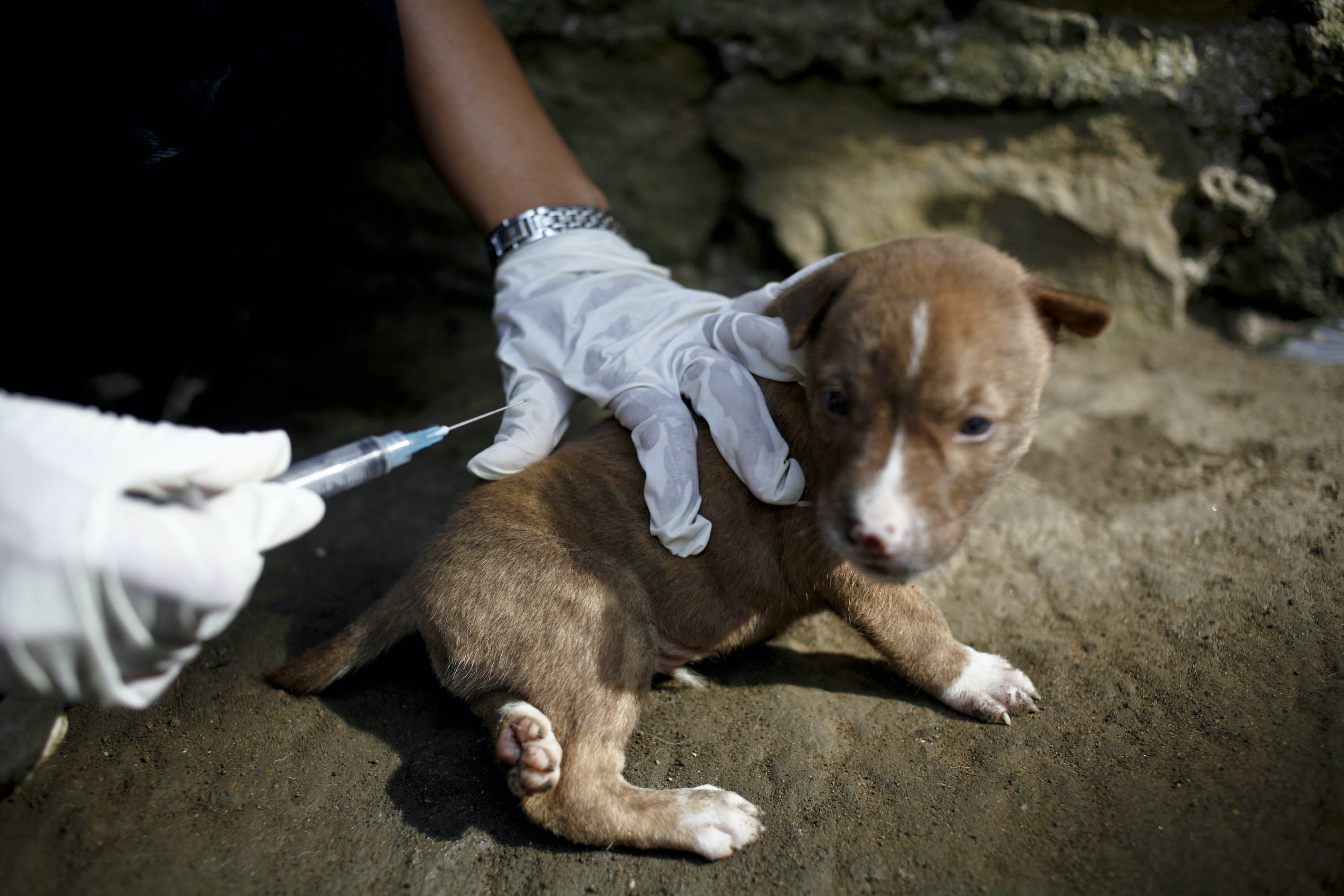
Before the emergence of the newest animal-borne disease, COVID-19, the world was in the last mile of eliminating one of the oldest animal-borne diseases – rabies.
For around 4,000 years, humanity has been contending with this infectious disease. Rabies has the highest case fatality rate of any conventional infectious agent at close to 100%. And it is almost always transmitted to people through bites from infected dogs.
A vaccine for dogs was developed as early as 1799. Widespread vaccination and other preventative measures have since saved an estimated 2.9 million human lives annually.
The canine vaccine is inexpensive and prevents transmission to people. But this painful disease continues to kill around 60,000 every year – often children under the age of 15 across Africa and Asia. Part of the challenge is that rabies control has been a victim of its own success: with millions of lives saved and vast progress in recent years, momentum for the last mile is difficult to maintain, as the victims are often the poorest of the poor living in rural communities.
Now the world is the grip of a new pandemic which sets back the fight against rabies.
Restrictions imposed to control the novel coronavirus outbreak, for example, have made monitoring rabies cases more challenging. Community health workers would ordinarily be vaccinating dogs and reporting bites, infections, and deaths. But many have been diverted to the COVID-19 response, while others have faced limitations on travel. Many government and NGO programmes in Africa stopped for a period while imports of canine vaccines were delayed by up to three months in Malawi.
Rabies control efforts must innovate and adapt to protect the life-saving gains of the last century. It’s important to maintain momentum towards eliminating deaths in the context of the new global health landscape created by COVID-19 by re-committing to surveillance, vaccination and education.
Keeping track of cases
The COVID-19 pandemic has heightened global awareness of the importance of health surveillance. This is true in terms of cases of infection as well as vaccination levels.
Canine vaccination against rabies can only be effective if it is targeted at populations where the virus exists. But it’s also important to track where vaccination has already taken place to monitor and avoid duplicating efforts. Both rely on accurate data gathering.
One solution during the pandemic has been to develop new “One Health” surveillance systems. These must link communities to veterinary laboratories and medical doctors. The Pan-African Rabies Control Network, for example, gathers key indicators for more than 47 African countries so that both the animal disease and its risk to people is properly recorded by all those who play a role in protecting public health.
Read more: What’s needed to do a better job of pre-empting disease outbreaks
The Global Alliance for Rabies Control has also pioneered a simple and robust tracking device, as well as a mobile phone application, to allow animal vaccinators to track vaccine drives in the field.
These approaches allow rabies control efforts to continue amid the pandemic. They also offer lessons for public health in responding to and recovering from COVID-19.
Better surveillance of animal-borne disease is critical for protecting human health against threats like rabies and coronavirus, but so too is vaccination. Once a COVID-19 vaccine is available, health agencies and governments will need to be able to track coverage to know how much of the population is protected and how much remains at risk.
Away from the frontline of public health, national authorities are also adapting to new circumstances, which includes revising and managing competing health priorities.
With countries experiencing the pandemic to varying degrees and scale, there can be no “once size fits all” health policy, neither for COVID-19 nor for rabies control.
This is why the Global Alliance for Rabies Control works with governments using a step-wise approach that allows for rabies control strategies to be set according to the national conditions, needs and resources.
Over the next few months, the Global Alliance for Rabies Control will work alongside the UN’s Food and Agriculture Organisation to support eight central African countries to develop strategies to tackle rabies. This partnership is also aimed at moving each nation closer towards the goal of reducing human deaths from rabies to zero by 2030.
Finally, rabies control, even before the novel coronavirus outbreak, was embracing the potential of technology to reach and connect audiences in new ways.
Educating children about rabies risks and precautions is an important element of a control strategy, particularly given the high prevalence of cases among children aged fifteen or under.
And as more children are learning virtually and remotely, rabies education has also moved online across Africa and Asia to reach those being homeschooled during lockdowns, with online lesson plans available for schools.
Meanwhile, the Global Alliance for Rabies Control continues to develop professional training for national rabies stakeholders and communities to deliver their national plans, including elements of the existing alliance’s education platform, a set of online certification courses.
Keeping momentum
The COVID-19 pandemic may have compounded other health threats like rabies and added pressure on already stretched services and authorities worldwide.
But the world can’t afford a resurgence of this disease after coming so far towards ending the misery and suffering it brings to thousands of people every year.
Rabies control efforts must adapt and innovate – but they can’t stop.


