The International Monetary Fund (IMF) recently called for an accelerated global effort to distribute vaccines to end the COVID-19 pandemic. It was a welcome step because past official statements by world leaders have fallen short of delivering specific policies to reach desperate populations, particularly in low- and middle-income countries.
The IMF was also right to recognise that the cost of containing the COVID-19 pandemic is far less than the overall benefits for the global economy of full vaccine coverage. But it could have gone further by recognising that the inefficient vaccine allocation rules currently in place must be replaced by new cooperative institutional structures and more concrete steps by the Group of Twenty (G20) countries.
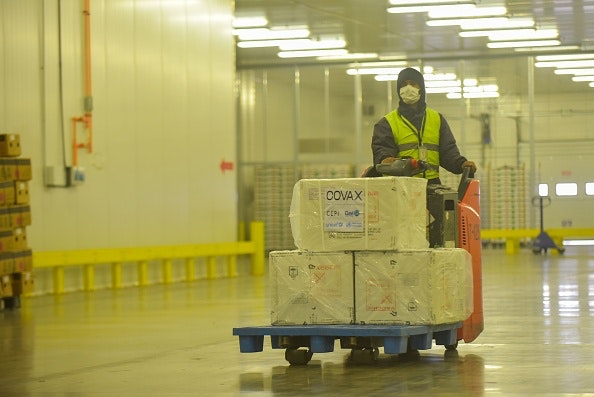
The IMF is approaching the problem too narrowly. It strongly supports vaccine donations and distribution to be carried out solely through the COVAX facility. COVAX is one of three pillars of the initiative known as the Access to COVID-19 Tools (ACT) Accelerator, which was launched in April 2020 at an event co-hosted by the World Health Organisation (WHO), the European Commission, French president Emmanuel Macron and the Bill and Melinda Gates Foundation.
COVAX was created to facilitate equitable access to vaccines. The first two pillars were focused on equitable access to diagnostics and treatment. As helpful as the arrangement has been, its model of approaching the problem has become out of date.
Since its creation last year, vaccines have become more available but distribution and other problems have become more apparent.
COVAX provided a good baseline model for expected public health needs. It was also useful for setting priority targets. The key one was to vaccinate about 20% of each country’s population as quickly as possible.
But the facility suffers from two major flaws.
Firstly, it primarily allocates vaccines in proportion to population sizes, which is not the best public health metric.
Secondly, it does not consider countries’ capacities to roll out massive immunisation campaigns.
Flaws
Setting vaccine distribution goals on the basis of population size is flawed for a number of reasons.
Firstly, it disregards the complexity of the problem. Countries are at very different stages of the pandemic. Some are suffering horrific losses and their health systems have collapsed. Others have a lack of adequate public health measures, and inadequate social adherence to these measures.
On the other hand, others face far less daunting scenarios.
Much has been said about the lack of vaccines in many African countries. But as precarious as this problem is on the continent, African countries aren’t currently experiencing the extremely aggressive outbreaks seen in India, Nepal, Brazil, and many other Latin American countries.
These cases lay bare the shortcomings of distributing vaccines on the basis of a population yardstick: the metric fails to capture the severity of the underlying public health problems facing different nations.
Criteria for allocation
Vaccine allocation, whether done through COVAX or directly, should be based on public health metrics. These include:
- The incidence rate. This measures the number of new cases of COVID-19 that occur during a specified period of time in a population at risk for developing the disease. Usually expressed as incidence per a certain number of persons (1,000, 10,000, 100,000), the rate is a measure of events, that is, the transition from a non-diseased to a diseased state, and thereby a measure of risk.
Countries at higher risk levels calculated using the incidence rate should have priority in vaccine allocations.
- The attack rate. This measures the number of susceptible people who become ill within a set period of time as a share of the total number of susceptible persons. Increases in the attack rate may suggest that a viral variant that is more transmissible is becoming dominant in a certain country.
Indeed, higher attack rates were associated with the emergence of Alpha, or B.1.1.7, in the UK, Gamma, or P.1, in Brazil and Delta, or B.1.617, in India.
Therefore, without widespread genomic surveillance, the attack rate may help in mapping the spread of dangerous variants of concern.
- Health system capacity. This is measured by the number of intensive care beds per 1,000 people in a given country, for example.
Abiding by these and other metrics for vaccine allocation would ensure that vaccines went to countries that had the greatest immediate need.
Vaccine allocation also needs to take into account the capacity that countries have to distribute them internally. Recently, Malawi burned 20,000 doses of the Oxford/AstraZeneca vaccine only 18 days after receiving them due to the risk of expiration.
South Sudan has announced that the government will send back to COVAX 72,000 doses of the Oxford/AstraZeneca vaccine, again because of the risk of expiration.
While these events are associated with increased vaccine hesitancy following rare blood clotting events associated with the Oxford/AstraZeneca vaccine, it is also the case that many countries in Africa, as well as in other regions, lack the resources to mount effective vaccination campaigns.
Without the necessary funding for these campaigns, donation of doses is not only insufficient but also a waste of life-saving vaccine doses, as the cases of Malawi and South Sudan illustrate.
What’s needed
Vaccine allocation efforts need to be guided by both equity and efficiency principles. By focusing chiefly on equity, COVAX and other initiatives are currently failing at delivering vaccine doses to address public health emergencies around the globe.
Moreover, the excessive focus on equitable distribution leaves out the capacities and resources that countries have for mounting mass vaccination campaigns.
Improving the existing structure requires concrete steps in global cooperation. This includes an agreement on the public health guidelines and metrics for vaccine distribution, actual donations of doses according to these guidelines in lieu of open-ended commitments or pledges to donate surplus doses, and mechanisms to ensure that vaccine supply chains can operate smoothly.
Designing this structure should be the main objective of the G20 in the coming months both to fight the current pandemic and to prepare for future ones.
This article originally appeared as a blog on the PIIE website.


