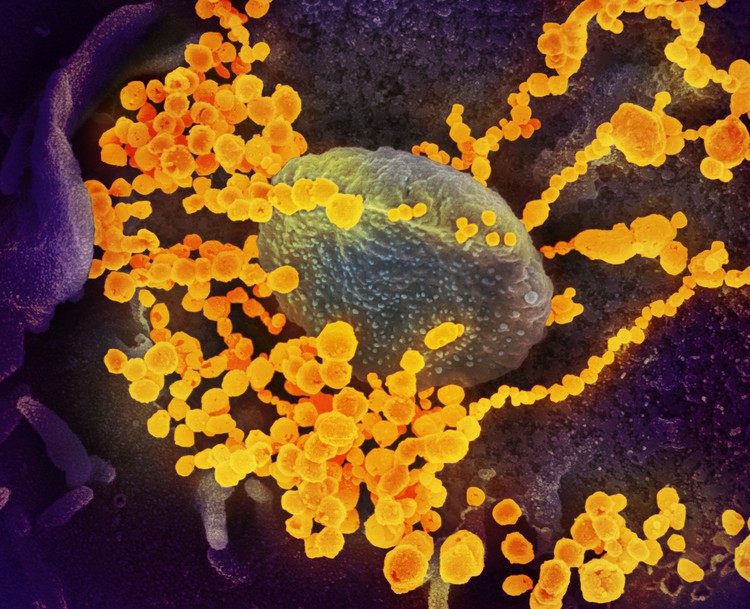
The Covid-19 pandemic and lockdown have deepened inequality on many levels, researchers have found. Image: NIAID-RML (CC BY 2.0)
- Inequality has deepened during the lockdown, the second National Income Dynamics Study – Coronavirus Rapid Mobile Survey (NIDS-CRAM) has found.
- Women, people in rural areas, the unskilled and the less educated have been hardest hit by job losses.
- Only 24% of those surveyed could work from home.
- But the new Covid-grant had brought millions of people into the grant system, with an estimated 40% of applications successful.
The Covid-19 pandemic and the nationwide lockdown have deepened inequality, especially in the job market and in education, according to a major survey released on Wednesday.
An alarming finding of the National Income Dynamics Study – Coronavirus Rapid Mobile Survey (NIDS-CRAM), was that the job losses may be long lasting. The 2.8 million jobs lost after February had not been recovered by June, according to this second NIDS-CRAM survey, based on the responses of 5,700 people.
If these job losses persist, they said, more than a decade’s worth of job gains will have been destroyed in six months.
“The evidence to date suggests that these losses may be long-lasting,” the researchers said.
The survey presentation material included a quote from Vladimir Lenin to highlight the devastation brought on by the Covid-19 pandemic and the lockdown imposed to limit its spread. “There are decades where nothing happens and weeks where decades happen,” according to Lenin.
NIDS-CRAM researchers found that about one-million people who lost their jobs during the Covid-19 pandemic fell into poverty. “The Covid-19 pandemic is a health crisis that will exacerbate the South African unemployment crisis,” they said.
Employers put 1.4 million people on leave during the lockdown and only 54% of these furloughed workers were re-employed in June, while nearly 40% were left unemployed. The remaining 6% of the workers were still on leave in June.
“From February to June 2020, workers who were poor, rural, female, unskilled and less educated have experienced the largest declines in employment,” NIDS-CRAM said.
“The percentage decline in employment between February and June was ten times higher for the poorest 50% of workers compared with the richest 25%,” the survey found.
In education, the researchers also found deepening inequality. “Wealthy children were twice as likely to attend school despite their grade being ‘closed’ compared to children in no-fee schools.”
Learners were expected to lose 40% of school days in 2020, raising the question about how they would recover this time – if at all.
“Analysis of the new school calendar shows that for grades 1, 2, 3, 4, 5, 8, 9 and 10, children will have lost between 82 and 87 schools days or 40% to 43% of typically scheduled school days in a year,” the researchers said.
They found that the prevalence of depressive symptoms doubled between 2017 and June 2020 from 12% to 24%. Those reporting extreme hunger were twice as likely to show depressive symptoms.
Like the first NIDS-CRAM survey, the second survey found that women were harder hit by job losses than men, and that wage inequality between men and women in the poorest 40% of the population increased by a factor of up to five between February and June.
“The driving force behind the widening gap is a change in working hours that has been disproportionately borne by women. This may have to do with women being employed in jobs that are less amenable to working from home, or disproportionate childcare responsibilities during the lockdown,” the researchers said. Only 24% of workers in June said that they could work from home.
A widening of inequality between rural and urban areas was another trend. In urban areas, employers by June had restored jobs, but the rural areas did not experience an employment “bounce-back”.
The Covid-19 social relief of distress (SRD) grant of R350 a month had brought millions of new people into the grant system. The researchers estimated that of the 11.3-million people who applied for the grant, nearly 40% were successful.
Women made up 34% of the recipients of the grant, and just 41% of those who received Unemployment Insurance Fund-Temporary Employer-Employee Relief Scheme pay-outs.
The researchers who contributed to the survey came mainly from the University of Stellenbosch, the University of the Witwatersrand, the University of Cape Town and the Human Sciences Research Council.
See also GroundUp’s report on the first NIDS-CRAM survey: Children eat wild plants to survive as hunger explodes
© 2020 GroundUp. This article is licensed under a Creative Commons Attribution-NoDerivatives 4.0 International License.
You may republish this article, so long as you credit the authors and GroundUp, and do not change the text. Please include a link back to the original article.