The South African education system is big (13 million learners), unequal and socially graded. Although improving, the achievement outcomes are still low, fragile and susceptible to shocks. The COVID-19 pandemic has dealt the education system a major blow, especially for poor and vulnerable learners.
In March 2020 South Africa, like most of the world, went into total lockdown, including school closures. The education system was unprepared for this. Schools, teachers and administrators were forced to build emergency remote-learning systems almost immediately. This threw the spotlight on access to digital devices, connectivity, having a quiet place to work in, and the problem of stubborn inequality.
Better resourced homes and schools were able to move to digital forms of learning and proceed with curriculum coverage. For the majority of learners, despite the best intentions, there was very little structured learning.
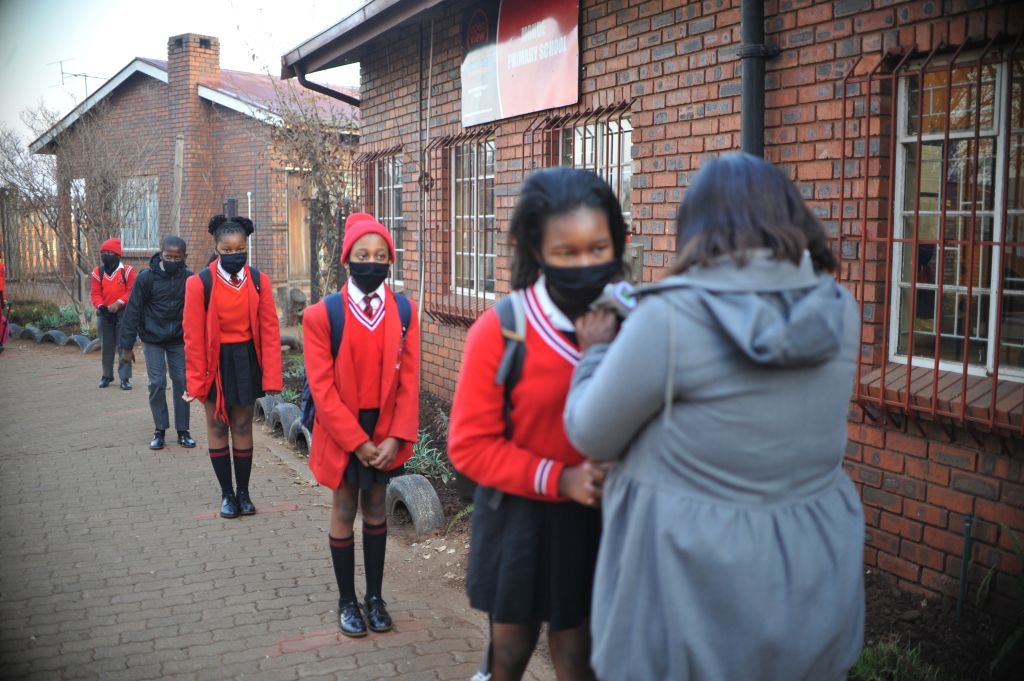
From June 2020, schools were reopened. Most schools followed a rotational timetable where learners attended school every second or third day. This rotational timetable continued in 2021.
Education scholars estimate that there was a loss of 60% of school contact time in 2020 and 50% in 2021. There were higher losses of school contact time in the less-resourced schools.
It’s uncertain exactly how much learning (knowledge and skills) has been lost and how wide the gaps may be for disadvantaged children. The global literature reports that:
- learners from poorer countries and households experienced higher learning losses,
- earlier grades were more susceptible to learning losses than secondary learners,
- learning losses were higher for mathematics than for reading and
- girls were more affected.
Learning losses in South Africa
For South Africa we estimated that the loss of school learning time in 2020 moved the education system backwards to the achievement levels as they were in 2015 – a regression by five years. The learning loss for learners from less resourced schools was 4.2%, higher than learners in more affluent schools at 3.4%. COVID-19 worsened already wide achievement gaps.
Read more: Counting the cost of lost schooling in South Africa
Studies measuring reading proficiencies in under-resourced South African primary schools in 2020 reported that grade 2 (8-year-olds) and grade 4 learners lost between 60% to 80% of a year of learning when compared to their pre-pandemic peers.
South African researchers compared pre-COVID grade 3 reading scores to grade 4 reading scores during the pandemic. They found that grade 4 home language learners were more than 1.25 years behind and English first additional language learners were half a year behind. The also found that learners were writing much less.
The World Bank cautions against underestimating the extent of the learning losses, saying that “the global education crisis is worse than we thought”.
Close the gap
Children from poorer households have missed substantially more classroom instruction time than children from higher-income households. Education researchers caution about the effectiveness of digital technology and e-learning to support learners who are out of school. The consequences of lost contact classroom will be felt for years.
In January 2022, South Africa’s Department of Basic Education gazetted that all learners would fully return to school and introduced measures to catch up on teaching and learning that was lost during school closures.
We don’t have a playbook of how learning recovery should happen. Drawing on past experiences and experiences in other countries, South Africa should consider implementing the following four components for education and learning recovery:
- consolidation and trimming the content of the curriculum,
- increasing the efficiency of instruction,
- supporting out-of-school education programmes and
- nurturing the well-being of all actors involved in education.
While it’s unclear whether the schooling system can recover the two years of disrupted schooling and learning time, the education system should use this moment to reduce content in the National Curriculum Statement. Countries like the Philippines, Guyana and Tanzania have revised the primary school curricula to focus on practical learning and literacy and numeracy skills.
South Africa reduced the content of the curriculum just for 2020. This reduced curriculum should form the basis of a new curriculum, especially for primary schools which should focus on building foundational knowledge and skills.
To enhance learning, younger children must be in stimulating environments which focus on first language development and reading with meaning, basic computational skills and writing simple sentences. Learners must demonstrate proficiency in reading, writing and computation before progressing to the next grades.
For most learners from vulnerable homes and who, pre-COVID, had low learning outcomes, in-person schooling is the only place for meaningful learning opportunities. To increase the efficiency of instruction, the first step is to keep schools open and try to avoid future school disruptions.
Educators and learners must be at school every day. Pre-COVID, South Africa experienced high levels of learner and educator absenteeism and latecoming. No more learning time should be lost in schools and school time must be used efficiently and effectively with high quality engagements. National, provincial and district officials must monitor and mitigate the levels of absenteeism of educators and learners.
Learning recovery requires both in-school and out-of-school programmes. Small group out-of-school tutoring programmes should be expanded, especially for high school learners. Primary school learners must be supported by parents with reading activities and cognitively stimulating educational television and radio programmes.
The last two years of learning under COVID-19 conditions have placed tremendous strain on everyone in the education system (learners, educators, administrators, departmental officials). We must recognise how tired the system is and move forward gently, avoiding too many ambitious changes to an already fragile education system.


