South Africa’s tourism industry has been rocked by the murder of a German visitor during an attempted robbery. The development resulted in negative media publicity, with a potentially adverse impact on the country’s image as a safe tourist destination. This comes at a time when the sector is recovering from the devastating effects of the COVID pandemic. The Conversation Africa’s political editor Thabo Leshilo asked Kaitano Dube, an expert in ecotourism, about tourism’s place in South Africa’s economy.
How important is tourism to South Africa’s economy?
Tourism is critical to South Africa’s socioeconomic development. It provides numerous benefits, including employment and entrepreneurship opportunities and much-needed foreign currency earnings. It also provides funding for conserving the country’s natural heritage in several protected areas.
In 2018, the tourism sector directly contributed 2.9% of South Africa’s gross domestic product (GDP) and 725,000 jobs. Its indirect contribution brought the share to 8.6% of GDP and 1.49 million jobs. Foreign visitors directly spent R82.5 billion, equal to 9.2% of national exports – the second most important export sector. Local tourists spent another R9.49 billion.
How has the sector grown – before and after COVID?
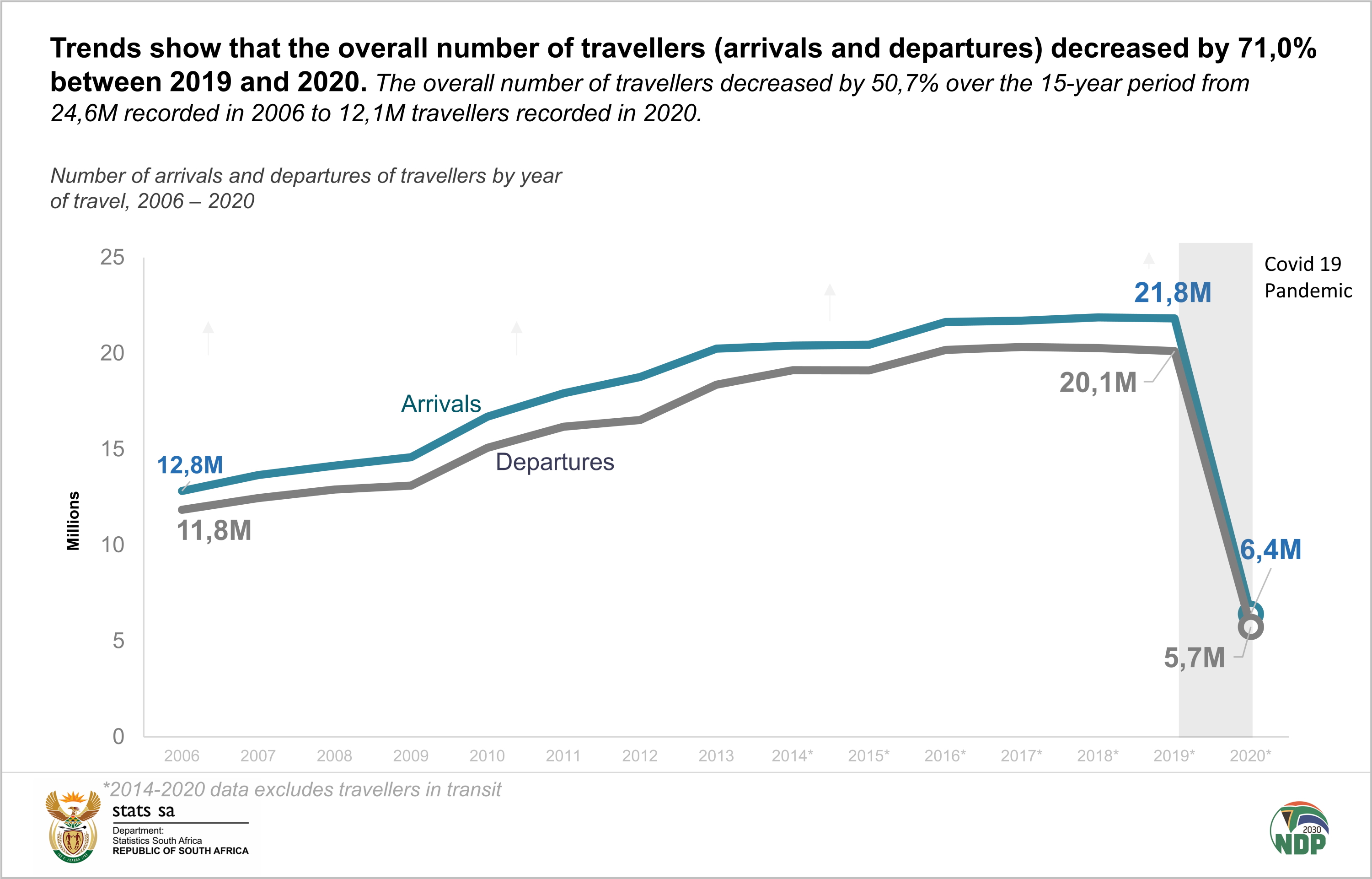
South Africa’s tourism industry had been growing steadily over the years before the outbreak of COVID in 2019. But the sector is vulnerable to disease outbreaks, economic downturns and other shocks such as climate threats. This was evident during the devastating 2018 “Day Zero” drought in Cape Town.
There was a dip in 2009 due to the 2008 global financial crisis. Before the COVID pandemic, the tourist arrivals stood at about 5.1 million. They plunged to about 2.4 million in 2020 before sliding further to about 930,000 in 2021.
Disease outbreaks on the continent also adversely affected the tourism sector around 2015 and in other periods due to the adverse impacts of Ebola in Guinea, Sierra Leone and Liberia.
The 2015-2018 drought in Cape Town also slowed tourism growth in the country, because the city is in one of the biggest tourism nodes.
As of the second quarter of 2022, the domestic tourism market had recovered by 139% as compared to 2019 base year which translates into 9 million domestic trips.
What are the main drivers of tourism in South Africa?
A rich cultural and natural heritage makes the country a must-visit tourist destination. The wildlife in 20 national parks and 10 UNESCO World Heritage sites ensures that tourists are spoiled for choice.
The coastline is another draw card. And South Africa is a gateway to other African tourist destinations.
Most tourists who come to the country travel for holidays (40%). Others visit friends and relatives (36.9%). Business meetings, incentives, conferences and exhibitions account for about 8% of visitors.
Prior to the COVID pandemic, most African tourists came from Zimbabwe (1,1 million), Lesotho (827 000) and Mozambique (681,530). The most important international markets outside africa were the US (183,134), Germany (149,531) and the UK (220,830). By the 2nd quarter of 2022 the domestic tourism market revenue grew to R24.4 billion representing a growth of 294.4% compared to 2019, while international market tourism spending went down to R11.1 billion marking a 36.4% decline.
What are the main threats to tourism and how are these being addressed?
The tourism sector in South Africa faces multiple threats, but nothing the country cannot handle. As noted earlier, climate change is an existential threat.
The deadly floods in KwaZulu-Natal province in 2022 also damaged the international airport and holiday homes and prolonged beach closures, with far-reaching implications for tourism recovery in the province and the country.
Diseases and pandemics remain a threat. The aftershocks of COVID can be seen in rising inflation, high interest rates and the fear of global recession. These threaten the sustainability of tourism in South Africa.
The political and social instability in the country, as seen in frequent mass protests and xenophobia, threaten the flow of African tourists. There is a clear decline in arrivals from countries such as Zimbabwe and Lesotho, which have been the targets of anti-immigrant rhetoric by some politicians.
Such hate campaigns against African countries threaten South Africa’s attraction as a destination for tourists from such places. Other negatives include the instability caused by infighting within the governing African National Congress – which resulted in the deadly July 2021 riots. This taints the country’s image and brand.
Other critical challengers include the knock-on effects of the Ukraine-Russia war. It has created uncertainties that have harmed the global tourism market, with implications for South African tourism. These can be worsened and compounded by internal challenges such as energy security.
Read more: South Africa’s economy has taken some heavy body blows: can it recover?
The South African tourism market is quite resilient, but the issue of tourists’ security warrants attention. The country is generally perceived as a risky destination due to high crime levels.
Other concerns pertain to air connectivity after several airlines went under due to mismanagement and the COVID pandemic. Some local airlines were placed under administration or went insolvent – including SA Express and Comair.
Read more: Airline tie-up for Kenya and South Africa: possible rewards, and risks
Mango, a subsidiary of South African Airways, is still battling to return to the skies after a severe cash burn.
It is not clear what impact new airlines such as Lyft, and the expansion of airlines such as SAAirlink, FlySAfair and Cemair will have on tourist movements across the country.