Curious Kids is a series for children in which we ask experts to answer questions from kids.
How do jellyfish find their food? Also, how do they poop? (Ethan, 4, Johannesburg)
Thanks for these great questions, Ethan! They’re just the sort of thing that scientists like me who work on jellyfish absolutely love to discuss. After all, jellyfish are the coolest animals on the planet. They can sting and paralyse prey, and eat whatever they can fit in their mouths.
You can find jellyfish in every ocean around the world and there are many different types of jellyfish, many with amazing colours and patterns.
Let’s start with the first part of your question: how do jellyfish find their prey?
Most jellyfish are “passive” feeders. This means that they float through the water eating whatever they happen to pass in the water and can fit in their mouths; anything from tiny shrimp and krill to small fish.
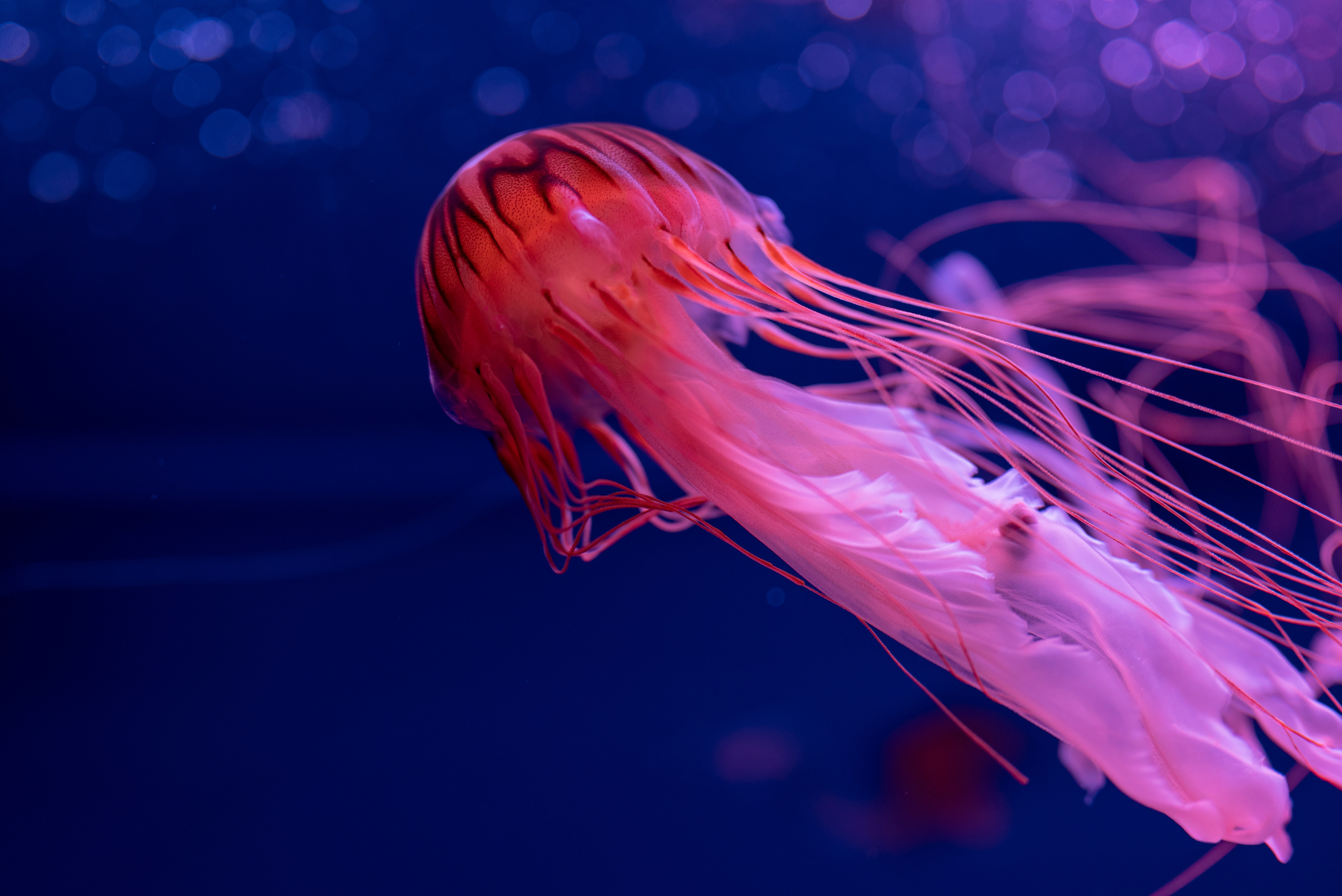
Jellyfish typically have a large blubbery bell – the bit that you would think of as its head – and from underneath it hangs what we call oral arms. In the centre of these oral arms, you usually find the mouth of the jellyfish, attached to the underside of the bell. Many jellyfish also have long tentacles that hang down from the bell. Both these oral arms and tentacles have stinging cells with spiky barbs that can sting and capture prey as the jelly floats past it, often also injecting a poison to paralyse their prey so it can’t move.
They then slowly move the prey to their mouths by pulling in their tentacles and oral arms. In this video, you can see a jellyfish contracting its tentacle and pulling a small fish through the water to its mouth, then into its stomach cavity.
Eye spots
Here’s another cool fact when it comes to jellyfish and their eating habits. There are more than 200 species of jellyfish in the world: some of them have many tiny mouths – hundreds or even thousands! – instead of one big mouth. These tiny mouths are scattered along their long oral arms and can each take up prey from the water as the jelly floats past.
Read more: Why we’re working to put Africa’s jellyfish on the map
You might also wonder how jellyfish can see, since they don’t have eyes in the same way that you and I do. What they have, instead, are things called rhopalia, or eye spots. These are usually around the edge of the bell I talked about earlier. Their eye spots help the jellyfish tell what’s up from what’s down and to stay the right way up while floating through the water. Their eyes can also sense changes in light. All jellyfish species’ eye spots give them these abilities – and in some species, like the box jellyfish, their eye spots are very well-developed so they can see and hunt their prey. In this article, you can see a video of a box jellyfish hunting.
I don’t know about you, but I’d be pretty scared if a jellyfish was hunting me. Don’t worry, jellyfish aren’t interested in hurting human beings: they may sting you if you get too close, but they don’t prey on people.
All about poop
So, now we know how jellyfish eat. On to your next question: how do they poop?
Once a jellyfish has moved its prey into its mouth and stomach cavity, the prey is digested by enzymes – enzymes are special chemicals that help them break down their food and get all the nutrients they need to survive. It’s a lot like what happens in our own tummies after a meal. Any waste – that’s poop – then comes back through the mouth. That’s because jellyfish only have one opening into their stomach, so waste comes out the same opening as food goes in.
There is still so much scientists don’t know about jellyfish: that is why there are more and more of us studying them. We are trying to find out what species there are and where in the world we can find them. We want to know what jellies eat and also what animals love to eat jellies. Maybe you can grow up to become a scientist and help us study jellyfish one day? I sure hope you do!
In the meantime, if you want to watch videos of jellyfish at an aquarium any time of the day or week, check out the jelly cam at the Monterey Bay Aquarium.


