Curious Kids: should I be scared of lightning?:
Curious Kids is a series for children in which we ask experts to answer questions from kids.
Should I be scared of lightning? (Callan, 10, Johannesburg)
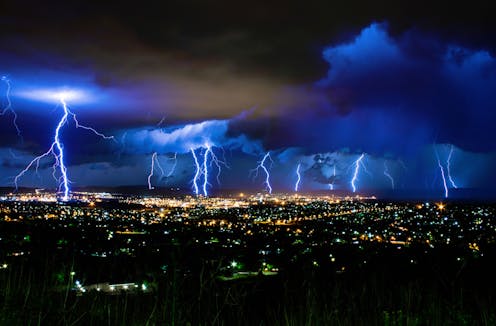
Big storms can be very scary. When a storm happens dark clouds appear, heavy rain often falls, winds are gusty and unpredictable, and lightning flashes across the sky.
Lightning happens all over the world. But it’s particularly common near the equator, where the strongest and most energetic thunderstorms take place. Storms can lead to all sorts of potential dangers, like flooded streets or homes, fallen trees, fires, and roofs being blown off houses.
Lightning can also be dangerous for people. No one knows how many people are killed every year by lightning, but it could be up to tens of thousands worldwide. In South Africa, around 250 people are killed every year, mainly in rural areas where there’s little protection when storms take place.
So there are many reasons to be careful when there’s a big storm. But there are also ways you can protect yourself to avoid lightning.
Many different cultural traditions believe that lightning is caused by gods or spirits. Some people believe that lightning can be prevented by planting certain trees or shrubs near the house, covering mirrors, or placing car tyres on the house roof.
There is no scientific evidence that any of these things make you safer from lightning.
But there are some practical things you can do to keep safe when lightning strikes.
-
If you are outside, keep on low ground and stay away from trees, poles and water. Or stay undercover in a car or building. Do not shelter under a tree;
-
If you are inside, stay away from windows, doors, metal objects and water (including taps);
-
Don’t use electrical equipment (including phones).
It’s also useful to know what lightning is – understanding something can make it seem less scary.
What is lightning?
Lightning happens when air moves around in the atmosphere, forming thunderclouds.
Dark clouds are the first visible sign that a storm is coming. Clouds are formed when air rises upwards in the atmosphere, cooling as it goes. We know that air is moving around because we can feel it – this is wind. As air rises, moisture condenses and clouds begin to form. Storm clouds reach high in the atmosphere and are spread sideways by the wind. This is what makes the dark heavy cloud shapes you see when a storm is brewing.
Once the clouds have formed, the air currents keep rising. If the air is cold enough, water droplets inside the clouds can freeze into ice crystals. These are lighter than liquid drops of water, so they get pushed up to the top of the cloud. The heavier liquid water droplets fall to the bottom of the cloud.
Because ice crystals and water droplets have different electrical charges, the tops and bottoms of storm clouds develop different patterns of charges as the storm cloud gets bigger. There are also differences in electrical charges between the bottom of the cloud and the land surface. If the charge difference is big enough, electrical energy suddenly flows from one place to another.
This flow of energy is shown as a lighting flash. A single lightning flash lasts for only around 0.0001 seconds but can reach temperatures of up to 30,000°C: five times hotter than the surface of the Sun. This huge amount of energy is why lightning can cause so much damage when it strikes.
You’ll also have noticed that thunder and lightning happen together. Thunder is formed when air molecules rapidly expand, forming a sound shock wave that travels through the atmosphere at the speed of sound, much faster than a plane can fly.
But the lightning flash travels much quicker than thunder, at the speed of light – that’s 300,000 km per second. (The top speed for cars on most highways is 120 km an hour.) The difference between the speed of light and the speed of sound can be used to estimate how far away the lightning is.
A good experiment is to slowly count the seconds between a lightning flash and when you hear the roll of thunder. You can then work out whether the storm is getting closer to you (if the time difference is getting shorter) or further away (if the time difference is getting longer).
A city like Johannesburg in South Africa has thunderstorms in the summer. But the lightning South Africans experience is still only a third of what is found in the world’s lightning hotspot: the mountains of Uganda, Rwanda and Democratic Republic of Congo.
Hello, curious kids! Have you got a question you’d like an expert to answer? Ask an adult to send your question to africa-curiouskids@theconversation.com. Please tell us your name, age, and which city you live in. We won’t be able to answer every question but we will do our best.

Jasper Knight does not work for, consult, own shares in or receive funding from any company or organisation that would benefit from this article, and has disclosed no relevant affiliations beyond their academic appointment.
Source: The Conversation – Articles (AFRICA)
Read more on The Conversation.
Join the fun: Add Your event | Submit a Press Release | Add your listing.


