Curious Kids is a series for children in which we ask experts to answer questions from kids.
Why are there so few craters on Earth? (Ivon, 11, Butterworth, South Africa)
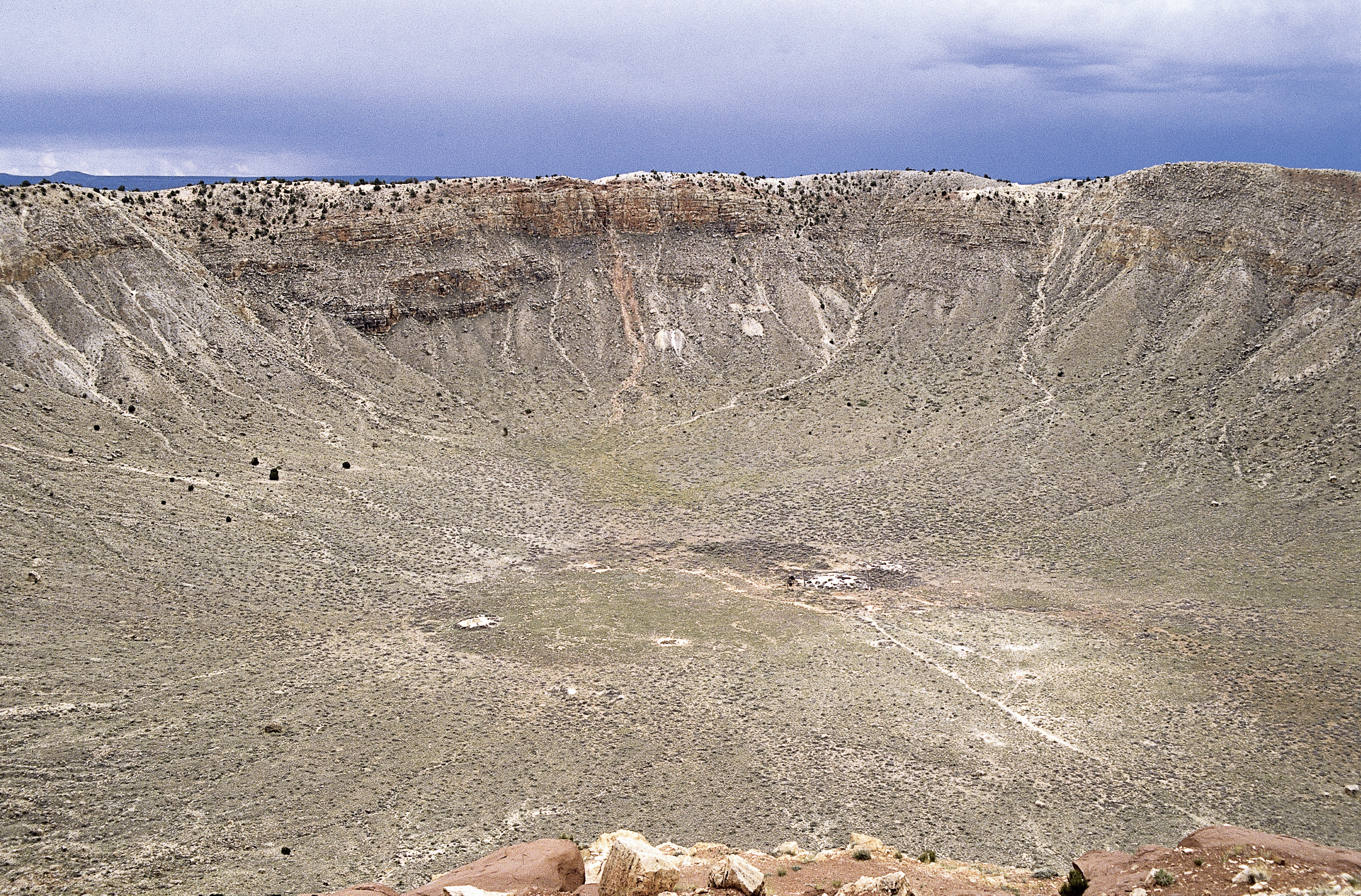
Thank you for the great question, Ivon. Scientists call these “impact craters”: a bowl-shaped depression in the rocky crust of a planet, moon or asteroid that is caused by another rocky piece of rocky space debris slamming into it really fast. This high-speed collision – over 36000 kilometres per hour! – releases a huge amount of energy that causes a lot of destruction.
I am a geoscientist who studies impact sites in Africa and on other continents. Scientists like me have identified the remains of around 200 impact craters across our planet. Some people might think that 200 is quite a big number, but you are right – compared to the Moon and the other rocky planets and moons in our solar system, it is exceptionally low. There are several reasons for this.
Understanding Earth
The first reason is that Earth’s surface is continuously changing because we live on a geologically active planet. Impact craters are relatively shallow, so these “dents” in Earth’s rocky crust (the surface bit we can see with our eyes) can be easily buried or wiped out by erosion. For instance, the giant, 160-km-wide Chicxulub crater in Mexico that wiped out most of the dinosaurs and many other species 65 million years ago is only 1-2 km deep and is hidden beneath younger layers of sediment. In contrast, the much older, equally famous, Vredefort crater in South Africa has experienced millions of years of erosion by rivers or glaciers so that the crater itself has been erased. Fortunately, ring-shaped patterns in the rocks indicate that something very violent and unusual happened in the distant past.
The next reason is that two-thirds of Earth’s rocky crust is hidden beneath the oceans. We actually know less about many parts of the deep ocean floor than the surfaces of other planets in the solar system. Could there be lots of craters hidden beneath the oceans? We don’t know the answer for sure, but probably not, because there is something unusual about Earth’s oceanic crust: it is much, much younger than the continental crust on which we live and the crusts of the Moon and other planets.
Let me explain. Since the 1960s we have known that new ocean crust is being created almost continuously along giant rifts (called mid-ocean ridges). At the same time, other parts of this basalt crust are sinking back into the mantle along subduction zones. This is like a conveyor belt and is part of what we call plate tectonics. The key point is that we can’t find any oceanic crust that is older than 200 million years. This means that any crater that formed more than 200 million years ago in an ocean has been destroyed. That sounds like a long time, right? But it’s a very small time window compared with the 4.6 billion years that Earth and the other planets have existed.
The presence of so much deep water on Earth means many smaller asteroids that would definitely make impact craters on dry land do not produce craters in the oceanic crust. This is because the water column absorbs all or most of the impact energy, maybe creating a short-lived tsunami but leaving no other trace.
Earth’s atmosphere also plays a role in reducing the number of impact craters. One of the remarkable observations from the Apollo programme that studied the moon was that every single sample showed signs of high-speed impacts, down to micro-craters. Up until the 1970s many scientists thought the reason there were so few craters on Earth compared to the Moon was because our atmosphere caused the small asteroid debris to burn up (as meteors) and slow down as it passed through the atmosphere so that it didn’t have enough energy left to blast a crater in the crust.
In some cases the atmosphere even “bounced” asteroids back into outer space, much like you can skip a stone across a pool of water. As there will be many more smaller craters – because there are many smaller asteroids – we can see that the atmosphere acts as both a filter and a shield to reduce the number of impacts.
Read more: Why the Moon is such a cratered place
Looking for impact craters
Finally, we need to consider our own role in your question: how good are scientists and ordinary people at recognising impact craters? There are thousands of craters on Earth, but craters can also be formed in other ways, such as volcanic eruptions and sinkholes.
So, geoscientists need to carefully collect and examine all the evidence before they can confirm that a crater (or, rather, what’s left of it) was formed by impact. Impact crater studies didn’t really exist until about 60 years ago. Up until then, most of the craters on Earth were thought to be caused by volcanic eruptions.
Then scientists working on underground military nuclear explosions started looking into the physics of shock waves in rocks caused by the nuclear explosions. Others began scrutinising the thousands of craters on the Moon as preparation for the Apollo moon landings. When they went looking for similar craters on Earth, they started to find unusual evidence that the rocks in and around some craters had been affected by exceptional shock pressures and temperatures that could not be explained by volcanic eruptions.
Read more: What a Moroccan crater reveals about a rare double whammy from the skies
So geoscientists have to be a bit like detectives: we need to collect evidence to prove that a crater was caused by an impact rather than by anything else. Every few years another crater is added to the list as the proof is presented to, and accepted by, the international geoscientific community.
There are many hundreds of possible, or suspected, impact craters on Earth that await confirmation or rejection, including dozens right here on the African continent where we live. Even though it’s really big, Africa still has only 20 confirmed impact sites and is definitely underrepresented in the global list. This may be partly because of its geology but it is also because too few African geoscientists are looking for impact craters in Africa – maybe one day you can join us, Ivon, and help in the search!


