Democracy in peril: Burundi’s referendum will cement Nkurunziza’s grip on power:
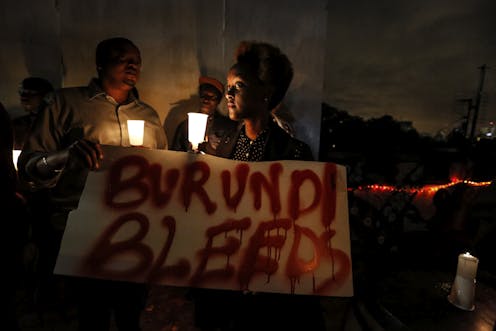
The citizens of Burundi, the small country in Central Africa that borders Tanzania, Rwanda and the Democratic Republic of the Congo, are about to vote in a controversial referendum.
The vote is likely to result in a set of amendments to Burundi’s constitution that will effectively consolidate the dominance of the ruling party, the National Council for the Defence of Democracy – Forces for the Defence of Democracy, or CNDD-FDD. This is a decisive moment in the country’s history. It may prove to be the final nail in the coffin of the Arusha Accords of 2000, which led to the constitution being ratified in 2005. And it may lead the country further down the path of electoral authoritarianism.
The upcoming poll will, among other things, ask Burundians to vote on whether the president’s term should be extended from five years to seven. This could allow sitting President Pierre Nkurunziza, who has been in power since 2005, to rule for another 14 years when his term expires in 2020.
If the referendum goes Nkurunziza’s way, it will also be a further blow to ordinary Burundians, who live in a state of hardship and adversity. Nearly half a million people have fled the country since 2015 and are now living as refugees in neighbouring countries. Food insecurity is rampant.
Dismantling peace accords
The ruling party tried to amend the constitution in a similar fashion in 2014. That was a bid to constitutionally allow Nkurunziza to run for a third term. The attempt failed to gain the necessary political support in parliament.
The party’s decision to select Nkurunziza as their candidate in the 2015 elections anyway was followed by mass protests and demonstrations. Such resistance is unlikely this time around, partly because of the crisis that followed: a trail of assassinations, arbitrary detentions, enforced disappearances, torture and sexual violence against those who raised their voices in opposition.
Nkurunziza has been remarkably successful in neutralising internal opposition during his years in power. He’s also withstood pressure from the region and the international community. Meanwhile, he has gradually undermined the very foundation for the peace that allowed him to lay down his gun and get elected in the first place: the Arusha peace agreement under which the 2005 constitution was ratified.
Burundi’s 2005 constitution was crafted to enable power-sharing between the country’s main ethnic groups, the majority Hutu, and the Tutsi and Twa minorities. This followed a history of ethnicised political conflict and civil war.
The referendum represents a dismantling of the core principles agreed in the peace accords.
Towards electoral authoritarianism
The build-up to the referendum has offered ample proof of Burundi’s continually degrading democracy. The campaigns for the constitutional referendum have included divisive language and what amounts to hate speech – this in a country that has experienced cycles of ethnically framed civil war and mass atrocity.
The ruling party and its youth wing, the Imbonerakure, have used violence to threaten and intimidate opponents of the referendum.
The government recently banned the international and national free press, including the BBC and the Voice of America.
And if constitutional amendments go ahead as proposed, there will be a further reversal of Burundi’s democratic gains. As author and scholar Stef Vandeginste has noted, the constitutional reforms do not create a complete upturning of the previous balance of power between Burundi’s ethnic Hutu majority and the Tutsi minority. However, they do cement the power of Nkurunziza’s ruling party through a virtual “one-party system”.
Echoing global and regional trends
Burundi isn’t the only African state to push through constitutional amendments. Uganda’s Yoweri Museveni passed amendments removing term limits in 2006 and age limits in 2017. Rwanda’s Paul Kagame also scrapped presidential limits in 2015.
The relative calm on the surface of these countries may lend itself to an international agenda of weighing short-term stability over political participation and human and civil rights. It may tempt the idea that perhaps strongmen who serve as presidents for life are simply part of a patrimonialist tradition that’s specific to African democracy.
For Museveni and Kagame, however, the costs of imposing their rule have been relatively low. They have not had a sizeable minority against them. They have remained strong military rulers under a light coating of civilian governance. Their authoritarianism can hold without too much exercise of widespread abuses and atrocities, which gives the impression of stability – at least to observers who are intent on not looking too closely.
Nkurunziza is in a different position. His ruling party has had to share power with others. It is historically riven with internal divisions, as the recent armed conflict and failed coup d’état in 2015 reveal.
He is not a classical founding father, but an everyman who must contend with other leaders in the party and the opposition, with their own sectarian politics, constituents, and charismatic personas.
The Burundian referendum can also be understood as yet another sign of the current global wave of counter-democratisation. There are worrying trends of ascendant authoritarian populist leaders around the world. These are big men like Russia’s Vladimir Putin, Turkey’s Recep Tayyip Erdoğan and Rodrigo Duterte in the Philippines.
One of Burundi’s own international allies, China, has recently scrapped its presidential term limits. This comes at a time when the partnership between Africa and China has begun to eclipse relations with Western governments.
The European Union and the US criticised Nkurunziza’s third term. China did not. It has focused on Burundi’s food and development issues but has largely ignored its political crisis, a strategy that the Burundi government welcomes and interprets as China’s acceptance of its state sovereignty.
Nkurunziza’s advance toward a presidency that could become a lifelong rule is worrying. If the referendum goes his way – and it almost certainly will – more of Burundi’s hard-won democratic freedoms will most likely be sacrificed.

Mimmi Söderberg Kovacs has previously held a research grant from the Swedish Research Council for a project on electoral violence in Africa hosted at the Nordic Africa Institute (NAI) in Sweden, in which both Angela Muvumba Sellström and Jesper Bjarnesen participated.
Angela Muvumba Sellström receives funding from the Swedish Research Council.
Jesper Bjarnesen does not work for, consult, own shares in or receive funding from any company or organization that would benefit from this article, and has disclosed no relevant affiliations beyond their academic appointment.
Source: The Conversation – Articles (AFRICA)
Read more on The Conversation.
Join the fun: Add Your event | Submit a Press Release | Add your listing.


