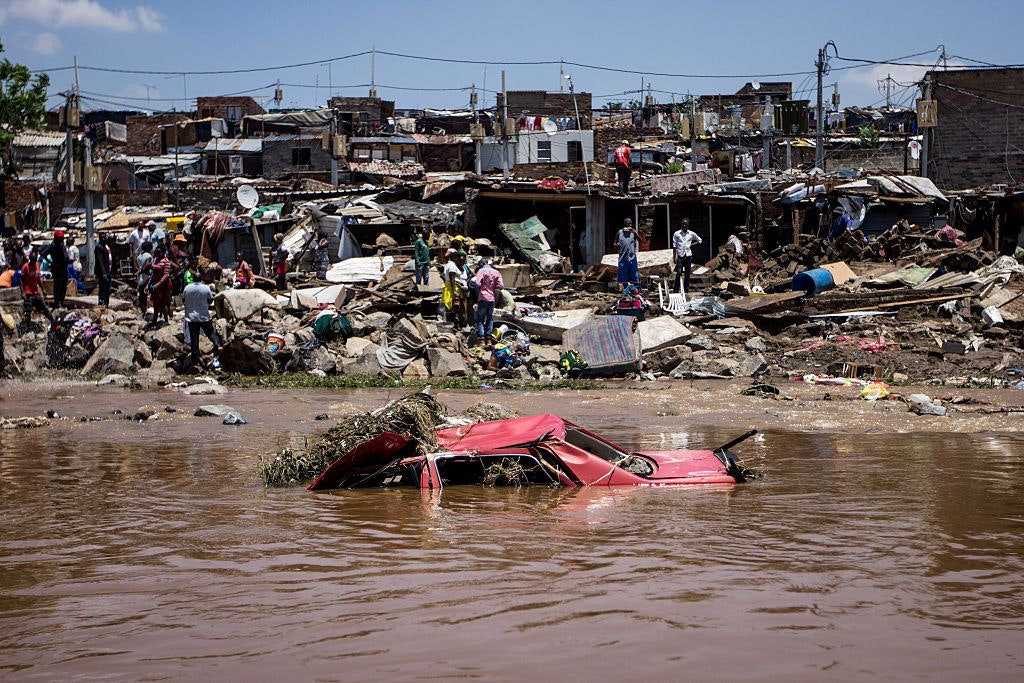
Following heavy rains in November 2016, flash floods washed through the Setswetla informal settlement adjacent to Alexandra in Johannesburg. The floods destroyed several dozen houses and a child was killed.
Local government and civil society first responders were on the scene quickly to assess the damage and affirm their support to the residents. A textbook response would have involved steps like assessing damage, providing first aid and shelter, and developing a strategy to prevent a future, similar disaster.
In this case, however, things worked a little differently. Urban policy makers and humanitarian actors did indeed provide aid to those who lost their houses. But they also planned for an oversupply of material – all in an effort to prevent tensions from escalating. This response pointed to the fact that relief actors in situations such as those in Alexandra have to engage with underlying vulnerabilities and divisions in the communities they serve. Textbook models don’t account for this.
Alexandra is one of the oldest black urban settlements in South Africa, going back to the early 20th century. It is close to the affluent business district of Sandton and along the Jukskei River. A relic of the country’s apartheid regime, the settlement saw rapid growth during the 1990s. Today it has an intimate mix of formal and informal dwellings. It remains one of South Africa’s poorest and underserviced settlements. It suffers from chronic violence, poor infrastructure and a range of environmental hazards.
The risk of the Jukskei River’s flooding, especially around the Setswetla informal settlement, is well known. With rapid urbanisation and growing pressure on land, more immigrants and rural South Africans have come to settle on the unsolidified landfill on the banks of the river. At the same time, continuous illegal dumping of construction waste in the river’s catchment area has increased the risk of flooding.
The greater Alexandra settlement has been plagued by violence too. Its inhabitants were exposed to state violence for decades under apartheid. In the democratic era since 1994, Alexandra has been the site of xenophobic violence with rising levels of anti-immigrant sentiment, ethnic division, and a sense of inter-group competition.
Violent crime, intercommunity tensions, political violence and distrust between the state and citizens constitute a complex landscape for urban policy makers.
Alexandra is a place where there’s a stark interplay between violent conflict and disaster risk. But little attention is given to policies that could mitigate such compounding risk. As conflict and vulnerability to disasters increasingly intersect in urban settings, city officials and local disaster managers need to know how to address these issues.
I conducted research that involved interviews with experts to shed light on how the conflict–disaster interface manifests itself in Alexandra. Disasters, such as the floods, and their recovery reveal the urban politics and conflicts in the affected communities as well as in wider urban governance.
Paying attention to the urban disaster managers’ understanding of place-based risk sheds light on the continuously compounding vulnerability and lack of sustainable disaster risk reduction in communities at risk.
Paradoxes of disaster recovery
Disasters in urban contexts take place in the context of a complex set of actors and diverging institutional mandates. Spatial inequality, histories of conflict and everyday politics pose challenges to disaster risk reduction. This is true even when a solid legal and policy framework for disaster management is in place.
My research shows that Johannesburg’s local government and humanitarian actors are faced with tough choices of prioritising, managing and balancing resources, locations and constituencies. In many situations, they go to great lengths to prevent inter-communal conflict in the event of disaster.
For example, they devised creative practices in their relief operations. Instead of supporting just victims of the disaster, charity organisations and city agencies would provide relief to other beneficiaries too. Instead of distributing 100 blankets, they would hand out 200 so that neighbours not directly affected by the flood received something too in an effort to avoid tensions.
Another example was that non-governmental organisations and local government would provide construction material for residents to rebuild their houses. This was done in the full knowledge that the location of the houses made the residents vulnerable to flooding. Nevertheless, this kind of support was an efficient way to provide shelter, stability, and a sense of dignity.
Challenging traditional approaches
The choices urban actors make are often faulty when viewed through the lens of traditional standards for this kind of work. Their decisions challenge many of the assumptions made by traditional humanitarian and disaster risk reduction models.
They also highlight the inevitable trade-offs and politics involved in dealing with marginalised communities. One of those trade-offs is the focus on the short term, at the expense of sustainable urban risk reduction.
In addition, based on their own risk assessment, residents opt to live in Setswetla because it is close to economic opportunities. Also, they lack better options.
Current conversations around climate-related hazards and other forms of so-called “natural” disasters often fail to link such risks to the communal, political and social conflictual dynamics. Natural hazards are, however, intimately linked with rapid urbanisation, informality, the legacy of apartheid, and chronic violence.
It is therefore time to present a more comprehensive picture of the risk landscape in urban settlements. It’s time to look at the adaptive strategies and choices urban managers and inhabitants make in the presence of compounding urban risk. Their choice to engage with some risks, but not with others, determines today’s urban planning and tomorrow’s urban risk landscape.


