Dug out houses along Burra Creek South Australia. Early miners from 1845 lived in these dugouts until the early 1850s.
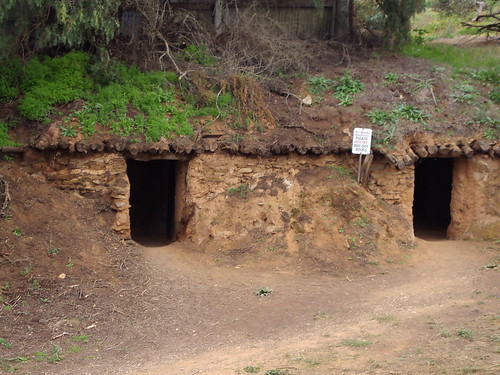
Image by denisbin
Burra was the largest inland town in Australia in 1850 and much bigger than places like Brisbane. The Victorian and NSW gold rushes of 1851 changed all of that forever. Burra is not mch bigger today than it was in 1850.
Copper was discovered in 1845 by two shepherds, William Streair and Thomas Pickett. Streair told Henry Ayres about the location of the copper whilst Pickett told Francis Dutton of the Kapunda Mine. Streair was given £3 for the information and Pickett was rewarded with £10, a team of bullocks and £1 a year for life!
Two companies were formed to take out mining leases but Governor Grey insisted the area by surveyed first at a cost of £20,000. The two companies joined together to raise the money agreeing that a card drawn out of a bag would decide the “winner” of the mine area. Dutton’s group, called the Princes Royal Mining Group or the Nobs was one, and Ayer’s group, called the South Australian Mining Association or the Snobs was the other group. Ayer’s group, the Snobs drew the lucky card. Ayers went on to become premier of South Australia seven times, and Ayers Rock was named after him. He lived in Ayers House on North Terrace at one stage. The Nobs extracted no worthwhile amounts of copper from their area of the survey.
The mine commenced on September 29th, 1845 and within a few hours the first load of ten tons of red copper oxide was loaded on drays for the journey to Adelaide. The mine was to provide not only great wealth for the shareholders but also for the state of South Australia. It helped stave off bankruptcy for SA and it gave rise to the first major settlement apart from Adelaide, whilst providing the capital and impetus for a railway into the mid north.
The so-called Nobs did operate mines at Burra but they recovered only £7,000 worth of copper. Ayer’s Snobs, on the other hand, produced £4.7 million worth of copper. At a later date a third group attempted mining at Burra, the Bon Accord Mine on the boundary of the Snobs land. It too was a failure and did not produce adequate returns for its shareholders. The mine at Burra was worked with underground shafts, which reached depths of 183 metres. The extracted ore averaged over 20% of copper in the first thirty years. Water was always a major problem in the mine; hence the huge pump known as Morphett’s pump. It began operations in 1860 after a convey of 40 bullock drays dragged it to Burra from Adelaide. It worked for the next 17 years without a pause, using ten tons of firewood each day. The big mine in Burra closed in 1877.
Burra Burra Township.
Burra is not an Aboriginal word as some might surmise. It was not uncommon for shepherds to have Indian assistants with them whilst tending the large flocks of sheep in this district. William Streair, who discovered copper at Burra was accompanied by an Indian shepherd and it was he who provided the Hindustani word for “big big” which is “burra burra” for the name of the town. This word was so appropriate as Burra was to become the biggest copper mine in the world in its day.
By 1849 Burra could boast of a smelter of its own and a large mining workforce, from both Cornwall and Wales. At the beginning Burra was very much a company town with the company providing houses for the miners, and a doctor service too – but at a cost to the miners. Money was deducted from everyone’s wages to cover housing and medical services. When wages were reduced by Henry Ayers in 1848 South Australia had its first labour strike. The company directors used assistance from the police to break the strike and they even banned the sale of the Adelaide newspaper in Burra when it published an editorial critical of management’s treatment of its miners! Miners could never buy a house, only rent it, and they were forced to use the medical services of the company doctor. The company’s benevolence came at a cost for the miners. Yet despite this style of management Ayers became premier of SA seven times, including 1867-68.
Kooringa, the central part of the present Burra township, became the first company town in Australia in 1845 and was a privately owned town. In 1848 the government surveyed a town called Redruth which provided a police station and gaol for the settlements. Later in 1857 another private township was surveyed called Hampton (an English settlement). This township had 22 dwellings by 1872, a Wesleyan chapel and more. The stone ruins of this deserted township are still visible on the hills above Redruth Gaol. Other private towns surveyed in the area were Aberdeen and New Aberdeen (Scottish settlements), associated with the Bon Accord mine, and Llwchwr, a Welsh settlement. These private towns and the government town were separated from Kooringa (present day Burra) by the Monster Mine and the smelting works.
Despite the provision of the township by the company there were still about 1,500 people living in dugouts on the banks of Burra Creek even in 1850. Although the dugouts were whitewashed inside, ventilation was poor, they were subject to flooding, and disease was common as all rubbish was dumped outside in the creek. Outbreaks of typhus and typhoid fever were common. To avoid these problems the company announced in 1851 that it would no longer employ any miners who lived in the dugouts. Burra Creek rises near Mt Bryan and flows east towards Morgan, petering out before it reaches the Murray.
This Big Seven image was automatically curated and published with WP Robot plugin – CLICK HERE to learn more about WP Robot for WordPress – a massive time and money saver.
Visit the MyPE YouTube Channel.


