Dugongs: looking to the gentle sea creature’s past may guard its future:
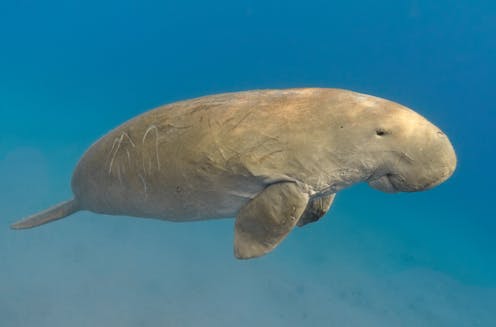
Most people look rather blank when asked if they know what a dugong is. Some may be aware that it’s a sea cow, something similar to the manatee. But they don’t know much more. This is a shame for two reasons.
The first is that dugongs (Dugong dugon) are beautiful, gentle creatures. A large adult reaches up to 2.6m and weighs about 300kg, which is comparable to the weight of a large adult tiger. They’re also rather rare: they are found only in the Indo-West Pacific region, from Mozambique in the west to New Caledonia in the east, and are considered vulnerable to extinction.
The second reason is that by tracking and understanding dugongs’ history, scientists can make good, informed decisions about marine conservation in the future.
Conservation of species requires robust scientific data. There is a lot of information about some of the remaining dugong populations and their decline in certain parts of the species’ range. But there has previously been no data on their broad-scale population genetic structure throughout their Indo-Pacific range, and how isolated or connected all these populations were. That’s where our work comes in.
Because dugongs are now so rare in the wild, my colleagues and I decided to investigate the genetic population structure of dugongs using material available in museum collections in Europe. This gave us an idea about how dugong populations are connected and how genetically different they are from each other.
Our study revealed the existence of previously unknown, new genetic lineages in the Indian Ocean. It highlighted other surprising results. Perhaps the most important was that all individuals from Madagascar – today a very small and little understood population of dugongs – belonged to a unique and genetically divergent population. This indicates that this population deserves a high conservation status.
We also found a significant drop in the genetic diversity in the Indian Ocean samples collected after 1950, most likely as a reflection of the rapidly decreasing population sizes in the region.
“Bring back the mermaid”
Dugongs are interesting for many reasons. The name of the Order Sirenia to which they belong indicates that early sailors mistook them for “sirens” or mermaids, as illustrated in the legend of Odysseus.
Dugong teats are located under their front flippers (in their “armpits”), so it may look like they are cradling an infant when suckling a calf. Or they may surface with some strands of seaweed covering their heads, appearing like long – albeit green – hair. These characteristics may have led to these animals being mistaken for mermaids.
There are five species in the Order Sirenia, but only four remain alive today: the West Indian manatee (Trichechus manatus), the Amazonian manatee (T. inunguis), the West African manatee (T. senegalensis) and the dugong. The fifth one, the Steller’s sea cow (Hydrodamalis gigas), became extinct within 27 years of its first discovery. This can be ascribed entirely to human consumption: sealers killed these animals for their tasty meat and used their uniquely hard skin for dugout canoes.
All Sirenians are herbivorous marine mammals, feeding almost exclusively on seagrass. Their inclusion in the Afrotheria clade, whose living members belong to groups that are either currently living in Africa or are of African origin indicates that they are truly African.
And, while the other members of the Sirenia are found in the Atlantic, the dugong is the only sea cow that is found in the Indian Ocean and western Pacific. This highlights its deep African connections.
Unfortunately, the dugong is one of the many marine mammal species currently threatened with extinction. While its overall conservation status has been evaluated as “vulnerable” by the International Union for the Conservation of Nature, it appears to be rapidly reducing in numbers in many locations. In fact, it’s believed to be “endangered” in parts of its range.
Collecting samples
Some marine mammals, like the dugong, are difficult to study in the wild. There are a few reasons for this: these animals either occur far offshore; are solitary; or their deep diving lifestyle makes them inaccessible to researchers. In the dugong’s case, however, it seems that the decline in animal numbers is the biggest hurdle to in-depth studies. In these cases, museum collections are a valuable resource to help us better understand the species in question.
So our work started with investigations into the availability of samples in the form of skeletal material – teeth, tusks or bones – in museums. These could provide a crucial source of dugongs’ DNA. A number of European museums agreed to work with us. Historically, scientific expeditions of European powers led to the description and collection of exotic animals. These specimens were used to build important research collections in European museums, as well as to provide material for public exhibitions.
Our sampling took place over three years and involved travelling to most major Western European natural history museum collections.
We managed to gather samples from 176 dugongs in this way, which originated from countries throughout the original range of the dugong and dated as far back as 1827. This allowed us to piece together the phylogeography of the species: we were able to consider the population genetic structure of individuals with respect to their geographic distribution.
Our study was also able to provide a likely geographic origin for those samples that did not have any information in this regard, because unknown samples would have been grouped with samples of known geographic origin.
Historical knowledge
This study added to our understanding of dugong biology. This will, hopefully, contribute to its conservation because it highlights previously unknown vulnerable or even isolated populations. With this knowledge, conservation organisations and governments will know where to invest resources to protect the species and prevent its extinction.
Our work also highlights once again how important historical knowledge is if we want to make good and informed decisions for the future. About one third (35.03%) of the samples used in our study originated from one of the largest marine mammal collections in the world, the Natural History Museum in London, UK.
In our increasingly fast, future-oriented world, these kinds of studies highlight the importance of museum collections around the world as repositories for representatives of past populations.
Leslee Parr of San José State University and Richard Sabin of the London Natural History Museum contributed to the research on which this article is based.

Stephanie Plön received funding from the Western Indian Ocean Marine Science Association (WIOMSA; WIOMSA-Marg II program), Ocean Park Hong Kong Conservation Fund (OPHKCF; grant id: 4030000112) and from the Convention for Migratory Species (CMS), Abu Dhabi Office, United Arab Emirates (grant-id: SSFA/CMSAD/2011/009). Stephanie currently works for the Bayworld Centre for Research and Education (BCRE).
Shane Lavery does not work for, consult, own shares in or receive funding from any company or organization that would benefit from this article, and has disclosed no relevant affiliations beyond their academic appointment.
Source: The Conversation – Articles (AFRICA)
Read more on The Conversation.
Join the fun: Add Your event | Submit a Press Release | Add your listing.


