Satellites have been sentinels in space, examining the earth since the 1960s to detect changing weather patterns, land use, deforestation, melting ice caps and fire patterns. They have also been used to identify atmospheric dust emissions.
Global inventories of the world’s major dust sources point to dry lake basins, many of which are in Africa. Etosha and the Makgadikgadi, for example, are large natural dust emitters in southern Africa. Fine sediment from these basins can travel to the oceans, where it acts as a nutrient for primary marine organisms. Saharan dust from North African basins is even known to reach the Amazon and Caribbean, where it has a fertilising impact on the rain forest but is detrimental to coral.
Closer to the source, the dust can also affect flora, fauna and soil, especially if the dust is salty. The finest dust particles can be inhaled and may even enter the lungs and bloodstream.
Dust clouds show up regularly in space imagery and point to source areas. Some of these are remarkably persistent: the same areas can be seen to emit dust year after year. As researchers, our primary question has been the precise origin and cause of dust in drylands, since the source areas would tell us more about the composition and impact of the dust and how to control it.
Our recent study involving more than 300,000 satellite snapshots, covering South Africa over an 11-year period, pointed to persistent dust emissions in the western Free State province. Unlike natural dust in remote locations, which has limited consequences, soil loss in the middle of South Africa could influence air quality and threaten future food security.
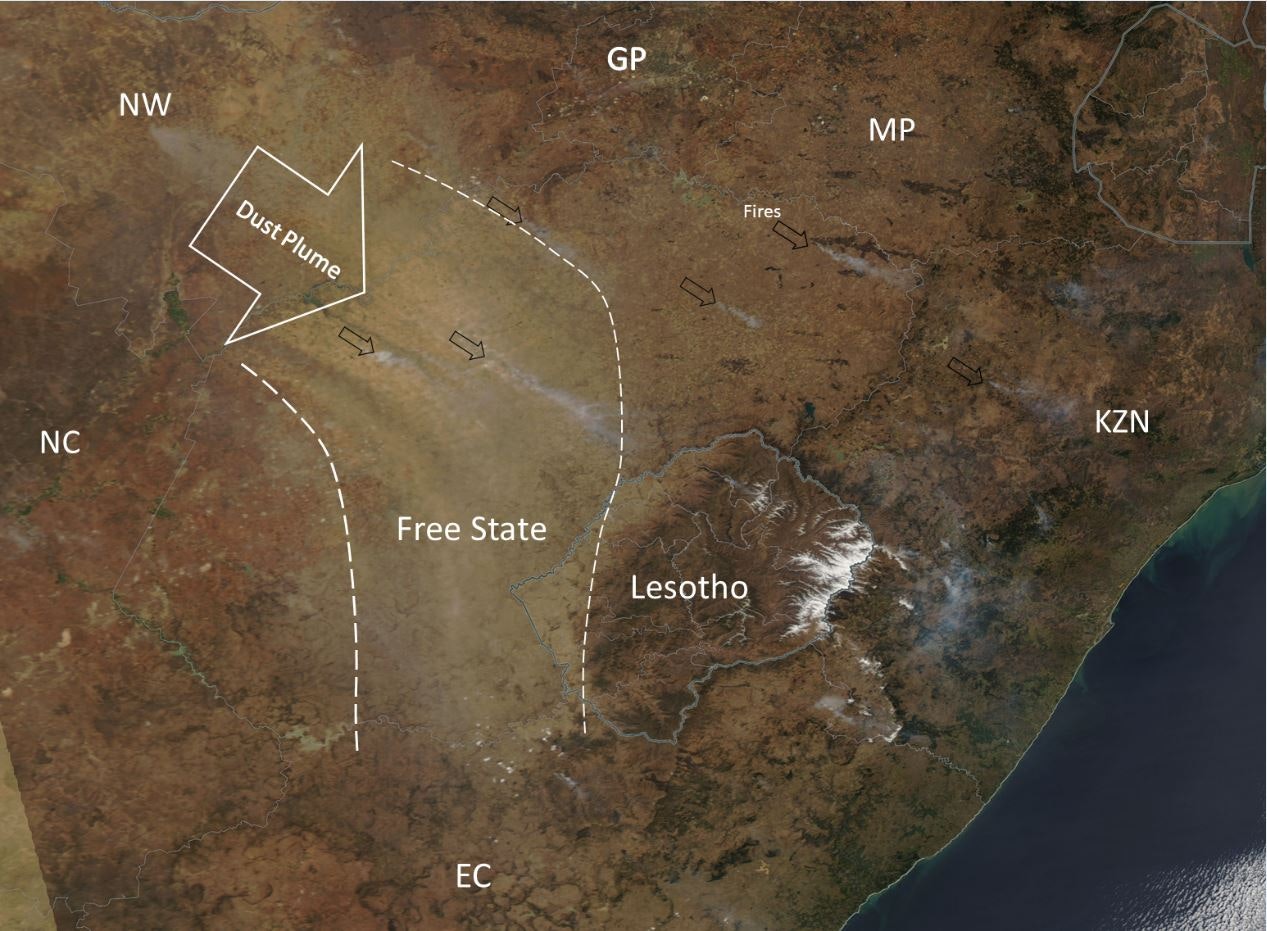
The study suggests that South Africa has few major natural dust sources and it appears that the dust is largely caused by the human response to drought conditions. The western Free State is primarily home to rain-fed maize agriculture and relies on summer rainfall. The timing of rainfall can be erratic and delayed, especially during a drought, as was seen in 2015 and 2016.
It was during this period that we identified the largest dust plumes by far, originating from an area of 30,000 square kilometres. Satellites showed clouds of dust from the Free State reaching the Indian Ocean and neighbouring countries.
South Africa’s major dust sources in the satellite record are largely caused by human activity, since delayed rains may result in the land remaining fallow, as confirmed by crop statistics from the Department of Agriculture, Forestry and Fisheries. The department reported a decline in maize cover and a pronounced increase in fallow land for periods in our 11-year image record when most dust was being emitted.
Fine dust also constitutes a loss, since sediments provide a useful service. Fine particles act as nutrients, and may include carbon, retain water, and generally improve the soil quality. Soil loss is regarded as detrimental in the long run, with an impact on food security. Soil is not a resource that can be renewed on human timescales.
Dust also allows for the transfer of microbiological material. Project associates from the University of Pretoria are currently examining whether dust sources carry a genetic fingerprint and how to ascertain the biological impact of its fallout.
While conducting our study with colleagues from the Agricultural Research Council, we also noted individual field conditions that were responsible for the emissions. We learned that some farmers were practising soil conservation methods, primarily by retaining maize stubble, which may act as a wind barrier.
Given future drought scenarios, it would be useful to identify farming practices that could conserve soil during difficult years, but also consider longer term land use changes that would suppress dust and, for example, promote carbon storage. Dust in the Free State atmosphere is a symptom of problems and challenges that require wider awareness, aimed at both farmers and policy makers.


