Education can help protect sawfishes in Mozambique and Madagascar:

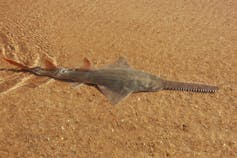
Of all sharks and rays worldwide, sawfishes – related to stingrays and manta rays – are considered to be the family at greatest risk of extinction. The long, toothed saw – which gives them their unique appearance – also makes them extremely vulnerable to entanglement in fishing nets. Their numbers have fallen because they are caught accidentally in industrial fishing nets. In addition to that, they are targeted by some fishermen because their fins can fetch high prices.
There are five species of sawfish globally. Two can reach around seven metres in total length (including the saw), making them the third largest members of the shark and ray family.
Sawfishes were formerly common along both the west and east coasts of Africa. Until a few years ago there was no knowledge of whether they still inhabited these waters, or if populations had plummeted as they have done elsewhere.
I set about addressing this gap six years ago. Since then, I have interviewed more than 500 fishers in six different African countries. I collected information on when and where people last caught sawfishes, how they used them and what their local value was. My research showed that sawfishes are now locally extinct from many parts of West Africa, but are still encountered – at least occasionally – by fishers in Madagascar and northern Mozambique.
Working in fishing communities and engaging in the lives of fishers has provided me with some insights into how sawfishes can best be protected in countries like Madagascar, as well as an understanding of the approaches that won’t work.
In the two developed countries where sizeable sawfish populations still exist – Australia and the US – an important step in preventing further declines of these endangered species is to declare them protected under national law and to prohibit activities that threaten them. So catching and killing of sawfishes is banned.
This is an effective approach in countries with the capacity and funding to enforce such laws. But in developing countries, a different approach is needed – a “bottom-up” approach in which communities take the lead. And for that to happen, scientists need to convey the implications of their research to the people who rely directly on the natural resources around them, in relevant, easy-to-digest ways.
The challenge
Sawfishes are not legally protected in most African nations. And even if they were, legislation is rarely an effective approach in countries with little or no capacity to enforce species protection laws.
In addition, fishers who catch sawfishes value them as sources of income (through the sale of their fins, meat, and occasionally other parts) and food. Artisanal fishers along the coasts of Madagascar and Mozambique are some of the poorest communities in these countries; they often live in remote rural areas and have few alternatives to fishing as a way to make a living.
Unless fishers are provided with livelihood alternatives, any efforts to prevent sawfish mortality could be considered to compromise their immediate wellbeing. Fishers are unlikely to sign up to an approach which will mean more hardship for them.
What can be done
We need to reduce the number of sawfishes being caught in fisheries, and ensure that their habitats, especially coastal waters and mangroves, are protected. These two steps would have far-reaching and long-term benefits.
But in my view, the only way to achieve these goals is by encouraging communities to become caretakers of the natural resources they rely on for their own survival. And to achieve this, they first need to understand why these goals should matter to them.
The right educational tools can be used to explain that freshwater and marine ecosystems, fished responsibly, provide food and saleable goods, while mangroves protect coastal communities from storm surge and erosion. The communities themselves can then understand the trade-off between short-term, personal gain and longer-term, communal value, and can choose which path they wish to take.
My insight from working in fishing communities is that as a scientist, I have a duty to explain my findings, their implications and encourage communities to engage in developing strategies to address conservation issues. This benefits the communities as well as the species and habitats that need protection.
To this end I developed a short educational film and a story book. These both aim to convey the importance of sharks and sawfishes as part of healthy marine and freshwater ecosystems. They also point out the many ways in which communities stand to benefit from the sustainable use of sawfishes and other aquatic resources.
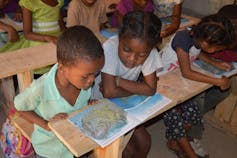
The film was made in multiple languages for both Mozambican and Malagasy audiences to ensure it could reach the widest possible audience. These resources have also given audiences beyond Africa insight into the lives of fisherfolk and the specific challenges facing sawfish conservation in these places.
The experience has taught me that we may be missing opportunities to use stories built around our work, to inspire interest and change where it is most needed: at community level. Armed with the right knowledge and understanding of why protecting mangroves, coastal waters and their inhabitants is important, communities can be the caretakers of these natural resources, both for their own benefit and for the planet’s.

Ruth H. Leeney's research in Mozambique and the development of educational materials for Mozambique and Madagascar was funded by NOAA Fisheries grant NA15NMF4690193. She was funded by the New England Aquarium Marine Conservation Action Fund, the Rufford Foundation, the Swiss Shark Foundation and the Save Our Seas Foundation.
Source: The Conversation – Articles (AFRICA)
Read more on The Conversation.
Join the fun: Add Your event | Submit a Press Release | Add your listing.


