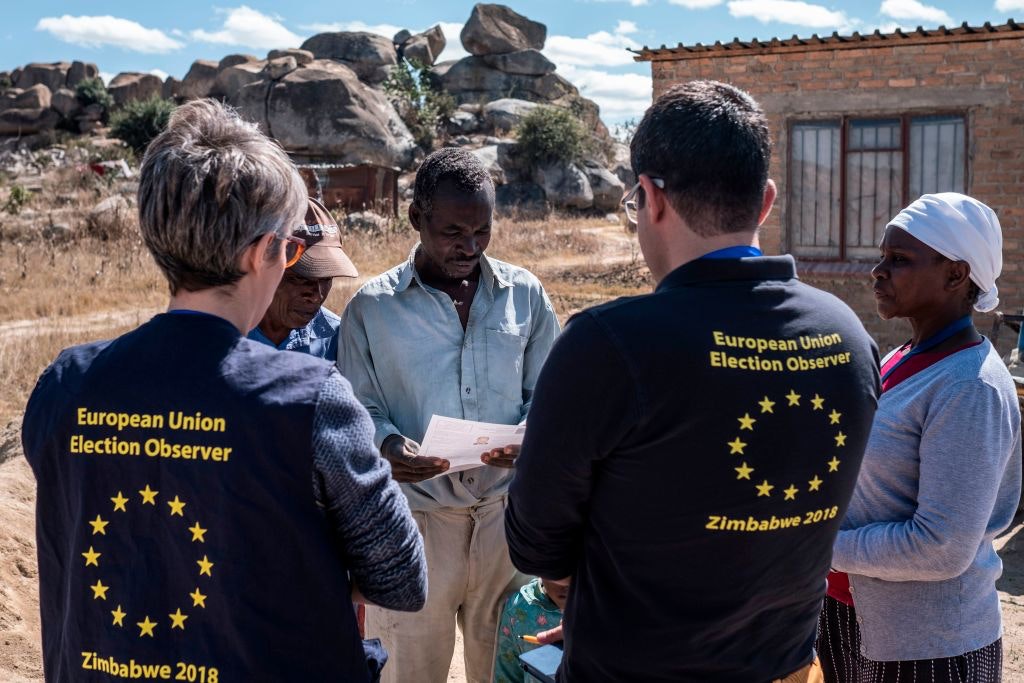
Election observers keep watch over polls throughout the world. Their job is to support efforts to improve electoral quality and to provide transparency. In African countries, both local citizen and international observers have been deployed regularly since the 1990s.
During several recent elections across the continent, however, questions have arisen about the competence and impartiality of observation missions. This has led to concerns about the future of observation, both in Africa and elsewhere.
In 2023, more than 20 African countries are scheduled to go to the polls. It will be a busy year for observers who’ll be present at the majority of these elections.
When done well, election observation detects ballot-box stuffing, voter suppression and political violence. Observers’ presence at polling stations deters election-day fraud.
Observers also provide public statements about election quality and offer recommendations on how electoral processes could be improved.
Yet some observers have been criticised for a reluctance to point out flawed processes, for holding biases and for weaknesses in their methodologies.
The perception that observation missions’ verdicts were “proved wrong” by court judgements in Kenya (2017) and Malawi (2019) has been particularly damaging. In both cases, many commentators (mis)interpreted international observers’ statements as endorsements of electoral processes that the courts later annulled.
Read more: How Kenya’s judiciary can break the cycle of electoral violence
It’s not clear how widely held these critical views are. The perspectives of the broader public in countries holding elections are often missing from discussions on observation. So we set out to get a sense of what voters in three African countries thought.
We found that people wanted to know more about election observers, but couldn’t easily get the information. Both the media and observers need to do more to provide it. Knowledge of observers’ goals and statements is essential if they are to play the role of public arbiters of election quality.
What citizens think
Our research into citizen perceptions and media representations of election observation took place in Zambia, The Gambia and Kenya. These three countries have had varying experiences of election observation.
We interviewed 520 citizens about topics relating to their perceptions of election observation. In each country, we conducted in-depth interviews in both urban and rural areas, and in constituencies that supported the opposition and the incumbent.
Ordinary citizens in our case study countries rarely offered criticisms of election observation.
For example, we asked 120 Kenyans to evaluate the past performance of election observers during the run-up to the country’s 2022 election. Only one person referred to the controversy surrounding observation in 2017 and the supreme court’s annulment of the presidential election.
Instead, we found strong support for election observation among citizens. This was the case in all three of our case study countries, which cover east, southern and west Africa.
Our respondents tended to have concerns about the electoral process in their own country. They spoke favourably about the potential of observation to improve overall electoral quality and transparency. They also felt that observers contributed to reducing the potentially destabilising effects of elections, such as violence.
In both Zambia and Kenya, support for the presence of international observers was higher than support for citizen observers. Respondents in The Gambia, however, tended to prefer citizen observers.
Read more: What the rest of Africa can learn from The Gambia’s transition to democracy
The explanations from those who chose international observers highlighted a perception that they were more impartial than citizen observers, who were often viewed as being biased or corruptible.
Perceptions in Zambia and Kenya may be influenced by:
-
political polarisation
-
a perception that political corruption is high
-
the prominence of ethnicity in politics.
These factors appear to reduce confidence in citizen observers.
Despite the popularity of election observers in our case study countries, we found that citizens knew little about their roles. Few could name any specific observation missions. Citizens often confused observers with other electoral actors like polling station staff, the electoral management body and party agents.
It’s common for citizens to believe observers can and should intervene in the electoral process. Yet, non-interference should be a key principle for both citizen and international election observers.
The information gap
Our interviews made it clear that citizens – especially those in rural areas – found it difficult to get information about the activities and statements of election observers. Few of the respondents heard this information when missions issued their preliminary statements.
The media can bridge this information gap by providing more coverage of election observation.
The quality of this coverage could also be improved, as observers’ preliminary statements are often mischaracterised.
Observers’ statements tend to be complex and nuanced because they are commenting on numerous aspects of an ongoing process. In media coverage, these statements are often reduced to simple either/or judgements (such as “free and fair”).
Way forward
Our project has drawn upon interviews with African journalists and editors to create a short list of tips on covering election observation. These are designed to improve the circulation of accurate information. The tips include getting a range of perspectives from observer missions and reaching out to them early.
Observer missions could also be more active in raising the profile of their work. We created a list of suggestions from the media in our three case study countries to help them do this. One of the tips is to interact with the media in local languages.
Citizens are more likely to criticise observers for the poor flow of information than for anything else. This doesn’t invalidate other criticisms of observers. In fact, if citizens begin to get more information, these criticisms may become more common. Our research suggests the media and observers need to provide it anyway.


