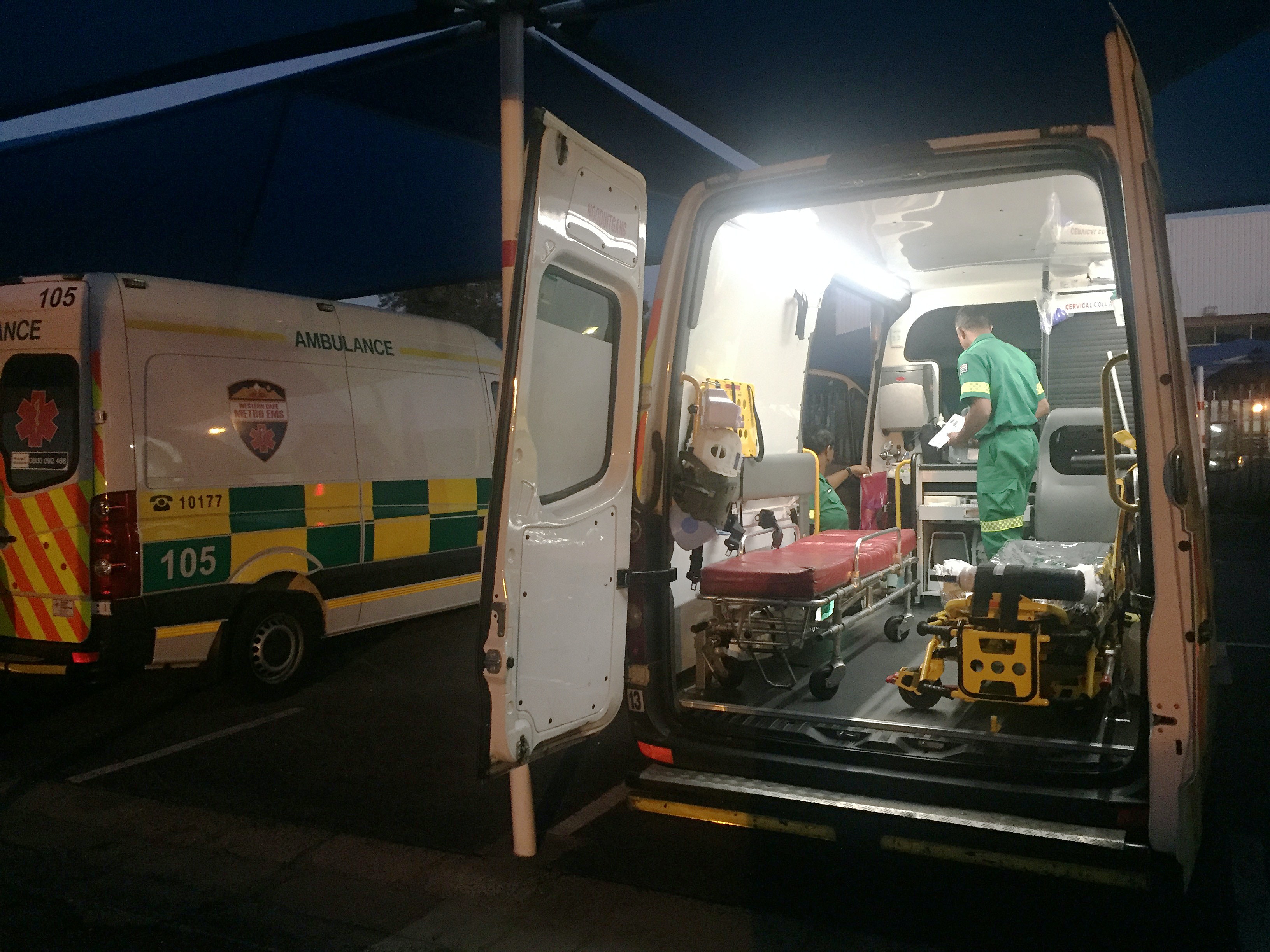
In a medical emergency, the time it takes emergency services to respond could be the difference between survival or death. Ambulance response time is a global benchmark of efficiency.
But no healthcare system has an endless supply of ambulances. It’s always possible that an ambulance might be sent from too far away to get to the patient in time. Ambulances may struggle to get through difficult terrain; ambulance staff may be targeted by criminals.
Community-based ambulance services may be one way to improve response times and to support established healthcare systems. In a recent study, we tested this idea using a volunteer community-based ambulance service in the suburb of Hout Bay in Cape Town, South Africa.
We found that the Hout Bay Volunteer Emergency Medical Service had an average response time within its own area that was 42.3% faster than the Western Cape government’s emergency medical services. Its ambulances consistently beat the target time of 15 minutes for life-threatening calls in urban areas. Because the service is based within the community – which isn’t easy to reach from elsewhere in the city because of its mountainous topography – its ambulances are able to reach people in need faster than those coming from elsewhere.
We believe the model can be expanded to other communities across the African continent. This is a key need: less than 9% of people across Africa are served by an emergency care system. Developing effective emergency care systems could potentially save lives. The World Health Organization estimates that more than 50% of deaths in low- and middle-income countries result from conditions that could be managed by emergency care. This is not the only reason for high mortality and morbidity rates. But it’s a contributing factor.
Collaboration and good working relationships are crucial for community-based ambulance services to work. Residents must work with each other, as well as with government departments and formal emergency medical service providers.
Understanding Hout Bay
Hout Bay has been recorded as covering 32.3km². In the 2011 census, the official population was recorded as approximately 33,000 people. The umbrella term “Hout Bay” describes three sections: Hout Bay, Hangberg and Imizamo Yethu. These sections differ in terms of socioeconomic conditions, ranging from abject poverty (no bulk water, sewerage or electricity) to adequate housing and healthcare, and to luxury.
The Hout Bay Volunteer Emergency Medical Service was started by a group of residents in 1994. They were concerned about how long it took ambulances to respond to medical emergencies in the area.
Part of the reason for this is that the area is physically isolated. It is enclosed on three sides by mountains, and by the coastline on the fourth side. Vehicles can only get in and out on three two-lane roads via the mountains. This causes delays in medical emergency response times, especially in peak traffic, tourist season or bad weather. Without traffic, it takes at least 25 minutes to drive into the suburb from the central business district of the city.
The Hout Bay Volunteer Emergency Medical Service operates with one sponsored ambulance that’s staffed by at least two volunteers. The number of volunteers who regularly work shifts fluctuates depending on season, for example more volunteers are available over the festive season as they have leave from regular work. The average number of volunteers who contribute shifts in a year is 20.
Trust, collaboration and partnerships
Based on our study, we’ve identified various factors to consider when developing community-based response systems. First, these should suit the setting. One must consider the specific community needs and the disease profile. This may include the distance to the closest appropriate facility, and the number and type of emergencies commonly seen in the setting. For example, it may be an area that has a high number of road traffic accidents, requiring rescue equipment and capabilities. Or there may be a high number of pregnancies.
It also helps if the community-based response system is embedded within existing community programmes or systems. For instance, the first Hout Bay Volunteer Emergency Medical Service emergency care responders were volunteer members of the National Sea Rescue Institute Station 8 in Hout Bay. These volunteers organised a basic ambulance assistant course through the provincial ambulance college. The institute was already well established, and initially most members were volunteers with both organisations. This helped to develop a coordinated response to emergencies.
The two organisations still have a close relationship. The Hout Bay emergency services is also embedded in other community-based partnerships. These include the community policing forum, neighbourhood watch and sponsors like local businesses.
Identifying, establishing and maintaining stakeholder relationships is probably the most vital component when developing a community-based response system. These relationships need to be nurtured and maintained, and Hout Bay Volunteer Emergency Medical Service has seen the benefit of appointing a dedicated liaison officer within the executive committee to build and maintain stakeholder relationships.
While the community, other community-based organisations and sponsors are important stakeholders, the Western Cape Government Department of Health and Wellness Emergency Medical Service is the main enabler and a powerful stakeholder of the Hout Bay Volunteer Emergency Medical Service. An executive committee portfolio is dedicated to maintaining this key relationship and the service is permitted to function by a service level agreement between the two parties.
Trust is also key. Residents must know about and trust the service. This can partially be achieved simply by delivering a good, reliable service. The Hout Bay emergency service also interacts regularly with community leaders, offers community first aid training, facilitates fire prevention training, visits schools and provides medical support at community events.
Conclusions
Emergency medical services remain underdeveloped in many African countries, resulting in underserviced communities. The findings of this study suggest that volunteer services can have a meaningful impact in communities. This isn’t the only volunteer emergency medical service on the continent. But the longevity of the Hout Bay emergency services suggests that the model has been sustainable and provides valuable lessons for other communities.


