Eragrostis trichophora plant6 NWP
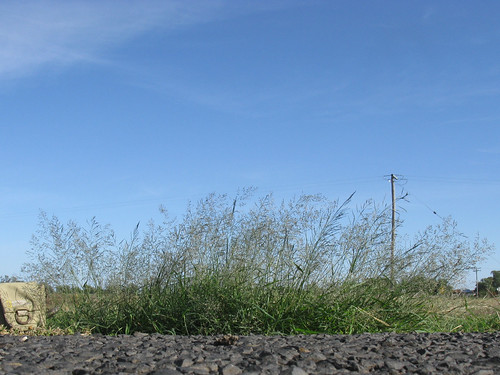
Image by Macleay Grass Man
Introduced warm-season perennial tufted, sometimes stoloniferous, C4 grass; stems are erect, geniculate to prostrate, relatively brittle, to 70 cm tall and with a ring of glands below the nodes. Leaf blades are soft and sheaths are hairless or with tubercle-based hairs (i.e. with small wart-like outgrowths at their base); there are rigid 2-4 mm long hairs either side of the ligule. Flowerheads are contacted panicles at first, becoming open panicles at maturity and 8-27 cm long; lower branches are whorled, hairs are only found in the axils of the main stem and the lower ones sometimes have a brown ring of glands below them. Spikelets are 4-5.5 mm long and 1-1.5 mm wide, usually 3-7 flowered, flattened, unawned and with lemmas 1.5-1.8 mm long. Flowers in summer and autumn. A native of Africa, it grows on well-drained gravel to sandy loams in disturbed and overgrazed areas, especially roadsides. Found as far south as Wellington. Thought to have been brought in as a seed contaminant of Eragrostis curvula, it is spreading along roadsides on the north west slopes. Of no importance to livestock as it currently mostly grows on roadsides. Grows in same habitat as Eragrostis curvula and Eragrostis pilosa and often mistaken for these species. This plant has recently been mown.
This North West South Africa image was automatically curated and published with WP Robot plugin – CLICK HERE to learn more about WP Robot for WordPress – a massive time and money saver.
Visit the MyPE YouTube Channel.


