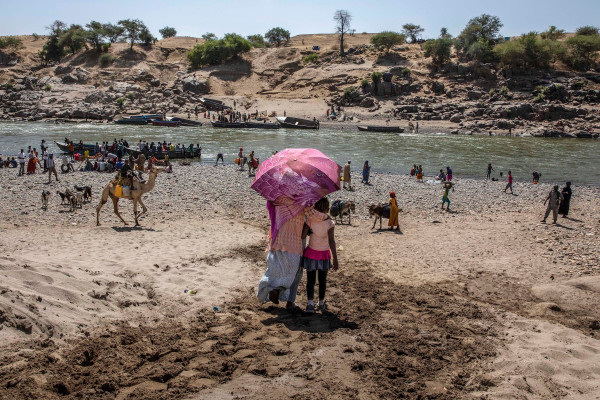
Amhara security forces are responsible for a surge of mass detentions, killings, and forced expulsions of ethnic Tigrayans in the Western Tigray territory of northern Ethiopia, Amnesty International and Human Rights Watch said today.
Tigrayan civilians attempting to escape the new wave of violence have been attacked and killed. Scores in detention face life-threatening conditions including torture, starvation, and denial of medical care.
“The new onslaught of abuses by Amhara forces against Tigrayan civilians remaining in several towns in Western Tigray should ring alarm bells,” said Joanne Mariner, director of crisis response at Amnesty International. “Without urgent international action to prevent further atrocities, Tigrayans, particularly those in detention, are at grave risk.”
Since the armed conflict began in November 2020, Western Tigray, a disputed administrative territory, has been the site of some of the worst atrocities, including massacres, indiscriminate shelling, and large-scale forced displacement of the Tigrayan population.
On December 2, 2021, the United Nations Office for the Coordination of Humanitarian Affairs (OCHA) reported that 1.2 million people have been displaced from Western Tigray since the beginning of the conflict. A December 9 OCHA report found that between November 25 and December 1, over 10,000 Tigrayans were newly displaced from Western Tigray. It also stated that Western Tigray remained inaccessible to aid agencies due to security concerns.
In November and December, Amnesty International and Human Rights Watch conducted phone interviews with 31 people, including 25 witnesses and survivors, as well as relatives of those detained and expelled, about abuses by Amhara militias and regional security forces against Tigrayan civilians in the towns of Adebai, Humera, and Rawyan.
Since early November, Amhara regional police forces and militias, including militia groups known as Fanos, have systematically rounded up Tigrayans in Adebai, Humera, and Rawyan. These forces separated families, arrested teenagers aged 15 and older, and men and women civilians. They have forcibly expelled women and younger children, as well as sick and older people from the area. Some of those expelled have since arrived in Central Tigray, while others remain unaccounted for.
“Tigrayans, regardless of [their] sex and age, were taken to a school,” said one man in Rawyan who witnessed the house-to-house roundups of Tigrayans by Fano militia. “They separated the old from the young, took their money and other possessions…. Older people and parents were loaded on big trucks [going] east. They let them go with nothing, while the young remained behind.”
Following roundups in Humera on November 20 and 21, two witnesses described seeing as many as 20 trucks full of people leaving on those days toward Central Tigray.
Six witnesses said Amhara forces shot at Tigrayans seeking to flee the roundups in Adebai and attacked them with sticks and sharp objects. An unknown number were killed. “They started shooting [at] whoever was in range running,” said a 34-year-old farmer from Adebai, who ran to nearby fields from Fano militias attacking him and others. “When the people tried to escape, … [the Fano] attacked them with machetes and axes so no one could escape.… We were passing bodies and we were all in shock.… After we calmed down, we noticed that there were more bodies there too. Everywhere you turned, there would be five, ten bodies.” Four witnesses said armed elements also shot at Tigrayans crossing into Sudan.
Satellite imagery captured between November 19 and December 5 shows significant activity in Adebai, including moving vehicles, groups of people around a makeshift detention site, large amounts of debris on the main road, and burned structures. Imagery taken on December 5 in Humera shows 16 open-back trucks near the town’s central roundabout.
Three former detainees held in Humera prison, some of whom had been held for as long as five months before they escaped in November, said that Amhara authorities kept them in extremely overcrowded cells for extended periods. Guards denied them food and medical treatment and tortured and beat detainees whose hands and feet had been tied with sticks and rifles. One former detainee, arrested on July 19, escaped around November 13 while loading corpses of fellow detainees onto a tractor. He said he knew of 30 people who died while he was held there, including 7 of the 200 men in his cell:
“All of us have gone through it [the beatings] but the most vulnerable ones were the [older men],” he said. “They couldn’t handle the torture, that’s why they were dying.” He said that the Fano militia members beating them threatened all Tigrayans with death.
The roundups, abusive detentions, and forced expulsions separated families and left communities from the three towns desperate for news about the safety and whereabouts of their loved ones, many of whom were put on trucks and remain unaccounted for. One man who fled Adebai in late November said:
“My wife and my mother called me four days ago, told me they had put them in vehicles, and they don’t know where they are taking them. After that I have never heard from them.”
The Ethiopian authorities should immediately cease attacks on civilians, secure the release of those arbitrarily detained, and urgently provide unimpeded access to Western Tigray for aid agencies and organizations with a mandate to visit detention sites, Amnesty International and Human Rights Watch said.
Given the gravity of the ongoing abuses, the UN Human Rights Council should urgently establish an independent international mechanism to investigate abuses in the Tigray conflict, including serious violations of international humanitarian law (the laws of war), identify those responsible at all levels, and preserve evidence for future accountability.
Forced displacement and deliberate attacks on the civilian population violate the laws of war. Everyone in custody has the right to be treated humanely and with respect for their inherent dignity, including having access to adequate food and medical care. Ordering civilians displaced for reasons not required for their security or imperative military necessity, attacking civilians who are not directly participating in hostilities, and torturing or otherwise mistreating detainees are war crimes.
“The global paralysis on Ethiopia’s armed conflict has emboldened human rights abusers to act with impunity and left communities at risk feeling abandoned,” said Laetitia Bader, Horn of Africa director at Human Rights Watch. “As evidence of atrocities mounts, world leaders should support the creation of an international investigative mechanism and the UN Security Council should put Ethiopia on its formal agenda.”
Distributed by APO Group on behalf of Human Rights Watch (HRW).


