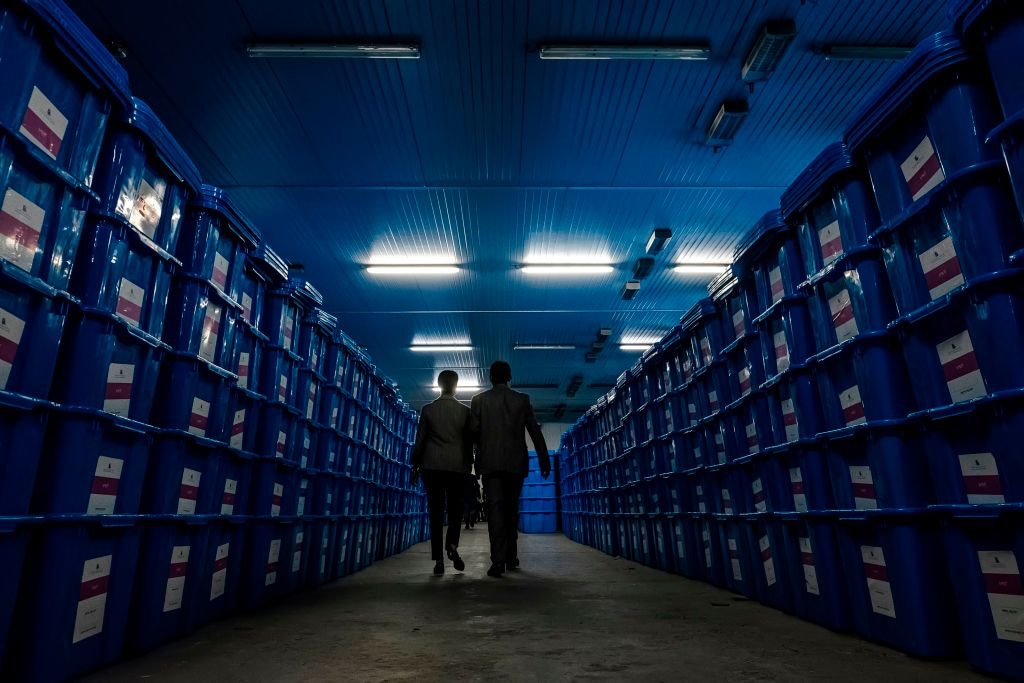
Ethiopia is set to hold general elections for members of the federal parliament and regional councils on June 5, 2021. It will be the sixth such elections, and another chance for Ethiopia to transit to democracy.
For many centuries, Ethiopia was ruled by a long line of absolute monarchs . The last emperor was overthrown by a popular revolution in 1974. However, the revolution was hijacked by a military junta that ruled the country until its overthrow in 1991.
There was hope that Ethiopia would embrace democracy for the first time when the Ethiopian Peoples’ Revolutionary Democratic Front, a coalition of four ethnic political parties, took power in 1991 and introduced multiparty elections. This was not to be. The front conducted five sham general elections and ruled the country with an iron fist for 28 years.
From 2016 up to 2018, the coalition faced a popular uprising against increased human rights violations and massive corruption. It also faced an internal power struggle between reformists who sought the opening of the political space and those who wanted to maintain the status quo.
The political crisis climaxed in the exit of prime minister Hailemariam Desalegn and entry of prime minister Abiy Ahmed in 2018.
The new optimism of a democratic transition springs from several important developments. In the last two years, the government has taken political and legislative reforms that may contribute to a more competitive election. For example, the electoral board which oversees the polling has been re-established as an independent institution.
Despite the upbeat expectations, the June elections face serious challenges. Ethiopia’s party system is extremely volatile. Political parties are weak and fragmented. And the elections will take place amid the upheaval in Tigray, one of the country’s 10 federal regions.
Advances
There are many reasons for the optimism.
Firstly, several exiled opposition politicians and political parties are allowed to operate inside the country.
Secondly, a new electoral law has set out new rules for political party registration. These have had the effect of pushing out a large number of weak and fragmented political parties from the party system. Previously, there were more than 130 political parties many of which were weak and volatile. The majority were not active in elections or any political movement. The new law requires re-registration on the basis of standards such as proof of endorsement from voters and constituencies.
Alongside this, political parties that have previously been marginalised in the regional states of Afar, Benishangul Gumuz, Harari, Gambela, and Somali are now part of the national political discourse.
Thirdly, the National Electoral Board of Ethiopia is now accountable to the House of Peoples’ Representatives, the federal legislative house. And, in a significant compromise between the ruling and opposition political parties, a prominent former opposition politician and political prisoner, was appointed by the House of Peoples’ Representatives in late 2018 to lead the board.
Fourth, the Federal Supreme Court and the Ethiopian Human Rights Commission are now led by prominent professionals. Both worked for the advancement of human rights and social justice for many years.
And a new law on civil society has made it possible for nongovernmental organisations, professional associations, and consortiums to engage in the advancement of human rights and democracy. These include civic and voter education, capacity building for political parties, human rights institutions, and courts.
Nevertheless there are still serious challenges.
Challenges
Parties continue to exist that don’t have strong links with voters and constituencies. In addition, most of the political parties that make up the party system are regional and continue to be focused on ethnicity to mobilise supporters.
The problem with this is that ethnic political parties use extreme ethnic propaganda to win the support of the ethnic groups they claim to represent. They are also unlikely to seek political compromises.
Another challenge is the first-past-the-post election rule. The rule makes representation of diverse interests and views in the federal and regional legislative organs difficult. Likewise, some leaders of opposition parties are in prison, limiting the diversity of views and interests that should be represented in the general elections.
The lack of security in some constituencies poses an additional challenge to the general elections. In the regional state of Tigray, the election for the regional council has been postponed by the National Electoral Board until security is improved, and election polls are established by the provisional regional government.
Also, the COVID-19 pandemic remains a threat against several aspects of the election process. This includes voter and candidate registration, voter education, organisation of polling stations and constituencies, election campaigns and voting.
Postponed ballot and fallout
The 2021 elections were originally set to be carried out on 29 August, 2020. But they were pushed back by the House of Peoples’ Representatives because of the COVID-19 pandemic. This led to an extension of the mandate of the federal government that run out on 5 October, 2020.
Both processes faced criticism from opposition politicians and political parties. The Tigray Peoples’ Liberation Front, the political party which governed the regional state of Tigray for 30 years, opposed the extension. Moreover, the front refused to recognise the federal government beyond 5 October, 2020.
The front conducted its own regional election on 20 September, 2020 and declared itself the winner. This was in violation of the Federal Constitution and against the mandate of the National Electoral Board. This action led to the escalation of political differences between the front and the federal government.
The Tigray Peoples’ Libration Front had been on a collision path with the federal government from the first day of its fall from a federal to regional power in 2018.
In addition, the fact that the Tigray Peoples’ Liberation Front is an armed ethnic political group arguably made it inherently susceptible to resort to violence as a way of resolving political differences.
Conclusion
The upcoming 6th general elections are yet another historic chance for Ethiopia to hold free and fair elections. Through democratic competition, Ethiopia can avert conflict, strengthen its democratic institutions, and begin the transition to democracy. The elections are a matter of survival.


