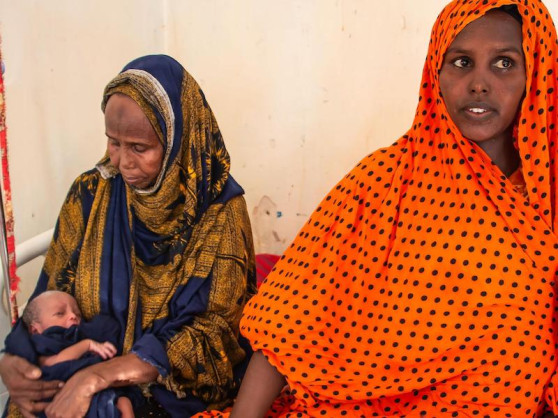
“When I saw my baby’s hand coming out, I ran for our lives. We travelled nearly 90 kilometres to the nearest health facility… We are both lucky to be alive.”
Ayan Abadi Wali, 24, recounted her story while recovering from a life-saving Caesarean-section delivery in Gode, a town in Ethiopia’s Somali region, and one of the hardest hit by the country’s worst drought in four decades.
“There is no water or pasture anywhere you go. I don’t know how we are going to survive.”
Ms. Abadi is currently living at an informal settlement in the Shabelle zone with her seven children and her mother-in-law, Ms. Barkhado, alongside hundreds of others displaced by the drought. Ms. Barkhado has weathered many crises in her 60 years, but said this one is the most devastating yet: “Of all the droughts I have experienced in my life, this is the worst. There is no water or pasture anywhere you go. I don’t know how we are going to survive.”
Climate shocks and extreme weather are driving up humanitarian needs across the Horn of Africa and piling unbearable pressure on already struggling health systems, with limited facilities, a severely stretched workforce and almost nonexistent infrastructure. Dr. Mahamed Sheh, Medical Director of the Gode General Hospital, said, “We noticed an increase in maternal and newborn deaths in the last months. Almost all our cases are women who have travelled up to 200 kilometres to reach the facility, many with labour complications and no transport.”
A climate crisis weighing heaviest on the health of women and girls
In eastern and southern Ethiopia, seasonal rains have now failed for the third time since late 2020, fuelling mass displacement and deepening an already dire humanitarian situation. Nearly 8 million people have been affected and more than 286,000 Ethiopian Somalis have been forced from their homes in search of survival as crops, livestock and livelihoods are wiped out.
The main source of food and income for affected communities, nearly 1.5 million livestock have perished as wells have dried up and crops failed. Like millions of others, Ms. Abadi’s only source of income has evaporated as fast as her hope. “We lost everything we had – 30 goats and 10 cattle,” said Ms. Abadi. “We only have one cow left, which can barely stand on its feet. It is too weak to walk.”
When boreholes run dry, it is usually women and children who trek for miles in search of water for the household, putting them at greater risk of gender-based violence as they often travel exhausted and unaccompanied. Displaced women and girls are at heightened risk of sexual and physical violence and coercion, and with more than 1,115 schools in the region either fully or partially closed, girls are increasingly being forced into child labour and early marriage as their parents search for ways to make ends meet.
The gruelling trek to access maternal and reproductive health services
In the Somali region alone, some 930,000 people need emergency and reproductive health support and more than 565,000 people have reduced access to protection services, including women, children and survivors of gender-based violence. According to the Ethiopian Public Health Institute, more than 60 per cent of those living in the region are at least an hour’s walk away from the nearest health facility – which may or may not be functioning if they do manage to reach it.
“Displaced mothers arrive with complications, and they leave in the same condition.”
More than 154,000 women are currently pregnant in the region, and over the course of the next month some 2,560 women and 3,425 newborns will experience complications, with potentially deadly consequences if skilled care and services aren’t available.
“Displaced mothers arrive with complications, and they leave in the same condition. We don’t have maternity wards and we can’t keep them here for a month waiting in the delivery room or in the hallway. When they come back, sometimes it’s too late,” said Aston Ma’am, a midwife at the Gode hospital.
Ensuring no mother or newborn is left behind
With the support of Irish Aid and in partnership with UNICEF, UNFPA is scaling up its response in the Somali region through a package of essential health services, including support for critical maternity wards to help women like Ms. Abadi. Mobile health units staffed by trained midwives will also be deployed to some of the hardest-to-reach areas, and eight health facilities in the Shabelle and Erer Zones will receive emergency obstetric equipment and supplies.
Meanwhile five safe spaces and one-stop centres will ensure comprehensive medical and psychosocial support for survivors of gender-based violence, and reproductive health medicine, dignity kits containing sanitary and hygiene items, and ambulances will be distributed to health centres in the region.
The UNFPA Humanitarian Response Appeal 2022 is calling for nearly $24 million to strengthen the health system and build back the capacities of maternal and reproductive health services in the Somali and seven other crisis-affected regions in the country. To date, just over half of the appeal has been funded.
Distributed by APO Group on behalf of UNFPA – East and Southern Africa.


