A dynamic private sector is key for the economies of the region to grow out of their currently high debt levels; Unlocking sustainable growth in the region’s private sector requires reforms that facilitate innovation, the adoption of digital technologies and investments in human capital; Reforms to support these objectives must take account of sustainability and the global agenda to limit climate change
Download document: https://bit.ly/3HaueKJ
The European Investment Bank (EIB), the European Bank for Reconstruction and Development (EBRD) and the World Bank have published a joint report, Unlocking Sustainable Private Sector Growth in the Middle East and North Africa (MENA) (https://bit.ly/3H73CdA). The report analyses constraints on productivity growth and limited accumulation of factors or production in the MENA private sector.
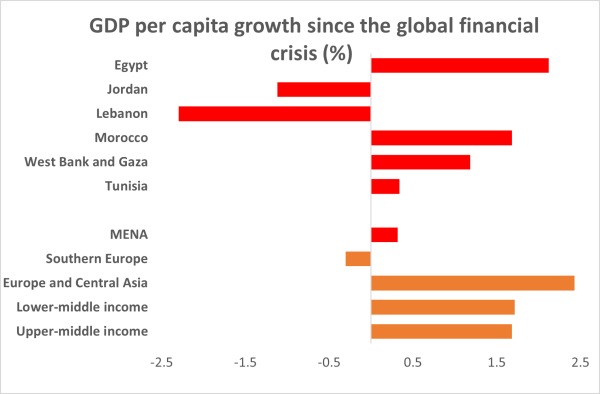
The report is based on the MENA Enterprise Survey conducted between late 2018 and 2020 on over 5 800 formal businesses across Egypt, Jordan, Lebanon, Morocco, Tunisia, the West Bank and Gaza. Historically, economic growth in the Middle East and North Africa has been weak since the global financial crisis of 2007-2009 and the Arab Spring of the early 2010s. Since then, gross domestic product (GDP) per capita has grown by only 0.3% a year in the MENA region. That compares unfavourably with rates of 1.7% on average in middle-income countries and 2.4% in the developing economies of Europe and Central Asia.
Achieving higher and sustainable growth is particularly important in view of other economic challenges facing the region. Public debt has increased considerably over the last decade, accompanied by declining investment. More recently, the coronavirus pandemic has battered the region, further straining public finances. In addition, the Russian invasion of Ukraine affects the MENA economies through higher hydrocarbon prices, risks to food security and declining tourism.
Against this background, it is important that policymakers exploit the potential of the private sector to propel the region towards greater prosperity.
“The spillovers from the war in Ukraine add to structural vulnerabilities in the region. The prospects for global financial tightening, persistently high energy and food prices and concerns for food security come on top of concerns related to weak economic growth and rising debt levels,” said EIB Chief Economist Debora Revoltella (https://bit.ly/2UYJi4s). “When responding to the new shock, MENA countries need to tackle the main structural bottlenecks affecting the region. Reforms that lower regulatory barriers, tackle informal business practices, promote competition, and facilitate innovation and digitalisation are crucial for achieving sustainable economic growth and improving resilience to future shocks.”
The business environment in the MENA region as reported in the survey has been held back by various factors. Political connection and informality are undermining fair competition, bringing economic benefits to a limited number of companies. Management practices lag behind benchmark countries, with a decline in average scores in all MENA countries since 2013.
Customs and trade regulations appear to be more severe barriers for firms in the MENA region than in other countries. Firms need more time to clear customs to import or export than in other countries. The MENA economies depend on high levels of imports compared to low export activities.
Although firms trading in the international market are more willing to develop and innovate processes, only 20% invest in innovation, which can affect the long-term economic prospects for the region.
The region needs to make better use of its human capital. Predominantly, only a few foreign-owned companies invest in training their human capital, and they tend to be digitally connected exporting firms. Additionally, a significant share of companies are not engaging in financial activities with other economic players, opting to self-finance voluntarily.
Incentives for companies to decarbonise are weak, and MENA firms are less likely than their counterparts in Europe and Central Asia to adopt measures that reduce their environmental footprint.
Unlocking sustainable growth in the region’s private sector, the report calls for MENA economies to lower regulatory barriers for businesses, promote competition and reduce disincentives emerging from political influence and informal business practices.
The region is also in need of reforms to facilitate innovation, the adoption of digital technologies and investments in human capital, while being in line with the global agenda to limit climate change, enhance sustainability and protect the natural environment.
Improving management practices can be instrumental to that. “Good management practices can account for as much as 30% of differences in efficiency across countries,” said Roberta Gatti, Chief Economist for the Middle East and North Africa at the World Bank. “Management practices are lacklustre in firms in the region, particularly in those with some state ownership. Improving these practices can have substantial benefits, is not costly, but is not easy. It will require — among others — a change in mindsets.”
Companies should also be given incentives to exploit the benefits of participating in cross-border trade and global value chains more broadly, accompanied by better management practices.
At the same time, the state has a duty to ensure that this transition process is just, through measures that help workers to take advantage of opportunities to obtain new, higher-quality jobs linked to the green economy, while also protecting those at risk of losing their jobs. Such measures include labour market policies, skills training, social safety nets and action to support regional economic development.
EBRD Chief Economist Beata Javorcik said: “Climate change creates an opportunity for the MENA region to build up its green credentials and use them as a source of competitive advantage. This will create the much-needed high-quality jobs linked to the green economy.”
Distributed by APO Group on behalf of European Investment Bank (EIB).
Press contacts:
Eva De Francesco
eva.defrancesco@eib.org
+352 437 986 637
mobile: + 352 691 289 150
Serena Sertore
s.sertore@eib.org,
+352 437 970 859
Website: www.eib.org/press
Press Office:
+352 4379 21000
press@eib.org
Social Media:
Twitter: bit.ly/3pMKidw
Facebook: bit.ly/31TarPV
Instagram: bit.ly/3IES169
YouTube: bit.ly/3yoLR57
RSSFeed: bit.ly/3dOhXy0
LinkedIn: bit.ly/3m0yZNN
Background information:
The European Investment Bank (EIB) (www.EIB.org) is the long-term lending institution of the European Union owned by its Member States. It makes long-term finance available for sound investment in order to contribute towards EU policy goals.
The World Bank Group (www.WorldBank.org) is one of the largest sources of funding and knowledge for developing countries. Its five institutions share a commitment to reducing poverty, increasing shared prosperity and promoting sustainable development.
The European Bank for Reconstruction and Development (EBRD) (www.EBRD.com) is a multilateral bank that promotes the development of the private sector and entrepreneurial initiative in 38 economies across three continents. The Bank is owned by 71 countries as well as the European Union and the EIB. EBRD investments are aimed at making the economies in its regions competitive (https://bit.ly/3tubaBF), inclusive, well-governed, green, resilient and integrated (https://bit.ly/3zwwg6e).


