Family, community and university support helps lesbian students thrive:
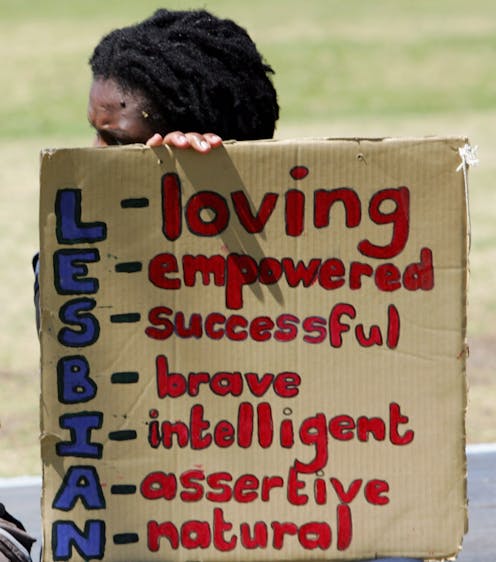
During a ceremony at the University of Fort Hare earlier this year, I had the pleasure of watching some students who’d participated in one of my research projects graduate. As they crossed the stage to receive their degree certificates their families, friends and lecturers all ululated with delight.
What made this moment perhaps surprising was that the graduates were lesbian women. Fort Hare is in South Africa’s Eastern Cape province, which is known to hold conservative ideas about sex and sexuality. But these graduates were self confident and proud. They made no attempt to hide their non-conforming expressions of gender: a more masculine style of dressing, for instance.
How, in an environment that is considered conservative and even sometimes openly homophobic, did these women develop such a strong sense of self-confidence? I was able to find out through a project I conducted as part of my ongoing research about youth, sexuality and gender. The purpose of all my research is to try and shift attitudes towards the lesbian, gay, bisexual, transgender, intersex and queer (LGTBIQ) community at Fort Hare through increased visibility and the normalisation of queer identities.
The research project in question was conducted with black lesbian students to understand their experiences at Fort Hare University. Black here refers to people of African descent; the majority of Fort Hare’s student population is black.
I found that family support, being valued in their own homes and enjoying strong support from their social structures – friends and, in some cases, churches – were key to instilling these women with a strong sense of self. This allowed them to live openly as lesbians even when sometimes faced with discrimination. It also contributed to their personal growth.
The university’s own work in tackling discrimination also played a vital role in helping the students to feel happier, more accepted and confident. This suggests that higher education institutions can do a great deal to help their LGBTIQ students feel more at home, which could be an important intervention in a country and on a continent with high levels of homophobia and violence against lesbian women.
Individual academics and departments can get involved in producing research that seeks to dispel myths and encourage tolerance of different sexualities, as my colleagues and I around South Africa have done.
Acceptance and support
There is a Zulu adage, “Akusilima sindlebende kwabo”. This really means that, irrespective of how socially unacceptable one’s child’s sexual orientation may be, parents tend to provide warmth and unconditional love.
My study involved 21 black lesbian students aged between 18 and 28 years old. They were drawn from various faculties and departments at the university. One participant, Fikile (not her real name), told me:
I overcame discrimination while young. My family supported and loved me unconditionally hence I view myself like any other women. I have so much to live for and I do not regret being a lesbian.
Others explained how their families had shown support by accepting their romantic partners and welcoming these partners into their homes. This helped the women to feel valued at home. Lesbian students attributed their social competence, leadership qualities and well-being to their parents’ positive attitudes towards same-sex relationships. They also spoke of family members encouraging them to find a support group in the form of friends or sports clubs. This provides spaces in which they can be visible in their communities and develop strong networks.
Previous studies have suggested that most religious people oppose gender equality and acceptance of lesbians. There are some positive exceptions in the traditionally conservative Eastern Cape province. Sihle (not her real name), explained how her brother, who is religious, and members of their church valued her:
My brother is protective of me and where I come from in Port Elizabeth, the church members do not exclude us from the activities that concern women.
Other participants revealed that they never experienced discrimination from campus–based church societies. This echoes the findings of a study about LGBTIQ students’ experiences at Walter Sisulu University, which is also in the Eastern Cape. This suggests that there is at least some acceptance of lesbians by the province’s religious community.
Lecturers also emerged as a critical source of support for lesbian students. Participants told me that they received emotional, psychological and academic support from their lecturers. One told said that the university had “created a platform for sexual minorities to be recognised in all aspects”.
Part of this work had been done through the establishment of a task team that aimed to alleviate discrimination towards LGBTIQ students. The student commented that the inclusion of gay men and lesbian women on this task team had contributed to her sense of feeling “emotionally stable”.
Many of the students also took part in sport at the university, which offered an additional layer of support.
The way forward
Universities must continue to advocate for lesbians’ rights as enshrined in South Africa’s Constitution. Work must also be done to strengthen institutions’ existing policies related to discrimination and protection.
Individual academics who are working on sexual orientation and gender identity can also pool their resources. For instance, I am part of a network of academics from ten universities that advocate for universities across the Southern African Development Community to destabilise heteronormativity. This is the belief that heterosexuality is the only sexual orientation and is “normal”, where queer identities are “abnormal” or somehow “wrong”.
As part of our advocacy, we disseminate research that we believe will foster an enabling and tolerant environment that normalises homosexuality and gender diversity. This is an example of the kind of interventions that academics and university departments can get involved in.

Jabulani Kheswa receives funding from the University of Fort Hare for his publications and conference attendance.
Source: The Conversation – Articles (AFRICA)
Read more on The Conversation.
Join the fun: Add Your event | Submit a Press Release | Add your listing.


