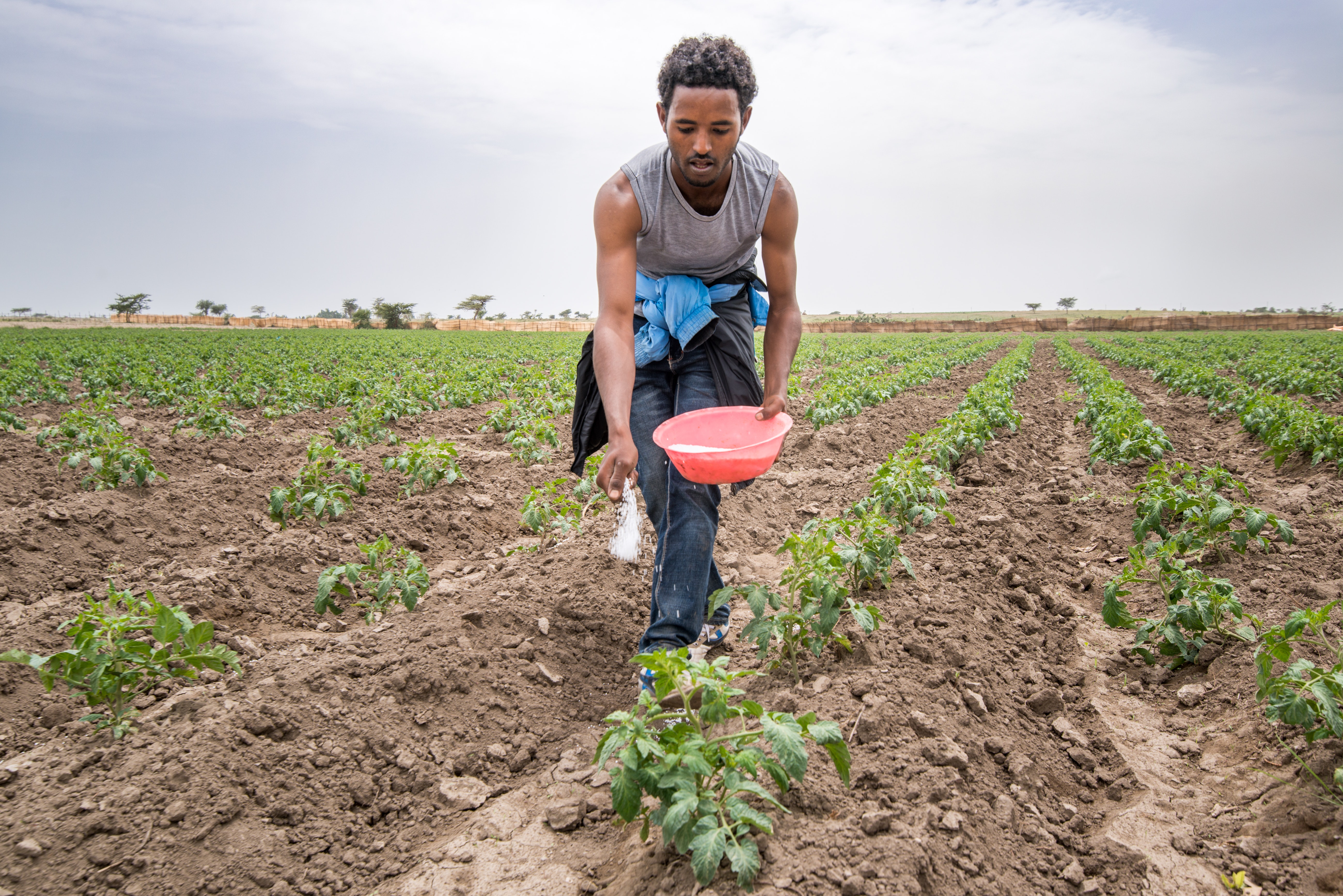
Agriculture involves a difficult balance between food production and environmental impact. For example, fertilisers can help to achieve good crop yields, but over-using them produces greenhouse gas emissions and pollution.
Some of these impacts also threaten future agricultural production. Greenhouse gas emissions, for instance, contribute to climate change and increase the likelihood of extreme weather events.
To sustain agriculture, then, it is necessary to minimise the use of inputs like fertilisers, and support crop growth in other ways. One approach is through increasing ecological functioning within farms. This means enhancing relationships between different on-farm organisms, including crops, livestock, microbes, and wild plants and animals. Using these relationships to support crop yields is called “ecological intensification”.
Previous research has shown that ecological intensification can be effective. But studies have only been done over short timescales of just a few years, whereas the effects of agricultural practices often take longer to become clear. Variation in weather between years can obscure effects in the short term, and some ecological processes take several years to stabilise.
In a recent study, my colleagues and I explored whether long-term studies also support ecological intensification. To answer this, we sought out 30 long-term experiments from around Europe and Africa. We used these experiments to look at whether ecological intensification could reduce the need for two inputs: nitrogen fertiliser and tillage.
We found that ecological intensification can partly replace fertilisers to support crop yields, because both ecological intensification and fertilisers increase soil nutrients. So farmers could use ecological intensification to reduce fertiliser use while maintaining the same yields. Farmers who already used low or no fertiliser could increase their yields.
Ecological intensification could also increase yields whether farmers were ploughing or using no-till farming. This was because tillage and the ecological practices we tested had different functions, and contributed to crop yields in different ways.
Overall, ecological intensification can help balance food production and environmental impacts by reducing high fertiliser use without reducing yields. And it can supplement low inputs to boost yields in poor, remote communities where inputs are expensive or hard to access.
What we measured
We selected experiments that had been running for 10 years or more. We made an exception to include two nine-year-old experiments to increase representation of smallholder farming practices in our dataset.
The 30 experiments in our study tested different practices in a diverse range of climates, soil types and farming systems. We looked for common trends across experiments. In particular, we wanted to know how ecological practices and input use interacted. Was it better to combine multiple ecological practices and inputs, or were they most effective when used independently?
Within our dataset, there were three classes of ecological practices and two types of inputs tested frequently enough to include in our analysis.
The ecological practices were:
-
crop diversification – rotating crops or planting different crops close to each other
-
including fertility crops such as forage or ground covers rather than staple food crops
-
organic matter management – like using compost or manure to fertilise crops, and retaining crop residues on the field to cycle nutrients.
Ecological intensification entails replacing or augmenting inputs. So we compared the effects on crop yields of increasing the three ecological practices against the effects of decreasing two inputs: synthetic nitrogen fertiliser and tillage intensity. Fertiliser provides the nitrogen that crops need to grow, but can also cause pollution. Intensive tillage (or ploughing) removes weeds but can increase soil erosion.
What we found
Our results showed that ecological practices usually increased yields when added to a farming system. However, the benefits of crop diversification, fertility crops and adding organic matter were typically high when synthetic nitrogen fertiliser use was low. Often there was no benefit when nitrogen fertiliser use was high.
This showed us that you can use either an ecological practice or a nitrogen fertiliser to increase yields. But if you use both together, the effect is the same as using either one.
We deduced that this is because the practices and the fertiliser have the same main function: all provide nitrogen to the crop. Crop diversification and fertility crops often involve adding legumes to the system. Plants such as beans, peas and clovers fix atmospheric nitrogen and add it to the soil. Manures and composts release nitrogen from decomposing plant material or livestock wastes.
Sometimes we observed small extra benefits of using an ecological practice alongside high nitrogen. For example, adding manures and composts still increased yields when nitrogen was high. Other research has shown that these organic matter additions help to improve soil structure and microbial activity. They can also contribute to soil water retention and the cycling of other nutrients.
Using two ecological practices together was generally beneficial, because each provides different functions.
Similarly, using ecological practices together with inputs can increase yields when their functions do not overlap. This can be achieved, for example, by using fertiliser in small amounts to top up the nutrients provided by ecological practices.
We also found that diversifying with non-legume crops under high nitrogen had a yield benefit. It is likely due to the interruption of weed, pest and disease cycles.
In our study, tillage did not strongly interact with ecological practices, suggesting that each had different functions. This means that farmers can adapt their tillage practices to their environment independently from their decisions on using diversification, fertility crops and organic matter.
The net effect
Ecological intensification could be a way to distribute fertiliser more equitably to improve global food security while minimising environmental impacts. Currently, average fertiliser rates in Africa are a small fraction of those in Europe. Smallholders in particular use much less than their fair share. Too much fertiliser causes environmental impacts, but too little fertiliser makes it difficult to produce enough food.
Other studies have suggested that if fertiliser use is reduced where it is currently high (such as large commercial farms in developed countries), then fertiliser use could be increased where it is currently very low (smallholder farmers in developing countries), without overloading global ecosystems with nitrogen pollution.
Our study shows how ecological intensification could help to achieve this.


