In his 1859 book, On the Origin of Species, British naturalist Charles Darwin put forward his theory of natural selection. This, he argued, was the mechanism of biological evolution: like an animal or plant breeder selects for certain characteristics, individuals with better survival ability leave more offspring. In this way nature favours traits that increase the survival of organisms. These traits are called adaptations. For instance the internal structure of an eye, comprising a lens and a light-sensitive retina, leaves little doubt that the organ is an adaptation for vision. When viewed from outside science, adaptations appear to have been designed.
However, animals and plants often have characteristics perceived as advantageous, but for which there is no evidence of evolutionary adaptation. The red colour of blood has some advantages – it allows humans to rapidly notice and react to injuries – but there’s no evidence that the colour is an adaptation or has been designed. Rather it is the fortuitous biochemical consequence of an iron molecule bound to each haemoglobin molecule in the blood.
Assuming that natural selection shapes all animal and plant traits is a false impression. Natural selection is not all-encompassing.
Since humans are largely predisposed to see purpose and design, it may be hard to understand traits that appear to have been designed, but which just came about by chance. In a recent article, we showed that what seemed to be an example of adaptation – variation in female-biased sex-ratios of fig wasps – is in fact not.
Imperfection in nature
Fig wasps are tiny insects (about 2mm long) that pollinate fig trees. Fig wasp sex ratios have been touted as one of the best examples of natural selection’s effectiveness. Only one or a few mothers lay eggs in a single fig, in which mating between offspring also takes place. When only one mother occupies a fig, about 10% of her offspring are sons. In line with predictions, when more mothers lay their eggs in a fig, they lay a larger percentage of sons to use the mating opportunities provided by the daughters of other mothers. By varying the percentage of sons the mothers’ number of grandchildren can be maximised.
Our research debunks this notion. We reviewed sex ratios in 24 species of fig wasps and found that mothers sharing a fig with other mothers laid fewer sons than would be expected if this were an adaptation. Although the ratio of sons to daughters increases with the number of mothers, as theory suggests, the increase is significantly smaller than predicted.
This sort of work is important as it reminds scientists that apparent adaptations may merely be fortuitous consequences. It is a reminder that sometimes there is no point or evolutionary purpose of animal characteristics, even when it looks that way – natural selection is not the only process that changes species.
Sex ratios in single mother broods
Some species, resistant to the ill effects of inbreeding, have very female-biased sex-ratios. The British evolutionary theorist William Hamilton argued in 1967 that this is expected when one or a few mothers of a species such as wasps lay eggs in isolated patches and matings among offspring are restricted to within these patches.
Changing the sex ratio of offspring does not affect a mother’s number of offspring; it does, however, change her expected number of grandchildren. By laying more daughter eggs rather than son eggs, the competition between brothers is reduced and there are more mating opportunities for the remaining sons. Since a single son can fertilise many daughters, selection favours a mother that lays just a sufficient number of male eggs to fertilise all her daughters – a heavily female-biased sex-ratio. Fig wasps represent one such group of species.
Broods involving several mothers
Research in the 1980s established that single mothers in a patch have more daughters than each mother in a patch with two mothers, who in turn have more daughters than each mother in a patch with three mothers. Even though they have fewer daughters, they still have more daughters than sons. The theoretical benefit of the reduction in female bias stems from the mother’s sons competing less with each other and more with other males, and from a son benefiting from fertilising other females’ many daughters.
We reviewed sex ratios in 24 fig wasp species that have been studied. We found that although the ratio of sons to daughters increased with the number of mothers in each fig, as theory suggests, the increase was significantly smaller than predicted.
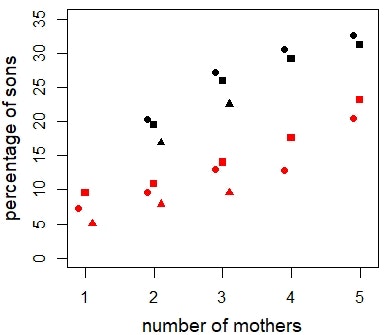
Mother fig wasps tend to lay most of their sons first, followed by mostly daughters. In wasps unfertilised eggs develop into males and fertilised eggs into daughters. When there are several mothers in a single fig, egg-laying sites (the small flowers inside a fig) become limited and mothers cannot lay all their eggs. Since these unlaid eggs would have been daughter eggs, the ratio of sons to daughters increases automatically.
Since these unlaid eggs would have been daughter eggs, the ratio of sons to daughters increases automatically. In about half the studied fig wasp species this mechanism is sufficient to explain skewed sex ratios in these wasps. In the other half of the studied fig wasp species, mothers actually increase the number of sons as if they sense other mothers. However, despite this change, there are still fewer sons per daughter as compared to theory involving adaptation.
So although natural selection could favour the observed shift in sex ratios, there is no evidence that it is the result of natural selection. This is a good example of a trait that appears to be adaptive, but is not. Our review suggests that even apparently “designed” traits may not be the result of natural selection – instead they may be be fortuitously advantageous consequences.


