Film review: Moffie is a harrowing meditation on white masculinity:
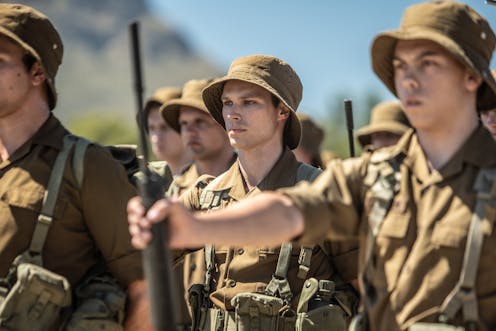
In the opening moments of the film Moffie, Nicholas van der Swart is walking away from a family gathering. As he disappears into the darkness, he is wishing that a part of himself will disappear.
It’s 1981. The 16-year-old is about to leave for his two years of conscription into the South African army. During apartheid it was compulsory for white men to serve in the military because South Africa was waging wars against liberation forces on its borders and beyond. Nicholas must enlist to fight the “communist threat” at the Angolan border.
Nicholas is gay. To the Christian nationalist rulers, he is just as much of a threat as the black resistance fighters who are nameless, faceless enemies to be exterminated in the film. Everything that is not in service of the apartheid state must be extinguished or repressed.
This repression is hammered home for the viewer through the constant verbal assaults that the young men suffer – and mete out – during their military training. In the South Africa portrayed in Moffie, every white character, be it a parent, general, pastor, even a friend, is policing borders and boundaries; there are clear lines that cannot be crossed.
Violence and language
The most powerful way that this mental conditioning takes place in the film is through the use of the word “moffie” (often translated as “faggot”) which those in charge use relentlessly to insult and control the troops. The scenes of training are often harrowing, and the word comes to be an act of violence on the viewer as well.
Its effect is to strip away any resistance, and to associate femininity, diverse sexuality and any emotional range as weakness. To be gay, then, is the ultimate offence against this regime of machismo.
The violence of the word is reinforced with physical violence – menial tasks that lead to exhaustion and deprivation – along with other epithets (racist, gender shaming) that destroy any sense of self-worth or individuality. The young recruits are becoming the men that apartheid South Africa needs in order to cling to life: men who are violent, hateful and emotionless.
Fear and desire
Only in moments of darkness and isolation do the characters feel able to be intimate. In the first scene where Nicholas (Kai Luke Brümmer) is alone with his love interest, Dylan Stassen (Ryan de Villiers), the young men are ordered to spend the night waiting in deep trenches.
Their commanding officer, Sergeant Brand (Hilton Pelser), seems to take pleasure in setting a boundary that they cannot cross, to stay in the trenches no matter what, until the sun rises. What Nicholas and Dylan find, trapped in the confines of these limitations on their freedom and movement, is a moment of intimacy, a spark of desire.
The fear that Nicholas feels in realising his attraction for Dylan is palpable. He can never be caught, because not only will he be subject to violence, but he will be sent to a mental facility to “cure” him of his desire.
These forbidden moments are riddled with anxiety, which seems to rob the boys of the love story which this film might have become.

The black body
Hermanus is masterful in linking oppressive masculinity to racism in Moffie. I’ve written before about his 2011 film, Skoonheid (Beauty), and how toxic masculinity and racism place limits on intimacy.
Moffie is in many ways a superior film, with striking cinematography emphasising the bleakness of the surroundings and a punching, unnerving score that points to the conflict and anxiety of the characters.
The film is bookended by two moments of violence against black characters. The first is when the young conscripts throw a bag of vomit into the face of a black man, demanding he not sit on a bench at a train station. The second is when Nicholas kills a black soldier in combat. Nicholas looking down at the corpse, in the dark of the night that he had once found refuge in, shows how he can never escape the racist and patriarchal duties that define apartheid.
There is a similar consciously political placement of black bodies in Skoonheid. Hermanus – a black man – features black characters in two highly charged moments in a film about the secret gay sex lives of white Afrikaner farmers. The one is before a sex scene and the other is on a university campus as Skoonheid reaches its terrible conclusion.
Standout performances
The actors in Moffie brilliantly portray these moments of being subject to the assault of toxic masculinity, with a particularly strong performance by Matthew Vey, who plays Nicholas’s best friend, Michael. Another strong performance is from Stefan Vermaak, who plays Oscar, the more willing participant in racist and patriarchal ideology.
Brümmer’s powerful performance as the central character shows both subtle resistance and then participation as an agent of the apartheid state.
At the end, it is unclear whether the young men are able to escape the encroaching ideology that dictates their lives, and whether the moments of refuge and isolation are enough to free them from the memory of the incessant labelling of “moffie” that defined their youth.
Moffie is a challenging and deeply affecting film that represents the important, often overlooked realities of living in apartheid for gay men.

Grant Andrews receives funding from the National Research Foundation Thuthuka Grant as part of a project on queer visualities and queer theory in South Africa.
Source: The Conversation – Articles (AFRICA)
Read more on The Conversation.
Join the fun: Add Your event | Submit a Press Release | Add your listing.


